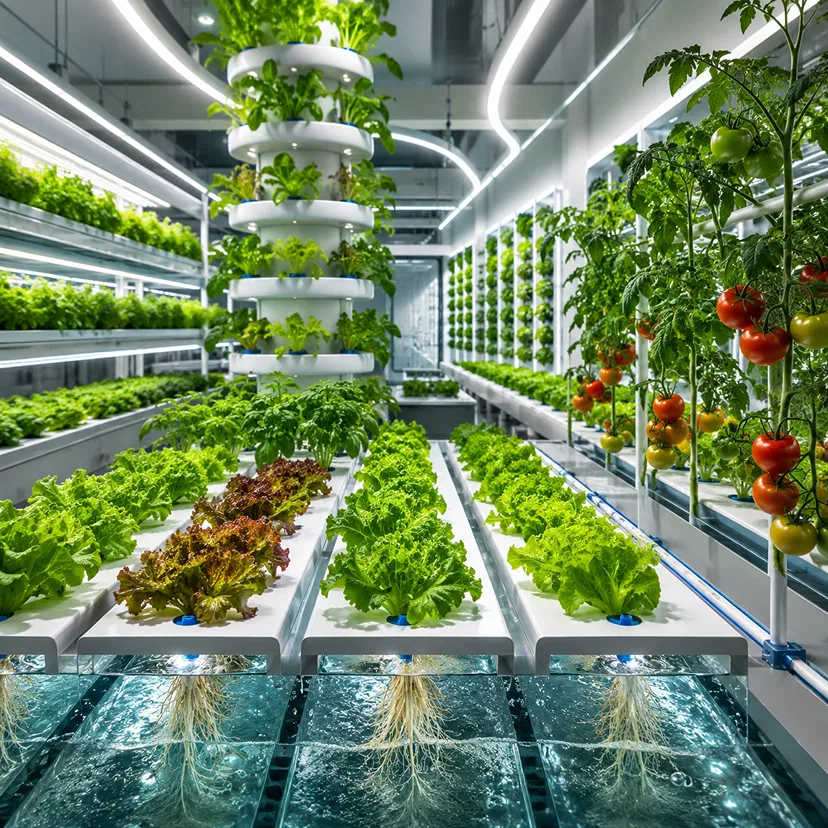
Hydroponics is the practice of growing plants with their roots suspended in or fed by a nutrient-rich water solution instead of soil. It sounds unusual if you're used to traditional farming, but agronomically it solves several problems that soil-based growing struggles with — inconsistent nutrient availability, water loss, and soil-borne disease among them. Here are eight real, practical benefits of growing without soil.
1. Precise Nutrient Control
In soil, nutrient availability depends on pH, organic matter, and microbial activity — all somewhat variable. In hydroponics, nutrients are dissolved directly in the water, so a grower can dose exactly what a crop needs at each growth stage using targeted micronutrients, adjusted far more precisely than is practical in open soil.
2. Stable, Correctable pH
Nutrient uptake is highly sensitive to pH — most vegetables prefer a range of roughly 5.5–6.5 in a hydroponic solution. Because the growing medium is water rather than soil, pH can be measured and corrected quickly with a pH balancer, something far harder to adjust reliably once nutrients are locked into soil chemistry.
3. Significantly Less Water Use
Hydroponic systems recirculate water rather than letting it drain away and evaporate from open soil, which can cut water use by 70–90% compared to conventional field irrigation for the same crop. Maintaining that recirculated water with a water conditioner keeps the solution clean and free of the mineral buildup that would otherwise stress roots over time.
4. Faster Growth Cycles
With nutrients and oxygen delivered directly to the root zone, plants don't expend energy searching through soil for resources, which often shortens time to harvest compared to the same crop grown in soil — leafy greens in particular can mature noticeably faster hydroponically.
5. Fewer Soil-Borne Pests and Diseases
Many of the most damaging plant diseases — including several fungal wilts and root rots — live in soil and infect roots directly. Without soil as a host, hydroponic systems sidestep this entire category of problems, reducing dependence on preventive treatments for soil-dwelling pathogens.
6. Growing Space Efficiency
Because roots don't need to spread through soil to find nutrients, plants can be spaced more tightly and grown vertically, producing more yield per square foot than an equivalent soil bed — useful for urban and space-constrained growing.
7. Works Well in Automated Systems
Nutrient dosing, pH correction, and watering cycles in hydroponics can all be timed and monitored through an automation device, something far harder to achieve consistently in variable soil conditions across a field.
8. A Growing Application: Hydroponic Fodder
One of the fastest-adopted hydroponic applications in Indian agriculture isn't vegetables at all — it's hydroponic fodder, where grain is sprouted into dense, nutrient-rich green fodder for livestock in just 7–10 days, using a fraction of the land and water that growing the same fodder in a field would require.
Frequently Asked Questions
Is hydroponic farming harder than soil farming for beginners?
It has a learning curve around nutrient and pH management, but once the system is set up correctly, day-to-day maintenance is often simpler than managing soil fertility and watering.
Do hydroponic vegetables taste different from soil-grown ones?
Flavour differences are usually minor and depend more on the variety and growing conditions than on the growing method itself.
Can hydroponics be done at a small, home scale?
Yes — many leafy greens and herbs adapt well to small home hydroponic setups, and they're often the easiest starting point before scaling up to larger systems.