Aphids are the most persistent sucking pest of cauliflower, and the damage they cause is easy to underestimate. They breed without mating and give birth to live young, so a handful of winged colonisers landing on a young crop can turn into dense colonies within two to three weeks. The loss shows up in two ways: sap removal that stunts the plant and deforms the leaves, and colonies lodged inside the curd that make an otherwise healthy head unsaleable. Aphids also carry viruses from one crucifer crop to the next, which makes early detection far more valuable than a heavy spray later.
Symptoms
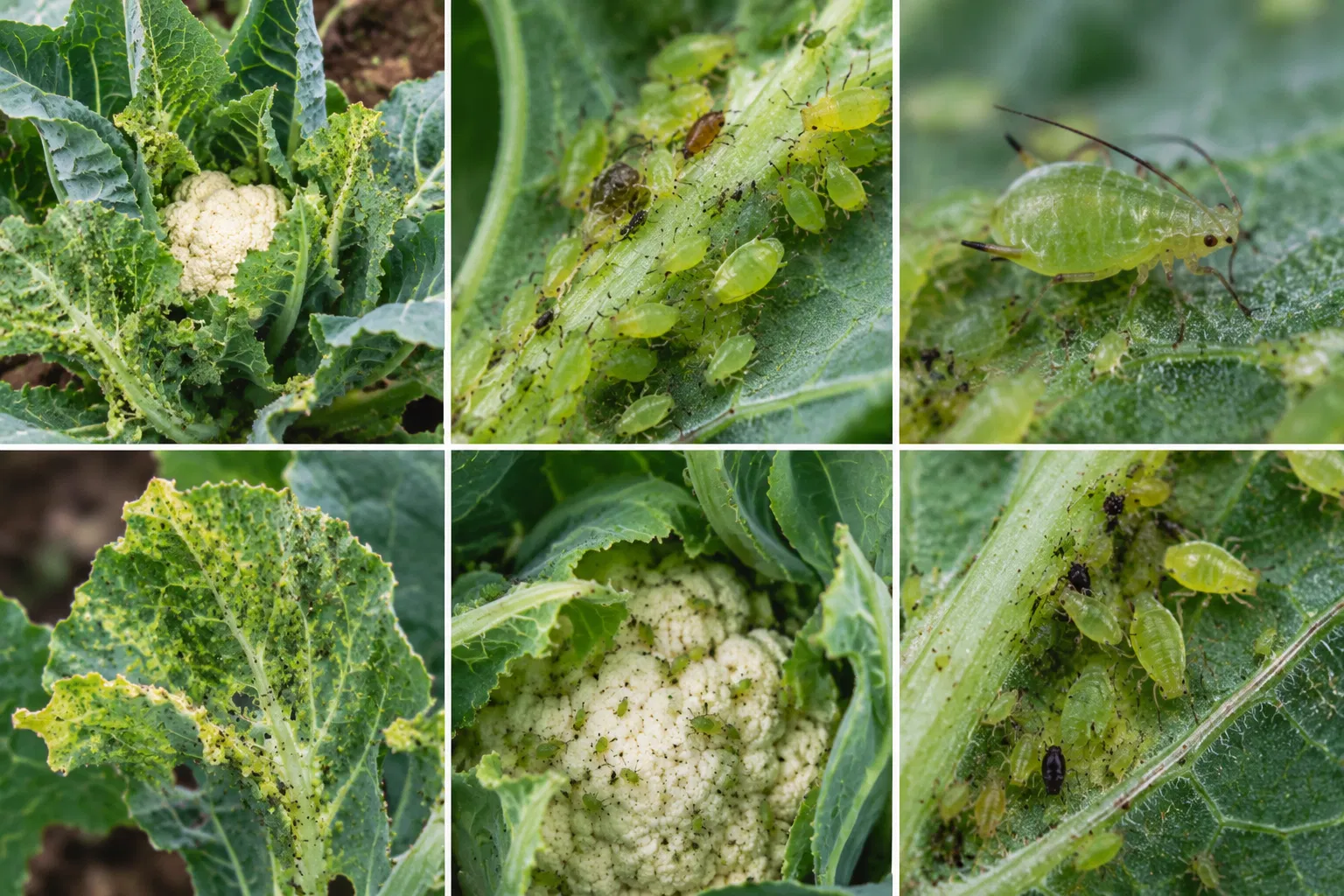
- Dense colonies of small, soft-bodied insects on the underside of leaves, in leaf axils and packed between the curd segments, often covered in a greyish waxy bloom
- Curling, cupping and crinkling of leaves, with stunted plants and reduced leaf size where colonies have been feeding for some time
- Yellowing and general loss of vigour as sap is drained, leading to smaller and poorly formed curds
- Sticky honeydew on the leaf surface, followed by black sooty mould that blocks light and reduces photosynthesis
- Ants moving up and down the plant, a reliable secondary sign that aphid colonies are established
- Mosaic mottling, vein clearing or ring spots on leaves where aphids have transmitted viral infections
Causes
- Cool, dry weather between roughly 15 and 25 degrees Celsius, which suits aphid multiplication; populations build quickly through the dry winter months and collapse under heavy rain
- Parthenogenetic reproduction, where females produce live nymphs without mating and those nymphs mature within about a week, so numbers multiply far faster than most pests
- Excess nitrogen, which produces soft, sap-rich foliage that raises aphid survival and breeding rate
- Continuous crucifer cultivation, or cauliflower planted next to an older cabbage, mustard or radish crop that releases waves of winged migrants
- Broad-spectrum sprays that eliminate ladybird beetles, syrphid larvae, green lacewings and the parasitoid Diaeretiella rapae, which normally suppress early colonies
- Cruciferous weeds on bunds and field borders serving as a reservoir between seasons
- Water stress and overly dense planting, both of which weaken the crop and create the sheltered canopy aphids favour
How to Identify
Aphids are 2 to 3 mm long, pear-shaped and slow-moving, and they cluster rather than scatter. The cabbage aphid, Brevicoryne brassicae, is the species most often found on cauliflower and appears greyish-green under a fine white waxy powder. The green peach aphid, Myzus persicae, is shiny yellowish-green with no wax coating and is the more dangerous of the two as a virus carrier. The confirming feature on both is a pair of short tube-like cornicles projecting from the rear of the abdomen.
Scout the underside of the older outer leaves and the growing point first, since colonies start there before spreading to the curd. Winged individuals mixed into a colony mean the population is about to disperse to neighbouring plants, and that is the point to act. Check 10 plants at 5 random spots per acre twice a week from transplanting, and put up yellow sticky traps to catch winged migrants and give early warning of an incoming flight.
Control Methods
Chemical Control
1. Dimethoate 30% EC
Dimethoate is an organophosphate that inhibits acetylcholinesterase, the enzyme that keeps the insect nervous system functioning, causing paralysis and death. It works by contact and by ingestion, and because it is absorbed and translocated through the plant sap, it reaches aphids sheltering inside curled leaves and deep in the curd where a surface spray simply cannot land. That systemic movement is what makes it the standard choice for an established infestation. It belongs to IRAC Group 1B.
Product Recommendation
- Tafgor Insecticide
- Rogor Insecticide
- Katyayani Dimethoate 30% EC - DEMAT
- Agriventure Dimete
- Rogorin Insecticide
Dimethoate is toxic to bees and to the natural enemies that keep aphid numbers down, so spray in the cooler hours when pollinator activity is low, and follow the pre-harvest interval strictly since cauliflower is a short-duration crop harvested soon after the last spray.
2. Fenvalerate 20% EC
Fenvalerate is a synthetic pyrethroid that modulates sodium channels in the insect nervous system, giving rapid knockdown by contact and stomach action. It is useful when exposed colonies need to be brought down quickly, particularly on outer leaves before the curd develops. Because it is purely contact-acting, thorough coverage of the leaf underside decides the result. It belongs to IRAC Group 3A.
Product Recommendation
Use fenvalerate as an occasional rotation partner rather than a routine spray. Repeated pyrethroid applications remove ladybird beetles and syrphid larvae far more effectively than they remove aphids, and the usual result is a heavier aphid rebound a fortnight later.
Biological Control
1. Azadirachtin 5% EC (50,000 ppm)
Azadirachtin, extracted from neem (Azadirachta indica) seed kernel, works through several routes rather than by straight toxicity. It deters feeding, disrupts moulting so nymphs fail to reach the adult stage, and repels winged aphids from settling on treated plants. It will not clear a heavy, wax-covered colony on its own, but applied at the first sign of the pest and repeated at 7 to 10 day intervals it holds populations below damaging levels while leaving ladybird beetles, syrphids and parasitoids intact. It also fits organic and residue-sensitive production.
Product Recommendation
Cultural Control
- Clear cruciferous weeds, volunteer plants and old crop residue from the field and bunds, since these carry aphid populations across seasons
- Avoid planting cauliflower directly beside an older cabbage, mustard or radish crop, which sends waves of winged aphids into the new field as it matures
- Keep nitrogen at the recommended dose and apply it in splits, because excess nitrogen produces the soft growth that raises aphid breeding rates
- Inspect and rogue out the first few colonised plants or outer leaves rather than waiting for a field-wide spray
- Maintain proper spacing and adequate irrigation, since crowded canopies and water-stressed plants both favour rapid colony build-up
- Protect natural enemies by avoiding calendar sprays; Coccinella septempunctata, syrphid larvae, Chrysoperla species and Diaeretiella rapae together account for heavy aphid mortality when left undisturbed
Mechanical Control
Yellow sticky traps at 8 to 10 per acre pull down winged aphids and, more importantly, tell you when a migration has started so the first spray can be timed correctly. Raise seedlings under insect-proof net so transplants enter the field clean, and use silver reflective mulch in the nursery, which disorients winged aphids and keeps them from settling. In the field, strip off and destroy heavily colonised outer leaves during routine scouting, and on small holdings a strong jet of water directed at the leaf undersides dislodges colonies without any chemical input.
Conclusion
Aphids in cauliflower are manageable as long as they are caught before colonies reach the curd, because no spray reverses a contaminated head. Scout twice a week from transplanting, start with neem while counts are low, bring in Dimethoate when colonies are established and hidden inside the canopy, and keep Fenvalerate as an occasional knockdown option rather than a routine one. Pair that with clean field borders, balanced nitrogen, yellow sticky traps and protection of the natural enemies already working in the field, and the crop stays clean through to harvest.
Disclaimer: Always confirm current label registration, approved dosage, water volume, and pre-harvest interval (PHI) for your state before using any product, since labels are periodically revised by regulatory authorities.
This guide is a general advisory. Do your own research and verification before using any product. Always confirm suitability for your crop stage, region, and field conditions before making any purchase, spray, or crop-management decision.