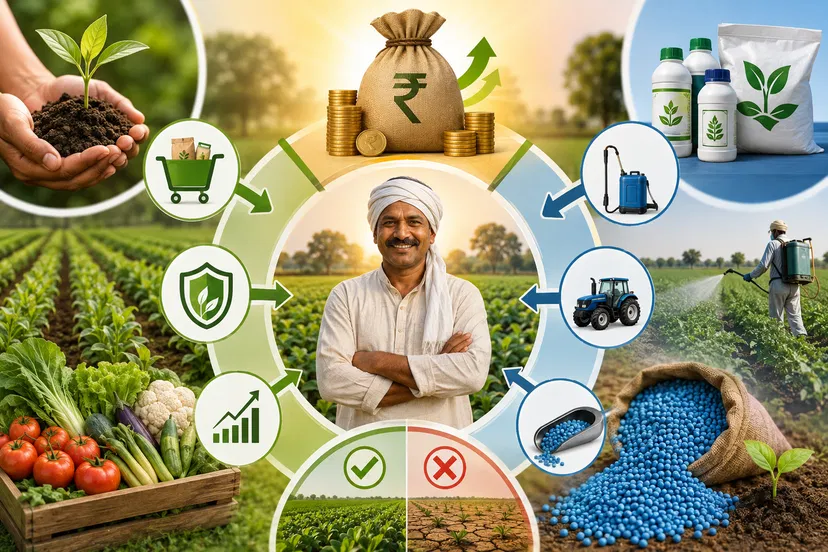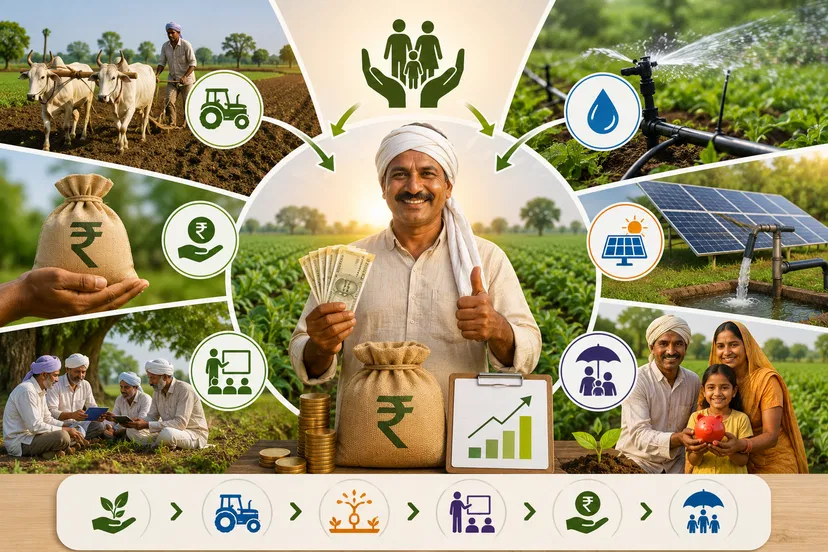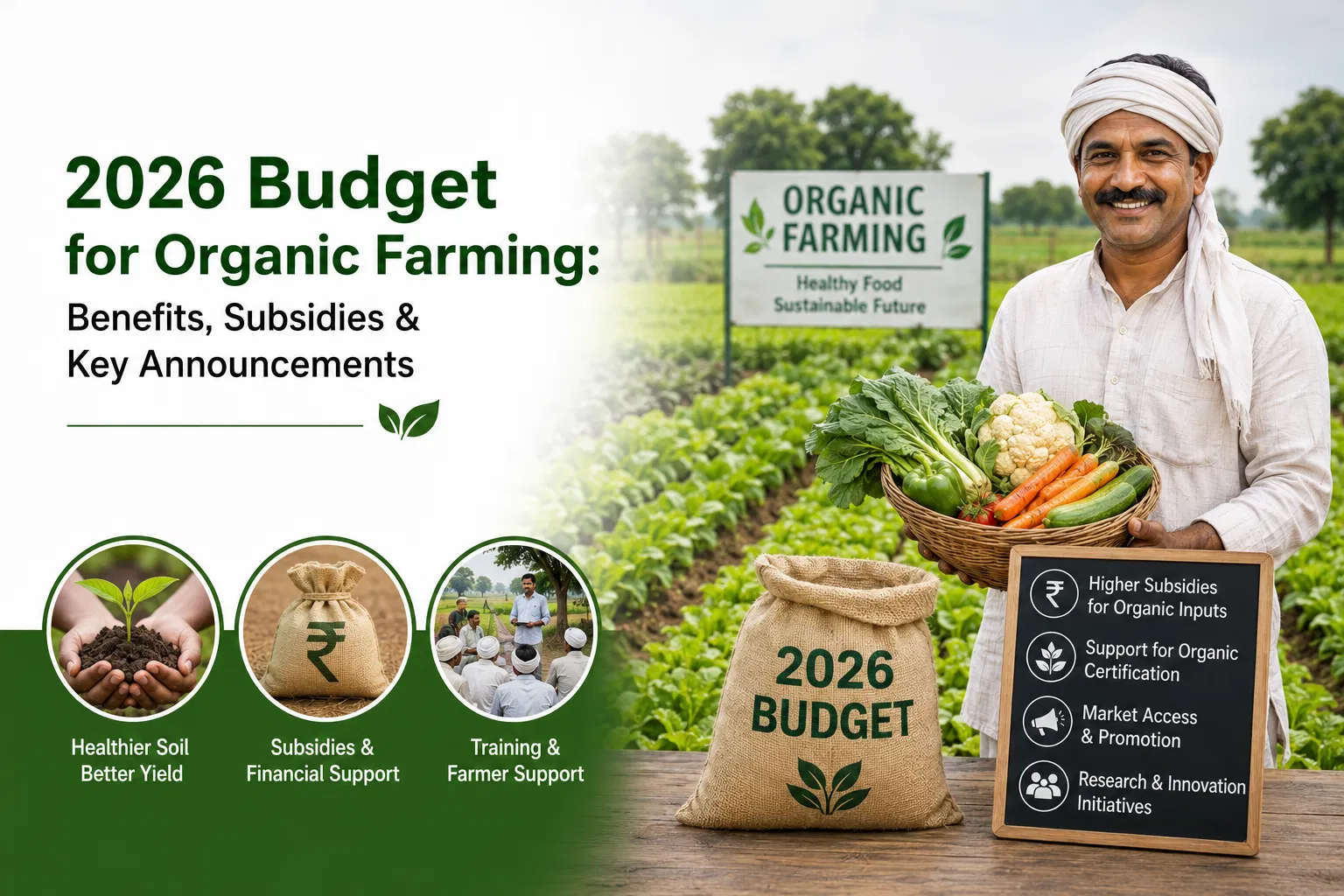
Finance Minister Nirmala Sitharaman presented the Union Budget 2026-27 on 1 February 2026, with the Ministry of Agriculture and Farmers' Welfare receiving a total allocation of around ₹1.40 lakh crore, up from ₹1.37 lakh crore in 2025-26. For organic and natural farming specifically, this budget continues to lean on two established pillars — the Paramparagat Krishi Vikas Yojana (PKVY) for organic farming across most of India, and the Mission Organic Value Chain Development for North Eastern Region (MOVCDNER) for the North-East — alongside the more recently launched National Mission on Natural Farming (NMNF), which has been steadily scaling up since its Cabinet approval in November 2024. Together, these schemes remain the backbone of how the government funds India's shift toward chemical-free and organic agriculture.
Budget 2026-27 Organic Farming Overview
- Budget Presented – 1 February 2026, by Finance Minister Nirmala Sitharaman
- Ministry of Agriculture and Farmers' Welfare Allocation – Approximately ₹1.40 lakh crore, a 2.19% increase over ₹1.37 lakh crore in 2025-26 (some analyses cite figures closer to ₹1.30-1.32 lakh crore depending on which components are counted)
- Key Organic/Natural Farming Schemes – Paramparagat Krishi Vikas Yojana (PKVY), Mission Organic Value Chain Development for North Eastern Region (MOVCDNER), National Mission on Natural Farming (NMNF)
- Type – Central Government (Centrally Sponsored Schemes), implemented through State/UT Agriculture Departments
- Helpline No – Kisan Call Centre, 1800-180-1551; farmers can also contact their District Agriculture Office or register directly on the Jaivik Kheti portal
- States Covered – PKVY: all states and UTs except the North-East; MOVCDNER: the 8 North-Eastern states; NMNF: nationwide, targeting 15,000 clusters in willing Gram Panchayats
Objectives of the Budget's Organic Farming Push
- Reduce farmers' dependence on chemical fertilisers and pesticides through cluster-based organic conversion
- Build end-to-end support for organic farmers — from production and processing to certification and marketing
- Scale up chemical-free natural farming nationally through the National Mission on Natural Farming's dedicated institutional structure
- Strengthen organic value chains specifically in the North-Eastern states through MOVCDNER
- Improve soil health and long-term farm sustainability alongside farmer income
Organic Farming Subsidy Structure
| Scheme | Financial Assistance | Coverage |
|---|---|---|
| Paramparagat Krishi Vikas Yojana (PKVY) | ₹31,500 per hectare over 3 years, including ₹15,000 per hectare transferred directly to farmers via DBT for on-farm/off-farm organic inputs | All states/UTs except North-East; over 32,384 clusters covering 6.4 lakh hectares and 16.1 lakh farmers reported so far |
| Mission Organic Value Chain Development for NE Region (MOVCDNER) | ₹46,500 per hectare over 3 years, including ₹32,500 per hectare directly to farmers for organic inputs, plus ₹10,000/hectare for training, handholding, and Internal Control System (ICS) documentation | 8 North-Eastern states |
| National Mission on Natural Farming (NMNF) | Total outlay of ₹2,481 crore (₹1,584 crore Centre + ₹897 crore states) through the 15th Finance Commission period, up to 2025-26, with continued funding expected into 2026-27 | Nationwide target of 1 crore farmers, 7.5 lakh hectares, and 15,000 clusters in willing Gram Panchayats |
Key Features of Budget 2026-27's Organic Farming Support
- PKVY and MOVCDNER continue as the two core organic farming schemes, both focused on forming organic clusters with preference given to small and marginal farmers
- Both schemes cover the full value chain — production, processing, certification, and marketing — rather than just the initial input subsidy
- NMNF was structured as a standalone scheme (rather than a PKVY sub-component) specifically to allow dedicated funding, a wider target base, and an institutional design suited to natural farming's distinct requirements
- NMNF focuses on institutional capacity for documentation, farmer-to-farmer demonstration, continuous training, and hand-holding rather than one-time input subsidy alone
- Over 6.22 lakh farmers had registered on the Jaivik Kheti portal as of early 2025, reflecting the ongoing digital push for organic farming registration and certification
- Multiple states have also developed their own organic product branding under these schemes — 8 states under PKVY and 7 North-Eastern states under MOVCDNER, as of recent government data
- Organic certification support continues through NPOP (National Programme for Organic Production), administered by APEDA, which is essential for farmers wanting to access export markets
Benefits to Organic Farmers
- Direct cash transfer for organic inputs — ₹15,000/hectare under PKVY or ₹32,500/hectare under MOVCDNER — reduces the upfront cost burden of transitioning away from chemical farming
- End-to-end scheme design means farmers get support not just for switching to organic inputs, but also for certification and market linkage afterward
- NMNF's cluster-based, Gram Panchayat-level approach means farmers can transition together with peer support rather than individually
- Access to certification (NPOP) opens the door to premium domestic and export markets, where certified organic produce commands a notable price premium
- MOVCDNER's higher per-hectare assistance reflects the additional cost of organic transition in North-Eastern terrain and market conditions
- Reduced long-term input costs and improved soil health, which compounds farmer income benefits over time beyond the subsidy period itself
Limitations and Points of Concern
- Assistance under PKVY and MOVCDNER is spread over 3 years, so farmers don't receive the full amount upfront — it's phased alongside their transition process
- Some organic and natural farming-related "missions" reportedly received zero funding in both the 2025-26 Revised Estimates and the 2026-27 allocation, according to agricultural policy groups, raising questions about implementation continuity for certain announced initiatives
- The organic farming sector remains small relative to India's total cropping area, and bridging the supply-demand gap continues to be a challenge despite years of PKVY and MOVCDNER support
- NMNF's funding period under the 15th Finance Commission runs up to 2025-26, so continued funding levels for 2026-27 and beyond depend on fresh budgetary allocation and Cabinet approval
- Certification through NPOP/APEDA can be a separate, sometimes lengthy process, meaning input subsidy alone doesn't guarantee immediate access to premium organic markets
Documents Required
- Aadhaar Card
- Land ownership or cultivation proof
- Bank account passbook (linked to Aadhaar for DBT)
- Passport-size photograph
- Registration on the Jaivik Kheti portal or relevant state organic farming portal
How to Access Organic Farming Benefits
- Contact your District Agriculture Office to check whether an organic cluster under PKVY (or MOVCDNER, if in a North-Eastern state) is being formed in your area.
- Register on the Jaivik Kheti portal or your state's organic farming portal with your Aadhaar, land, and bank details.
- Join or help form a cluster in your Gram Panchayat, since PKVY, MOVCDNER, and NMNF all operate through cluster-based group participation rather than individual standalone applications.
- Participate in the training, documentation (Internal Control System), and hand-holding support provided under the scheme during your transition period.
- Receive your Direct Benefit Transfer instalments for organic inputs as per the scheme's 3-year assistance schedule.
- Pursue NPOP certification through APEDA if you intend to sell in premium domestic or export organic markets, once your cluster has completed its transition period.
Conclusion
Budget 2026-27 doesn't reinvent India's approach to organic farming — it continues backing the proven cluster-based model of PKVY and MOVCDNER while letting the newer National Mission on Natural Farming scale toward its ambitious target of reaching one crore farmers. For farmers considering the shift away from chemical inputs, the practical entry point remains the same: connect with your District Agriculture Office, join or help form a local cluster, and register on the Jaivik Kheti portal to start accessing the phased financial and technical support these schemes provide.
[Disclaimer: This article is for informational purposes only. Scheme details, interest rates, and subvention amounts are subject to periodic revision by the Government of India, RBI, and NABARD. Farmers are advised to verify the latest terms and eligibility criteria with their bank, NABARD, or official government sources before applying.]