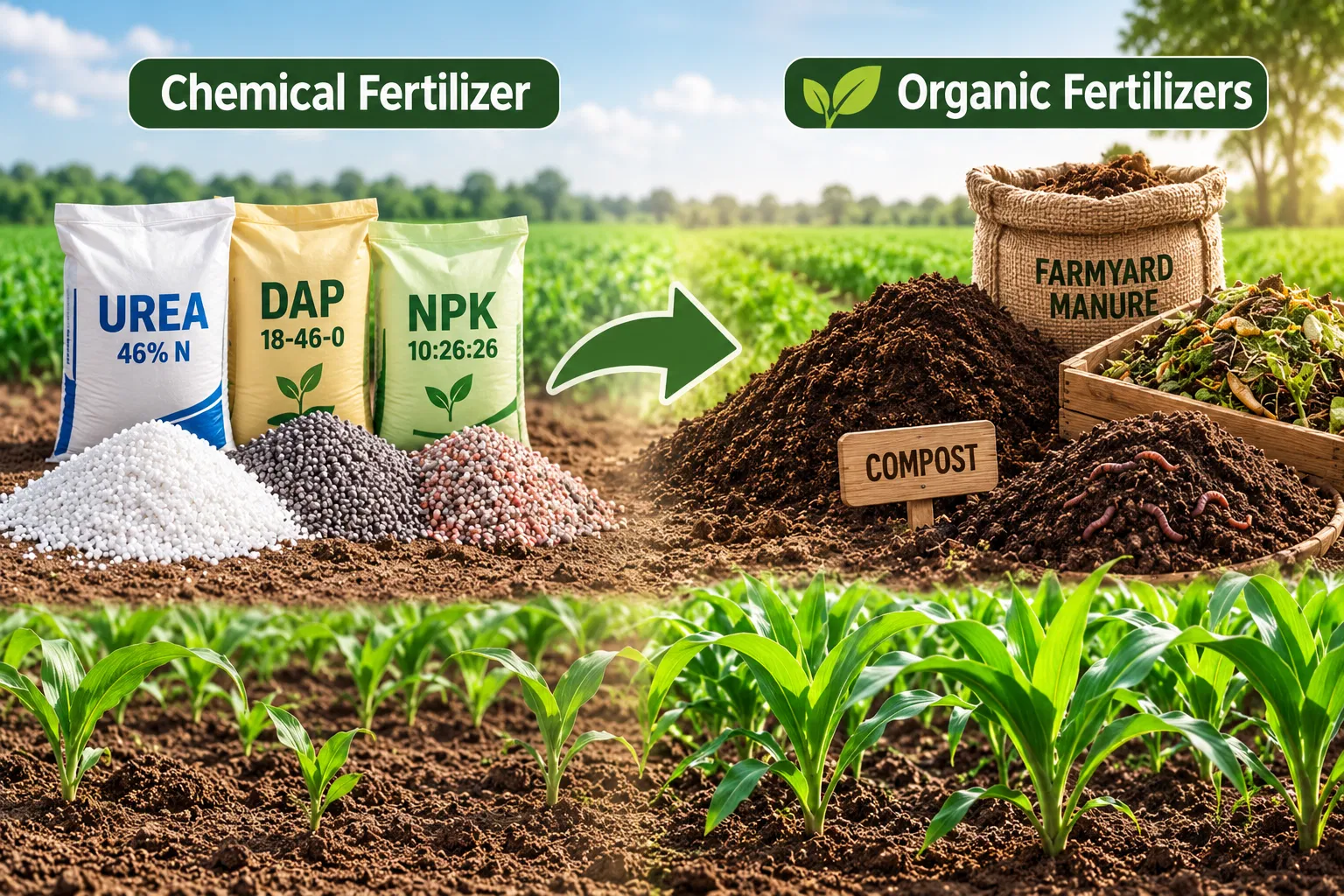
Moving from chemical to organic nutrient management can improve soil biology, organic matter, and long-term farm resilience. However, an abrupt change may reduce crop performance when the soil is depleted or when organic nutrient release does not match crop demand.
A successful transition is usually gradual. Farmers should reduce dependence on chemical fertilizers while increasing soil organic matter, biological activity, nutrient recycling, and monitoring. The objective is not simply to replace one bag with another; it is to rebuild the soil's nutrient-supplying capacity.
Why a Gradual Transition Works Better
Mineral fertilizers supply nutrients in immediately available forms. Organic inputs release nutrients through decomposition, which depends on temperature, moisture, aeration, carbon-to-nitrogen ratio, and microbial activity.
If mineral inputs are removed too quickly, a temporary nutrient gap can develop. A staged approach allows the soil system to improve while protecting yield and crop quality.
Step 1: Establish a Soil Baseline
Begin with a complete soil test. Record pH, electrical conductivity, organic carbon, available nitrogen, phosphorus, potassium, sulphur, and important micronutrient levels.
A reliable soil testing device can support routine field monitoring, but periodic laboratory analysis is valuable for detailed nutrient planning.
Repeat testing at the same time of year and use similar sampling locations. This allows meaningful comparison as the transition progresses.
Step 2: Calculate the Current Nutrient Program
List every nutrient source currently used, including basal fertilizer, top dressing, fertigation, foliar sprays, manure, crop residues, and irrigation water. Calculate the nutrient contribution rather than comparing products only by weight.
This prevents a common mistake: replacing a concentrated mineral product with the same weight of a low-analysis organic material. Organic products may require different quantities and application timing.
Step 3: Build Organic Matter First
Apply mature compost, farmyard manure, green manure, crop residues, or vermicompost according to soil and crop needs. Organic matter improves aggregation, water retention, cation exchange capacity, and microbial habitat.
Use only stable, uncontaminated material. Fresh manure or immature compost may temporarily immobilise nitrogen, increase salinity, or damage young roots.
Step 4: Reduce Chemical Inputs in Stages
Instead of stopping all mineral nutrients in one season, reduce them gradually while measuring crop response. The pace depends on soil fertility, crop value, yield target, organic input quality, and certification goals.
A practical transition may involve:
- Maintaining critical starter nutrients during the first season
- Replacing part of the basal dose with tested organic inputs
- Reducing later applications when crop colour and tissue tests remain satisfactory
- Increasing biological and residue-based nutrient cycling each season
High-demand crops may require a slower transition than pulses, cover crops, or low-input rainfed crops.
Step 5: Add Biological Nutrient Sources
Approved bio-fertilizers can support nitrogen fixation, phosphorus mobilisation, potassium mobilisation, or other biological processes. They are living products and must be stored, handled, and applied correctly.
Use the right organism for the crop and application method. Avoid exposing microbial products to direct sunlight, excessive heat, chlorinated water, or incompatible pesticides.
Step 6: Prevent Micronutrient Gaps
Organic systems can still develop deficiencies. Soil pH, crop removal, water quality, and nutrient interactions may limit iron, zinc, boron, manganese, and other micronutrients.
Use soil and tissue analysis to identify genuine shortages. Apply approved sources at recommended rates rather than assuming that compost alone supplies every element in sufficient quantity.
Step 7: Improve Crop Rotation
Rotate crops with different rooting depths and nutrient demands. Include legumes where appropriate to support biological nitrogen fixation. Deep-rooted crops can recover nutrients from lower soil layers, while residue-rich crops help rebuild organic matter.
A diverse rotation also reduces pest pressure and spreads nutrient demand across the season.
Step 8: Use Green Manuring and Cover Crops
Green manure crops produce biomass that is incorporated into the soil before maturity. Leguminous green manures add biologically fixed nitrogen, while non-legumes contribute biomass and recover residual nutrients.
Plan enough time between incorporation and planting the next crop. Fresh biomass needs time to decompose, and large amounts may temporarily affect seedbed conditions.
Step 9: Manage Water Precisely
Organic nutrient release depends heavily on soil moisture. Poor irrigation can slow decomposition, increase leaching, or create anaerobic root zones.
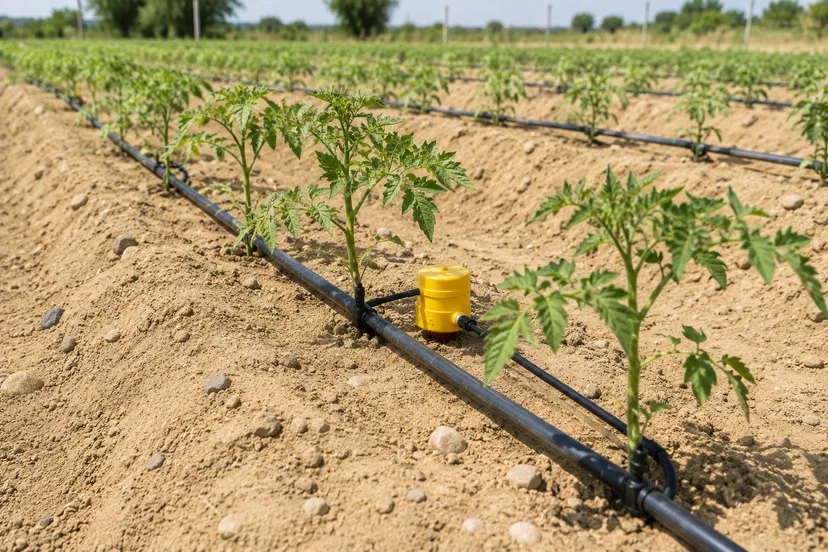
Maintain consistent moisture without waterlogging. In drip systems, place organic inputs where active roots and wetted soil overlap. Monitor source-water salinity and bicarbonates because poor water quality can reduce nutrient availability.
Step 10: Monitor Crop Response
Track crop colour, growth rate, root development, flowering, yield, produce quality, pest pressure, and soil condition. Use tissue tests during critical growth stages when possible.
Compare transition plots with a well-managed reference area. Small trial blocks allow farmers to adjust rates and timing before changing the entire farm.
Common Transition Mistakes
- Stopping mineral nutrients abruptly
- Using undecomposed manure or compost
- Comparing products by bag weight instead of nutrient content
- Ignoring phosphorus, potassium, sulphur, or micronutrient removal
- Expecting microbial products to work in dry or chemically hostile soil
- Failing to record costs, yield, and soil-test changes
- Changing the whole farm before running a trial
How Long Does the Transition Take?
Visible soil improvements may begin within one or two seasons, but rebuilding organic matter and biological function can take several years. Light soils, degraded fields, and intensive high-yield systems may require more time and careful nutrient support.
The correct pace is the one that improves soil health without creating serious nutrient stress or unacceptable yield loss.
Final Thoughts
Transitioning from chemical to organic fertilizers is a soil-management process, not a simple product substitution. Start with testing, build organic matter, reduce mineral inputs in stages, use biological products correctly, and monitor crop response.
A measured transition protects farm income while allowing the soil to become more biologically active, structurally stable, and efficient at supplying nutrients over time.