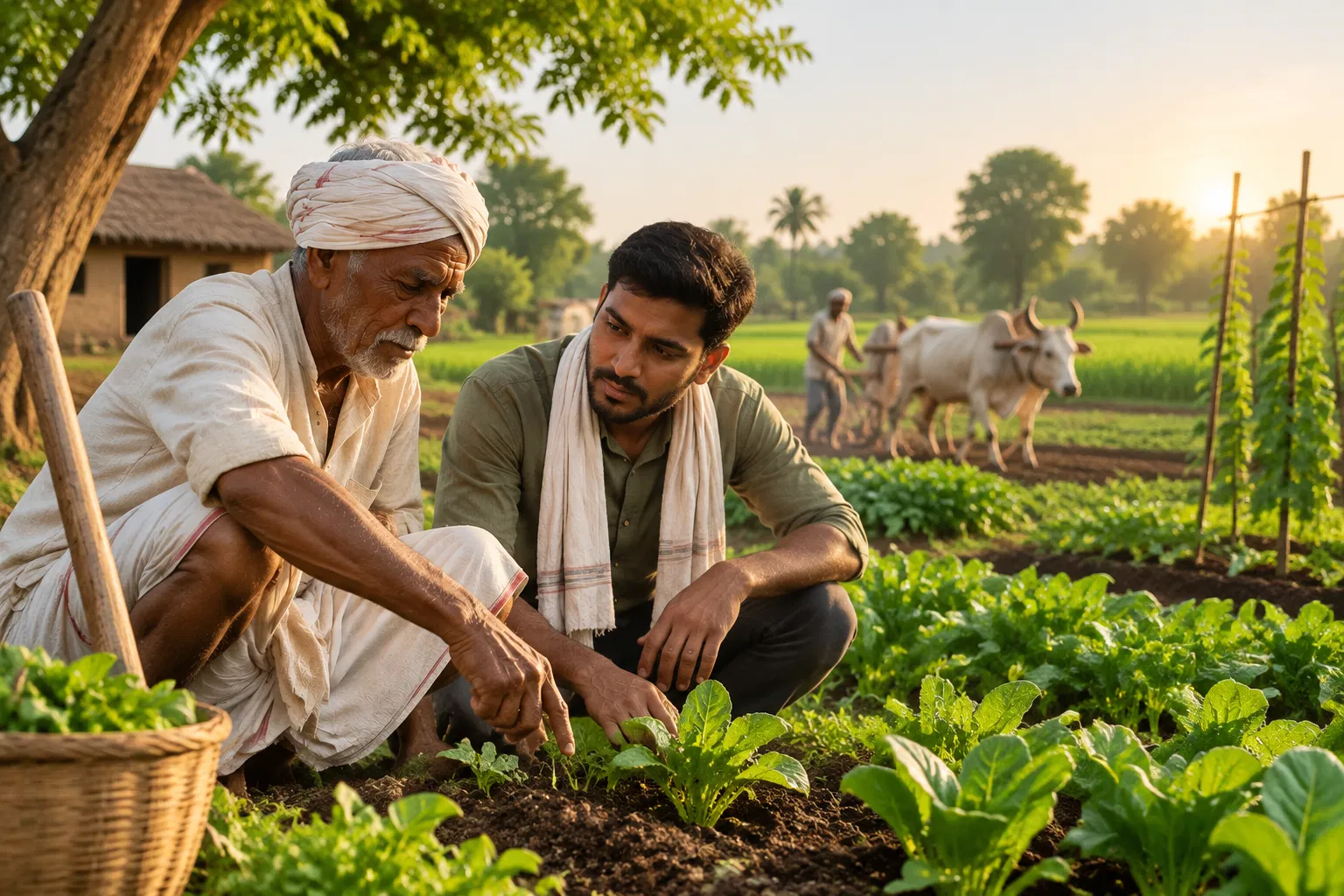
Long before soil tests and synthetic inputs, Indian farmers built a body of practical knowledge through generations of trial and observation. A good deal of it holds up remarkably well under modern agronomic scrutiny — not because it's traditional, but because the underlying mechanisms are sound. Here's what's genuinely worth carrying forward.
1. Mixed and Intercropping
Growing two or more compatible crops together — a cereal with a legume, for instance — is one of the oldest Indian farming practices, and it holds up well agronomically. Legumes fix atmospheric nitrogen in the soil through root-nodule bacteria, benefiting the companion crop, while different root depths and canopy structures reduce competition for water and light. It also spreads risk: if one crop underperforms due to pests or weather, the other can still deliver a harvest.
2. Crop Rotation
Rotating crop families across seasons rather than planting the same crop repeatedly breaks pest and disease cycles that build up in soil when a host crop is grown continuously. It also helps balance nutrient demand, since different crops draw on soil nutrients differently, and rotating in a legume periodically restores nitrogen that heavy feeders like cereals deplete.
3. Organic Residue Mulching
Covering soil with crop residue, straw, or dried leaves after sowing is a practice as old as settled agriculture, and it does exactly what modern research confirms: it reduces evaporation, suppresses weed germination, and moderates soil temperature swings. Where residue isn't available in sufficient quantity, a modern mulching sheet achieves the same core benefits with more consistent coverage.
4. Farmyard Manure and Composting
Returning organic matter — animal dung, crop residue, kitchen waste — back to the soil rather than treating it as waste is a foundational traditional practice that remains agronomically sound today. It improves soil structure, water-holding capacity, and microbial activity in ways that synthetic fertilizers alone don't address. Vermicomposting is a direct modern extension of this same principle, using earthworms to accelerate the process.
5. Neem-Based Pest Deterrence
Neem leaves, seed extracts, and neem cake have been used in Indian agriculture for generations to deter pests and improve soil health, and the active compound behind this — azadirachtin — is now a well-documented, widely used biopesticide ingredient. Neem cake continues this tradition as a soil amendment that combines slow-release nutrition with natural pest-repellent properties.
6. Rainwater Harvesting and Farm Ponds
Traditional water conservation structures — farm ponds, contour bunds, check dams — were built to capture and store monsoon rainfall for use during dry spells. This principle underlies much of modern watershed management today, and remains one of the most reliable ways to buffer against erratic rainfall, especially as monsoon patterns become less predictable.
7. Seed Saving and Local Landraces
Saving seed from well-performing local plants each season, rather than relying entirely on external seed sources, preserves varieties that are genuinely adapted to local soil, pest pressure, and climate over many generations. While modern hybrid seeds often out-yield landraces under optimal conditions, landraces frequently show better resilience under the exact local stresses — drought, specific regional pests — that farmers in that area actually face.
8. Contour Farming and Terracing on Slopes
Planting along the natural contour of sloped land, or terracing steeper slopes, slows water runoff and significantly reduces soil erosion compared to planting straight up and down a slope. This traditional technique remains a standard recommendation in modern soil conservation guidance for hilly and undulating terrain.
What to Approach with More Caution
Not every traditional practice has equally strong evidence behind it. Practices tied to lunar cycles or specific ritual timings for sowing, for instance, lack the same level of agronomic validation as the soil- and pest-management practices above — some farmers report good results, but the mechanism isn't well established the way it is for crop rotation or mulching. It's worth treating these as farmer-reported observations rather than proven agronomic principles, and testing them on a small scale before relying on them fully.
Frequently Asked Questions
Is traditional farming the same as organic farming?
Not exactly — traditional practices predate the formal organic movement, though many traditional techniques (composting, crop rotation, neem-based pest control) are also core organic farming practices.
Can traditional practices be combined with modern inputs?
Yes — many farmers successfully combine practices like mulching and crop rotation with modern fertilizers, biofertilizers, or targeted crop protection products rather than treating it as an either-or choice.
Why do some traditional practices work better than expected?
Many were refined through generations of direct observation of what worked in specific local conditions, which often aligns closely with principles later confirmed by formal agronomic research.
Disclaimer: General overview of traditional agricultural practices and their agronomic basis; effectiveness can vary by region, crop, and local growing conditions.