Broccoli: Planting and Package of Practices
Broccoli pays well because supply is still thin. City retail, hotels and salad kitchens take it steadily through the cool months, and locally grown heads fetch a far better price than most winter vegetables. The crop is also within reach of any farmer who already grows cauliflower, because the field work is close to the same.
Close, but not the same. Broccoli is eaten green, so it is never blanched. It drinks more water than cauliflower. It is unusually fussy about boron and molybdenum. And the harvest window is narrow: a few days late and the buds open, the head loosens and the price is gone. This guide works through the crop stage by stage, and every quantity is given per acre as well as per hectare.
Quick answer: Broccoli, also called sprouting broccoli or hari gobhi, is Brassica oleracea L. var. italica. It is a transplanted cool season crop. In the north Indian plains, sow the nursery from mid September to early November and transplant one month old seedlings at 45 by 45 cm. Use about 150 to 200 g seed per acre. Cut the head 75 to 90 days after transplanting, while the buds are still closed and the head is tight. A good crop can give 7 to 10 tonnes per acre, and side shoots can be picked after the main head.
Broccoli Crop at a Glance
ItemDetail
Botanical nameBrassica oleracea L. var. italica
FamilyBrassicaceae, the cole or crucifer group
Other namesSprouting broccoli, hari gobhi, green cauliflower
Part eatenThe compact cluster of unopened flower buds, with a short stem
How it is grownRaised in a nursery and transplanted, not direct sown
TemperatureGenerally 10 to 25 degrees Celsius. Sensitive to both cold and heat
SoilWell drained sandy loam or silt loam, rich in organic matter
Soil pHGenerally 6.0 to 6.8, with the wider range 5.8 to 7.2 also recommended
Seed rate150 to 200 g per acre (400 to 500 g per hectare)
Spacing45 by 45 cm, or 60 by 45 cm for a larger framed variety
Plants neededAbout 15,000 to 20,000 per acre, depending on spacing
Nursery to transplanting4 to 6 weeks, generally about one month
First harvest75 to 90 days after transplanting for most plains varieties
Second harvestSide shoots after the main head is cut
Yield7 to 10 tonnes per acre (17.5 to 24 tonnes per hectare)
Broccoli Is Not Cauliflower
If you already grow cauliflower, you are most of the way there. These are the five differences that actually cost money if you miss them.
What you do for cauliflowerWhat broccoli needs instead
Tie the leaves over the curd to blanch it whiteNothing. The head is meant to be green or purple. No official recommendation for broccoli includes blanching or tying leaves
Normal cole crop irrigationMore water. Broccoli is specifically noted as needing more water than cauliflower, so light irrigation more often
One cut and the crop is overCut the main head, then leave the plant standing. Side shoots form and can be picked as a second crop
Micronutrients as a general practiceBoron and molybdenum deserve specific attention. Shortage of either shows up directly in the head you are selling
A reasonably forgiving harvest windowA tight one. Once the buds begin to open, the head loosens and becomes unmarketable
Most of the field operations that are shared between the two crops are described in this complete guide to growing cabbage and cauliflower, which is worth reading alongside this one.
Crop Calendar: What to Do and When
This is the whole crop in one table. Work down it and you will not miss a step.
StageWhenWhat to do
Nursery bed preparation3 to 4 weeks before sowingMake raised beds over 15 cm high, mix in well rotted farmyard manure, and cover with transparent polythene for about 3 weeks to solarise
Farmyard manure to the main fieldAbout one month before transplantingMix in 6 to 8 tonnes per acre
Nursery sowingMid September to early November in the plainsTreat the seed first, then sow on raised beds or in pro-trays. A light straw mulch may improve germination
Nursery careThrough the nursery stageWater lightly. Cover with fine mesh netting against cabbage butterfly. Drench if damping off appears
Land preparation and basal fertiliserJust before transplantingMake ridges. Apply all the single superphosphate, all the muriate of potash and half the urea
TransplantingWhen seedlings are 4 to 6 weeks oldPlant at 45 by 45 cm on ridges, generally in the afternoon. Water immediately
First hoeing20 to 25 days after transplantingShallow hoeing to clear weeds and open up the soil
First top dressingAbout 30 days after transplantingOne quarter of the urea
Second hoeing and earthing upAbout 45 days after transplantingHoe again and draw soil up around the plants
Second top dressingAbout 45 days after transplanting, with earthing upThe remaining quarter of the urea
Boron sprayAbout 45 days after transplantingSpray boron at 3 g per litre. This is a routine step, not only a correction
Head formationGenerally 55 to 75 days after transplantingKeep moisture steady. Watch for diamondback moth, which does the most damage at this stage
Main harvest75 to 90 days after transplantingCut while the head is tight and the buds are closed, leaving a 10 to 15 cm stem
Side shoot harvestAfter the main cutLeave the plant standing and pick the side heads as they form
Recommended Varieties
Indian public sector releases for broccoli are few, so most of what sells is hybrid seed. Choose first by maturity group, because that is what has to fit your sowing window, and second by head colour and size.
VarietyReleased byHeadMaturityWorth knowing
Pusa Purple Broccoli-1ICAR Indian Agricultural Research Institute, New DelhiPurple, about 530 to 570 g75 to 85 days after transplanting. EarlyField resistance to downy mildew, black rot and Alternaria leaf spot. Anthocyanin rich. About 8.5 tonnes per acre. Suited to the north Indian plains, harvest December to January
Pusa Broccoli KTS-1ICAR Indian Agricultural Research Institute, KatrainGreen, about 410 gAbout 83 days. MidAbout 5.8 tonnes per acre. Harvest January to February
Palam VichitraCSK Himachal Pradesh Krishi Vishvavidyalaya, PalampurPurple, about 650 gAbout 120 days. LateThe largest head of the three. About 9.7 tonnes per acre. Harvest February to March. Sets seed only in the hills
Palam Samridhi, Palam Haritika, Palam KanchanCSK Himachal Pradesh Krishi Vishvavidyalaya, PalampurNot publishedNot publishedNamed releases from the same centre, which is known for coloured broccoli. Head weight and maturity figures are not published, so check with the university or your local centre before planting an area
Punjab Broccoli-1Punjab Agricultural University, LudhianaNot publishedNot publishedNamed variety for Punjab. Confirm the current recommendation with the university before planting
Maturity groups for the crop in general are useful when you are reading a seed packet: early types mature in 60 to 70 days, mid types in 90 to 110 days and late types in 110 to 120 days. Green sprouting types are the ones generally preferred in India.
Hybrid seed for different head types and maturities is available to order. The full range sits in the broccoli seeds collection, and these are useful starting points.
Sakata Green Magic Hybrid Broccoli Seeds
Tahoe RZ F1 Broccoli Seeds
Iris Cali-09 Broccoli Seeds
Iris F1 Broccoli Green Miracle Seeds
Indam Dome Green Broccoli Seeds
Tokita TSX 2004 F1 Hybrid Broccoli Seeds
Climate and Soil
FactorWhat the crop wants
TemperatureGenerally 10 to 25 degrees Celsius. The crop is sensitive to both low and high temperature
HeatHeads formed in warm weather tend to be loose and poor in quality, which is why sowing month matters so much
Soil typeSandy loam and silt loam are generally best. Well drained upland soil is preferred
Organic matterBuild the soil up with farmyard manure, compost or green manure. The crop responds well to it
Soil pHGenerally 6.0 to 6.8. A wider band of 5.8 to 7.2 is also recommended, and the crop tolerates slightly acidic soil
Why pH matters hereClubroot, the worst soil disease of cole crops, builds up in acidic soil. Knowing your pH is the first step in avoiding it
Official recommendations give the crop's overall range but do not print a separate temperature band for head formation, so the practical safeguard is sowing date rather than a thermometer. A soil test is free under the Soil Health Card Scheme, and this explains how to read and act on your pH.
Sowing Season by Region
Broccoli is a winter crop in the plains and a summer crop in the hills. Getting this the wrong way round is the most expensive mistake available on this crop.
RegionNursery sowingTransplanting and harvest
North Indian plainsMid September to early November. Mid August to mid October also works, and staggered sowing through September and October spreads the harvestTransplant one month old seedlings. Harvest December to February depending on variety
Hills above 1100 mThe crop season runs May to September, so this is a summer and monsoon cropIn the mid hills, transplanting from late June through July is practised. Harvest can take 100 to 120 days
Peninsular and south IndiaNo official sowing window is published for this regionCheck with your state department of horticulture or your nearest Krishi Vigyan Kendra before planting an area
One note of caution on the hills. Some recommendations give a September to October nursery sowing for hill areas, which conflicts with the May to September season in the state recommendations and with mid hill practice. Where sources differ this sharply, follow your own state department rather than a general figure.
Nursery Raising
Broccoli is transplanted, so the nursery decides the crop. A weak or diseased nursery cannot be rescued in the field.
StepWhat to do
Bed typeRaised beds over 15 cm high, or pro-trays. Raised beds are the main defence against damping off
SolarisationCover the prepared bed with 100 gauge transparent polythene for about 3 weeks before sowing. This cuts soil borne disease and weed seed
Bed enrichmentPlough the beds well and mix in well rotted farmyard manure
Seed treatment, biologicalTrichoderma viride 1.0 WP at 4 g per kg of seed
Seed treatment, chemicalCarbendazim at 2 g per kg of seed, or thiram or captan at 2.5 to 3 g per kg of seed
Seed treatment for black rotHot water at 58 degrees Celsius for 30 minutes. Black rot is carried in the seed, so this is the only reliable way to stop it before it starts
MulchA light straw mulch may improve germination
Pest protectionFine mesh netting over the bed keeps cabbage butterfly off the seedlings
If damping off appearsDrench the seedlings with carbendazim at 1 g per litre, or mancozeb at 2 g per litre
Age at transplanting4 to 6 weeks, generally about one month old
HardeningOfficial recommendations for this crop do not specify a hardening method, but reducing water and giving the seedlings more sun for a few days before lifting is normal nursery practice
For the nursery stage in general, how to raise a healthy vegetable nursery covers bed making through damping off, and how to harden off seedlings goes through that step properly. The reasoning behind the seed dressing is in best seed treatment practices before sowing, and the biological option is explained in this guide to Trichoderma.
Land Preparation and Transplanting
StepWhat to do
Farmyard manure6 to 8 tonnes per acre (15 to 20 tonnes per hectare), worked in about one month before transplanting
TillagePlough and work the field down to a fine, well drained tilth, as for any cole crop
Planting systemTransplant on ridges. Ridges keep water off the collar and reduce stem rots
Spacing, standard45 by 45 cm
Spacing, larger framed or hill crop60 by 45 cm, or 60 by 60 cm
Plants neededAbout 20,000 per acre at 45 by 45 cm, or about 15,000 per acre at 60 by 45 cm
Time of dayTransplant in the afternoon, so the seedlings are not hit by midday sun on day one
After plantingWater immediately
Get the manure properly rotted before it goes in. This covers composting organic manure if you are building your own supply.
Seed Rate
ItemPer acrePer hectare
Seed rate, standard150 to 200 g400 to 500 g
Seed rate, lower recommendation120 to 160 g300 to 400 g
Broccoli seed is small and a little goes a long way, which is why the rate is in grams rather than kilograms. Buy for the plant population you are actually going to transplant, and keep a margin for nursery losses.
Manures and Fertilisers
Here is one workable schedule in fertiliser bags rather than nutrient figures, so it can go straight to the field.
WhenUreaSingle superphosphateMuriate of potash
Basal, before ridge making50 kg per acre175 kg per acre40 kg per acre
About 30 days after transplanting25 kg per acreNilNil
About 45 days after transplanting, with earthing up25 kg per acreNilNil
Total per acre100 kg175 kg40 kg
That supplies roughly 46 kg nitrogen, 28 kg phosphorus and 24 kg potash per acre, which is about 115:70:60 per hectare and sits inside the officially recommended band. Add the 6 to 8 tonnes of farmyard manure per acre. Your soil test should decide where in the band you sit.
Extra feedRateWhen
Urea spray1 per cent, which is 10 g per litreAbout 15 days after transplanting
Nitrogen split, alternative scheduleRemaining half of the nitrogen in one dose instead of twoAt earthing up
For balancing organics against fertiliser over a rotation, start with this guide to integrated nutrient management.
Boron and Molybdenum: The Two That Decide Your Grade
Broccoli is more sensitive to these two than almost any vegetable, and both deficiencies show up in the part you sell. Boron shortage browns the head. Molybdenum shortage narrows and distorts the leaves, which is called whiptail. Neither can be fixed once the head is formed, so treat them as part of the schedule rather than as a rescue.
NutrientSoil applicationFoliar sprayWhat shortage looks like
BoronBorax or sodium borate at about 8 kg per acre (20 kg per hectare) at land preparation, where the soil is known to be short of boron. A lower rate of about 6 kg per acre is also recommendedBoron at 3 g per litre, about 45 days after transplanting, as a routine step. If browning shows, borax at 2.5 to 5 g per litre on the standing cropBrowning of the head. The head may look sound from outside and be discoloured within
MolybdenumMolybdenum at 1 to 1.5 kg per acre before plantingAmmonium molybdate at 0.1 g per litre, which is 0.01 per cent, on the standing cropWhiptail: leaves become narrow, strap like and distorted, and the plant does not build a proper frame
MagnesiumNot specifiedMagnesium sulphate at 5 g per litre, which is 0.5 per centYellowing of the older, lower leaves first
Two practical points. Where micronutrients have to be given to a standing crop, the head stage is the time to do it. And for molybdenum the material to ask for is ammonium molybdate, which is what official recommendations name for this crop.
For the wider picture on these nutrients, this complete guide to micronutrient management covers both boron and molybdenum with their deficiency symptoms, and the top 5 nutrient deficiencies every farmer should know explains how to spot them in the field.
Irrigation
PointWhat to do
After transplantingWater immediately, then keep the soil steadily moist while the seedlings establish
Through the cropLight and frequent irrigation. An interval of 10 to 15 days is recommended, but shorten it in warm or dry weather
Compared with cauliflowerBroccoli needs more water, so do not simply copy your cauliflower schedule
Head formation stageKeep moisture steady. Swings between dry and wet at this stage generally cost head quality
What to avoidHeavy flooding and water standing around the stem base, which encourages stem and root rots
No official source names a single critical irrigation stage for this crop, so steady moisture without waterlogging is the safe rule. Drip handles both at once, and drip irrigation for vegetables covers layout and costing.
Weeding, Hoeing and Earthing Up
PracticeWhenWhy
First shallow hoeing20 to 25 days after transplantingClears weeds and opens the soil for better aeration. Do it before irrigating
Second hoeing and earthing upAbout 45 days after transplantingGoes together with the second urea dose. Drawing soil up steadies the plant as the head builds
Plastic mulchLaid before plantingBlack film of about 30 micron suppresses weeds and holds moisture
Stale seedbedBefore transplantingLet the first flush of weeds germinate and destroy it, so the crop starts ahead of the weeds
HerbicideNot recommendedNo herbicide is officially recommended for this crop. Weed control is mulch and timely interculture
Pest Management
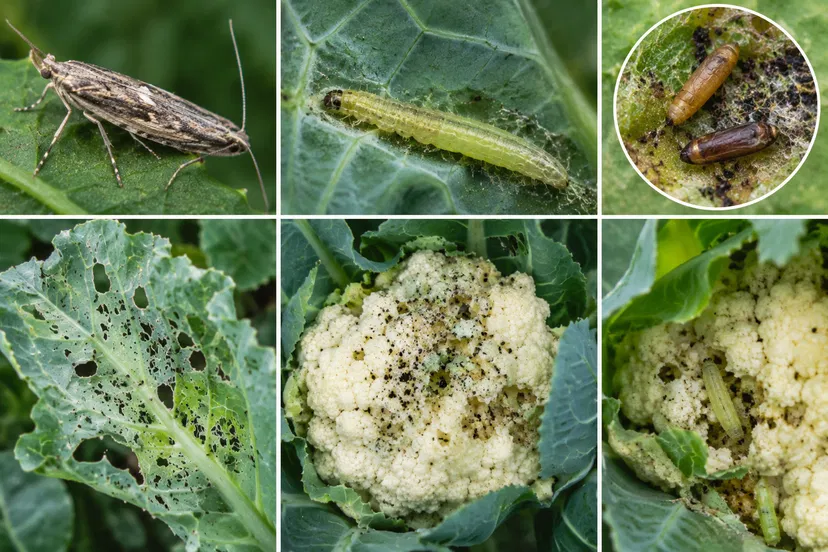
Diamondback moth is the pest that decides this crop. The official approach for broccoli leans heavily on traps, trap crops and biological control, with chemicals held back as a last resort, and that order is worth following because this pest develops resistance quickly when sprays are the first answer.
PestScientific nameWhat you seeWhat generally helps
Diamondback mothPlutella xylostellaSmall green caterpillars scraping the underside of leaves, leaving window like patches, then boring into the headPheromone traps at 4 to 5 per acre, with lures replaced every 2 to 3 weeks. Release Trichogramma at 20,000 per acre, 4 to 6 times weekly. In the hills, Diadegma semiclausum may be released. Spray 5 per cent neem seed kernel extract against eggs and young larvae
Cabbage butterflyPieris brassicaeLarge velvety caterpillars chewing leaves from the margins inwardFine mesh netting over the nursery. Hand collect at low numbers
Semilooper or cabbage looperTrichoplusia niLooping caterpillars making irregular holes in leavesPheromone traps. Neem seed kernel extract on young larvae. Light traps at 1 per acre, run from 6 to 10 pm
Cabbage head borerHellula undalisBoring into the growing point and head, with webbing and frassRemove and destroy affected plants. Trap crop rows of mustard around the field
Leaf webberCrocidolomia binotalisLeaves webbed together with caterpillars feeding insideNeem seed kernel extract. Destroy webbed leaves by hand
AphidsAphis speciesColonies on leaf undersides and growing points, sticky leaves, curling, and virus spreadYellow sticky or pan traps at 4 to 5 per acre, set about 15 cm above the canopy. Mustard as a trap crop. Clear weeds on bunds and channels
Mustard sawflyAthalia lugens proximaDark grubs eating holes through leaves, often down to the veinsBitter gourd seed oil emulsion works as an antifeedant. Conserve natural enemies
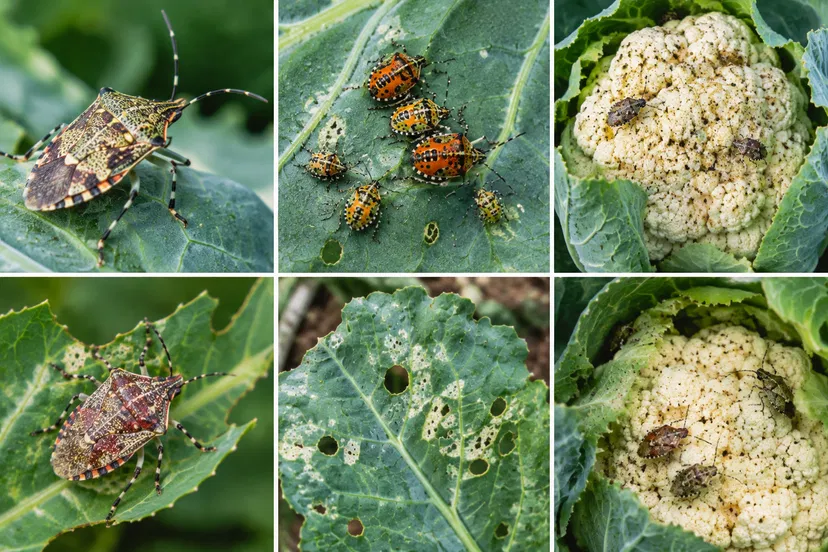
Painted bugBagrada cruciferarumSmall black and orange bugs sucking sap, with wilting in patches. Activity generally starts in SeptemberHand pick when numbers are low. Attend to the nursery and young crop first, where damage is worst
CutwormAgrotis ipsilonGrey to black larvae 3 to 4 cm long that cut seedlings at ground level and hide in the soil by dayHand collect in the evening. Castor as a trap crop at about 250 plants per acre
Root knot nematodeMeloidogyne incognitaStunting, patchy wilting, knots and galls on rootsNeem cake at about 180 kg per acre at transplanting
The trap crop layout that does most of the work
Mustard rows around and through a broccoli field pull egg laying away from the crop. The officially recommended layout is two rows of Indian mustard after every 16 rows of broccoli, with the first mustard row sown 15 days before the broccoli is planted and the second 25 days after. Alternate rows of tomato, garlic, coriander or carrot may also be intercropped. Bird perches at about 20 per acre let birds do some of the caterpillar control for you.
Traps and lures
Katyayani Diamond Back Moth Lure
Pheromone Trap with Trichoplusia ni Lure
Pheromone Replacement Lures for Trichoplusia ni
Where chemicals become necessary, indoxacarb 14.5 SC at 1 ml per litre and cyantraniliprole 10.26 per cent OD are among those recommended for caterpillars and sucking pests on this crop. Rotate between different groups rather than repeating one, since diamondback moth builds resistance fast.
For the pest complex shared across cole crops, this cabbage pest control guide covering diamondback moth, aphids and leaf eating caterpillars applies directly to broccoli. Diamondback moth is treated in depth in protecting crucifer harvests from diamondback moth larvae, and for aphids without chemicals see how to control aphids organically. The overall sequencing is in integrated pest management in vegetables.
Disease Management
DiseasePathogenWhat you seeWhat generally helps
Damping offPythium aphanidermatum and Rhizoctonia solaniNursery seedlings droop and fall over, with rot at the collar. Worst in humid, cloudy, overwatered bedsRaised beds over 15 cm or pro-trays. Avoid overwatering. Seed treatment. Drench with carbendazim at 1 g per litre or mancozeb at 2 g per litre
Downy mildewHyaloperonospora parasiticaFine hair like growth on the leaf underside with brown pinhead spots above. Can strike from nursery to head stageAvoid dense sowing in the nursery. Soil solarisation and burning of infected debris. Mancozeb at 0.25 per cent, repeated every 7 to 8 days while infection is active
Alternaria leaf blightAlternaria speciesBrown spots with concentric rings on leaves, leading to early leaf fallRotate for 3 years without cruciferous crops or crucifer weeds. Keep the crop well aerated and drained. Prune and burn diseased leaves
Black rotXanthomonas campestris pv. campestrisYellow patches spreading inward from the leaf margin in a V shape, with blackened veinsThis one is seed borne, so hot water seed treatment at 58 degrees Celsius for 30 minutes and certified seed are the real controls. Use a resistant variety where available
ClubrootPlasmodiophora brassicaeSwollen, club shaped, distorted roots. Plants wilt in the afternoon and recover at night, then stuntRaise soil pH to about 7.2 with hydrated lime, applied about six weeks before planting. Avoid excess irrigation. Soil solarisation. The disease favours acidic soil and wet conditions
White blister or white rustAlbugo candidaRaised white blister like pustules on leaves and stemsField sanitation, destruction of crucifer weeds, and rotation with non cruciferous crops
Sclerotinia rotSclerotinia sclerotiorumSoil borne rot at the base of the outer leaves, with sudden wilting of apparently healthy plantsDeep ploughing, since the fungus survives poorly below 15 cm. Soil drench with carbendazim at 1 g per litre. Improve drainage
MosaicCauliflower mosaic virusMottled light and dark green leaves, vein clearing, distortion and stuntingControl the aphids that spread it. Remove affected plants early
Black rot deserves extra attention because it is the one disease you can almost entirely prevent at the seed stage and almost entirely fail to control afterwards. Black rot in cole crops, its symptoms, spread and control goes through it in detail. Broader cole crop disease coverage sits in the cole crop pest and disease control guide.
What Goes Wrong, and Why
These are the four complaints that come up most often on this crop, and three of the four are not diseases at all.
What you seeLikely causeWhat to do
Head has opened out and gone loose, with yellow flower buds showingHarvested too lateNothing can be done to that head. Walk the field every 2 to 3 days once heads start forming, and cut while buds are still closed
Browning inside or on the headBoron shortageCorrect for the next crop with soil applied borax, and spray boron at 3 g per litre at about 45 days as a routine step
Narrow, strap like, distorted leaves and a poor plant frameMolybdenum shortage, called whiptailSpray ammonium molybdate at 0.1 g per litre on the standing crop, and apply molybdenum before planting next time
Yellowing of the older lower leavesMagnesium shortageSpray magnesium sulphate at 5 g per litre
Small or loose heads in a warm spellSowing date, not nutritionShift the sowing window so head formation falls in cool weather. For a general yield checklist, the steps that boost cole crop head size and quality apply here too
Harvesting: The Part That Decides Your Price
Broccoli has the tightest harvest window of any cole crop. The head is a cluster of flower buds, and the moment those buds start to open, the head loosens and becomes unsaleable. There is no recovering it.
Harvest pointDetail
When to start checkingFrom about 70 days after transplanting for early and mid varieties
First harvest, plainsGenerally 75 to 90 days after transplanting
First harvest, hills and late varieties100 to 120 days
How to judge it by eyeThe head should be compact and firm, dark green or purple, with buds still tightly closed. If buds look coarse and begin to separate, cut now
The sign you have waited too longBuds open, the head loosens and yellow shows. That head is no longer marketable
How to cutWith a sharp knife, leaving 10 to 15 cm of stem attached
How often to walk the fieldEvery 2 to 3 days once heads begin to form, because heads do not all mature together
Head weight to expectRoughly 400 to 650 g depending on variety
The second harvest most farmers miss
Cut only the main head and leave the plant standing. Side shoots, sometimes called cull heads, form afterwards in the leaf axils and can be harvested as a ratoon crop. These are smaller but sell into the same market, and they cost you nothing beyond the picking. Official recommendations confirm the practice but do not state how long the side shoots keep coming, so treat the duration as something to learn on your own field and variety.
Post-Harvest Handling
StepWhat to do
At harvestKeep the cut heads upright in clean trays. Heads laid on their faces bruise and discolour
Field heatHarvest in the cool of the morning and move the crop out of the sun straight away
GradingGrade by head size and firmness
BlanchingNot required. Unlike cauliflower, broccoli is not blanched and the leaves are not tied over the head
StorageOfficial recommendations for this crop give no storage temperature or humidity. The crop is perishable, so move it fast and keep it cool and moist
Yield You Can Expect
SituationPer acrePer hectare
Well managed crop, plains7 to 10 tonnes17.5 to 24 tonnes
Pusa Purple Broccoli-1About 8.5 tonnesAbout 21 tonnes
Pusa Broccoli KTS-1About 5.8 tonnesAbout 14 tonnes
Palam VichitraAbout 9.7 tonnesAbout 24 tonnes
North Eastern region2 to 6 tonnes, varying with variety, planting time and harvest period5 to 15 tonnes
Treat the upper figures as what a well managed crop of a high yielding variety may reach, not as a planning number for a first season. Variety, sowing date and how often you walk the field at harvest matter more here than any single input. For market framing, broccoli is one of the crops covered in 7 high demand exotic vegetables for Indian farmers.
Check with your state department for locally recommended varieties, local sowing dates and any subsidy on mulch film, nursery trays or protected structures.
StateOfficial portal
Himachal PradeshDepartment of Agriculture
UttarakhandDepartment of Agriculture
PunjabDepartment of Agriculture and Farmers Welfare
HaryanaDepartment of Horticulture
Uttar PradeshDepartment of Horticulture and Food Processing
BiharDepartment of Agriculture
RajasthanRaj Kisan
MeghalayaDepartment of Agriculture, package of practices
AssamDirectorate of Horticulture
MaharashtraMaha DBT Farmer Scheme Portal
Tamil NaduDepartment of Horticulture
KeralaState Horticulture Mission
Frequently Asked Questions
What is the seed rate for broccoli per acre?
About 150 to 200 g per acre, which is 400 to 500 g per hectare. A lower rate of 300 to 400 g per hectare is also recommended.
What spacing should I keep for broccoli?
Generally 45 by 45 cm on ridges. Go to 60 by 45 cm for a larger framed variety or in the hills.
When should broccoli be sown in north India?
Sow the nursery from mid September to early November and transplant one month old seedlings. In the hills it is a summer crop instead, grown between May and September.
How many days does broccoli take to harvest?
Generally 75 to 90 days after transplanting in the plains. Late varieties and hill crops can take 100 to 120 days.
How do I know when broccoli is ready to cut?
The head should be compact and firm with the buds still tightly closed. Once buds start to open and the head loosens, it is no longer marketable.
Does broccoli grow again after cutting?
Yes. Cut only the main head and leave the plant standing, and side shoots will form that can be harvested as a second crop.
Why is my broccoli head turning brown inside?
That is generally boron shortage. Spray boron at 3 g per litre at about 45 days after transplanting as a routine step, and correct the soil before the next crop.
Disclaimer: Recommended broccoli varieties, sowing dates, nutrient doses and plant protection measures can vary by state, altitude, soil and season, and official recommendations differ between regions, particularly on hill sowing seasons and micronutrient rates. Confirm with your state department of agriculture or horticulture, your nearest Krishi Vigyan Kendra, or the Kisan Call Centre on 1800 180 1551 before acting. Always read and follow the approved label on any plant protection product and observe the stated waiting period before harvest, which matters on a crop harvested over several weeks.