Banana: Planting and Package of Practices
Banana (Musa species) is one of the most important fruit crops in India, and India is the largest banana producer in the world. The crop is grown on nearly 10 lakh hectares, mainly in Andhra Pradesh, Maharashtra, Tamil Nadu, Uttar Pradesh, Gujarat and Karnataka. With good planting material, timely nutrition and careful bunch management, a single crop can give high returns in about a year.
This guide covers the full package of practices for banana, from choosing a variety and planting material to fertigation, bunch care, pest and disease control and harvest.
Banana at a Glance
Particular
Details
Botanical name
Musa species
Family
Musaceae
Climate
Warm and humid; grows at about 15 to 35°C, best around 25 to 30°C
Soil
Deep, well drained loamy soil rich in organic matter, pH about 6.5 to 7.5
Planting material
Sword suckers of 1.5 to 2 kg, or hardened tissue culture plants with 5 to 6 leaves
Pit size
About 45 to 60 cm cube
Common spacing
1.8 x 1.8 m for Robusta and Nendran (about 3,080 plants per ha)
Crop duration
About 11 to 16 months, depending on variety
Flowering to harvest
About 110 to 130 days
Yield
About 50 to 65 t per ha for Grand Naine and Robusta under good care
Climate and Soil for Banana
Banana grows best in a warm, humid climate with a temperature of about 25 to 30°C. Growth slows below about 15°C, and temperatures below about 12°C can cause chilling injury to leaves and fruits. Very hot, dry winds above 40°C can also scorch the leaves. The crop needs plenty of water, so well distributed rain or assured irrigation is important.
Strong winds can tear leaves and topple plants with heavy bunches, so windbreaks of tall crops or trees are useful in windy areas. Banana does well on deep, well drained loamy soils with good organic matter. Waterlogged, very sandy, saline or highly calcareous soils are not suitable.
Soil problem
What can help
Sodic soil (high pH)
Gypsum before planting and around 2 months after planting, extra organic manure and about 20 to 30% more potash
Acidic soil
About 100 g lime or dolomite per plant, and avoiding ammonium sulphate
Poor drainage
Raised beds or deep drains around the field
Recommended Banana Varieties
Variety choice depends on your region, market and whether you want dessert or cooking bananas. Cavendish types such as Grand Naine dominate commercial planting, while regional varieties often fetch premium prices in local markets.
Variety
Use
Duration
Bunch weight
Notes
Grand Naine (G-9)
Dessert
About 11 to 14 months
About 25 to 30 kg
Most popular tissue culture variety; good for export
Robusta
Dessert
12 to 14 months
25 to 30 kg
High yielding; susceptible to leaf spot and weevil
Dwarf Cavendish (Basrai)
Dessert
About 11 to 14 months
20 to 25 kg
Short plant; highly susceptible to Sigatoka
Nendran
Dessert and cooking (chips)
11 to 12 months
12 to 15 kg
Popular in Kerala and Tamil Nadu; not ideal for ratoon
Rasthali
Dessert
14 to 15 months
15 to 20 kg
Premium taste; susceptible to Panama wilt
Poovan
Dessert
11 to 14 months
About 25 kg
Hardy; tolerant to wilt but susceptible to bract mosaic
Ney Poovan (Elakki Bale)
Dessert
12 to 14 months
15 to 30 kg
Small, sweet fingers; tolerant to leaf spot
Red Banana
Dessert
About 18 months
20 to 25 kg
Premium price; susceptible to bunchy top and wilt
Karpuravalli
Dessert
12 to 14 months
8 to 9 hands
Hardy; tolerant to rhizome weevil
Monthan
Cooking
12 to 14 months
20 to 25 kg
Highly susceptible to Fusarium wilt
Varieties From ICAR-NRC for Banana, Tiruchirappalli
Variety
Key traits
Udhayam
Karpuravalli type with bunches of about 37 kg; tolerant to Sigatoka and nematodes; 15 to 16 months
Kaveri Saba
Cooking banana; tolerates drought, salinity and sodic soils; 12 to 13 months
Kaveri Kalki
Dwarf plant that needs no propping; suits high density planting; about 12 months
Kaveri Sugantham
Fragrant fruit; resistant to Fusarium wilt; 13 to 14 months
Kaveri Vaaman
Dwarf, early maturing selection of Grand Naine developed with BARC; needs no propping
Other regional favourites include Shrimanti and Basrai in Maharashtra, Tella Chakkerakeli and Bontha in Andhra Pradesh, Palayankodan in Kerala, Malbhog and Chini Champa in Assam, and hill bananas such as Virupakshi in Tamil Nadu.
Planting Material: Suckers or Tissue Culture
Particular
Sword suckers
Tissue culture plants
What to choose
Sword suckers with narrow leaves, 3 to 5 months old, weighing about 1.5 to 2 kg
Hardened plants about 25 to 30 cm tall with 5 to 6 healthy leaves and white roots
Disease risk
Can carry wilt, nematodes, weevils and viruses from the mother plant
Generally disease and virus free when bought from a certified lab
Crop uniformity
Uneven flowering and harvest
Uniform growth and harvest in a shorter time
Ratooning
Possible
Generally 2 ratoon crops
Treating Suckers Before Planting
Avoid water suckers with broad leaves, as they give weak plants and poor bunches.
Trim the roots and pare the outer layer of the corm to remove nematodes and weevil grubs.
Dip the pared suckers in hot water at about 50 to 55°C for 20 to 30 minutes to reduce nematodes, then dry them in shade.
Coating the corm with a thick clay slurry (pralinage) before planting is also commonly practised.
For tissue culture plants, applying about 25 g of Pseudomonas fluorescens or Bacillus subtilis per plant at planting can support healthy root growth. This guide on selecting banana suckers explains how to pick healthy suckers.
Planting Season
Region
Main planting time
Tamil Nadu, wetlands
February to April for Poovan, Rasthali and Monthan; April to May for Nendran and Robusta
Tamil Nadu, garden land
January to February and November to December
Kerala
April to May under rainfed conditions; August to September under irrigation
Maharashtra
June to July (Mrig bag) and October to November (Kande bag)
General guidance
Avoid planting in very cold (below 15°C) or very hot (above 40°C) spells
It is a good idea to time planting so that bunches do not emerge during very hot, dry or very cold months.
Land Preparation and Planting
Plough the field well, remove stubble of the previous crop and add about 10 tonnes of farmyard manure per hectare at the last ploughing.
Dig pits of about 45 to 60 cm cube and fill them with topsoil mixed with about 10 kg well rotted farmyard manure and 250 g neem cake.
Plant suckers or tissue culture plants in the centre of the pit, press the soil firmly and water right away.
Raised beds can help on heavy soils and in areas where water stagnates.
Planting system
Varieties
Spacing
Plants per hectare
Normal
Dwarf Cavendish
1.5 x 1.5 m
About 4,440
Normal
Robusta, Nendran, Grand Naine
1.8 x 1.8 m
About 3,080
Normal
Rasthali, Poovan, Karpuravalli, Monthan
2.1 x 2.1 m
About 2,260
Paired row
Dwarf Cavendish
1.2 x 1.2 m in pairs, 2 m between pairs
About 5,200
Paired row
Robusta, Grand Naine, Poovan, Rasthali, Ney Poovan
1.5 x 1.5 m in pairs, 2 m between pairs
About 3,800
Three plants per pit
Robusta, Nendran
1.8 x 3.6 m
About 4,500
High density and paired row planting can increase plant numbers and save water and fertiliser per plant, but they need drip irrigation and good management. In cold regions, wider spacing is generally advised.
Manures and Fertilisers
Banana is a heavy feeder, especially of potassium, which supports bunch size and fruit quality. Doses vary by variety and region, so a soil test is the best guide.
Variety or situation
Farmyard manure
N : P : K (g per plant per crop)
General recommendation
About 10 kg per plant
200 : 30 to 50 : 300 to 450
Grand Naine (Maharashtra)
About 10 kg per plant
200 : 40 : 200
Nendran (Kerala)
About 10 kg per plant
190 : 115 : 300
Tissue culture plants
About 10 kg per plant
About 50% more than suckers, in more splits
For soil application, give nitrogen and potash in 3 to 5 splits, generally starting about a month after planting and ending by the 7th month.
Apply phosphorus fully at or soon after planting.
Tissue culture plants generally do better with 5 to 7 smaller splits, every 30 to 45 days.
Bio-fertilisers such as Azospirillum and phosphate solubilising bacteria at about 25 g each per plant can be mixed with farmyard manure at planting.
Fertigation Schedule
Under drip, nitrogen and potash can be given weekly in small doses. A commonly followed schedule per plant is shown below, with phosphorus given in the soil at planting.
Weeks after planting
Urea per plant per week
Muriate of potash per plant per week
9 to 18
About 15 g
About 8 g
19 to 30
About 10 g
About 10 g
31 to 40
About 7 g
About 12 g
41 to 46
None
About 10 g
Total
About 340 g
About 375 g
Water soluble fertilisers that list banana include:
Mahadhan KNO3 13:00:45
Utkarsh SOP 00:00:50
Mahadhan Calcium Nitrate
Micronutrients
Zinc and boron shortages are common in banana. About 25 g zinc sulphate and 5 g borax per plant can be mixed into the soil, or a foliar spray of zinc sulphate 0.5% with boric acid 0.1% can be given at the 3rd, 5th and 7th months. A banana special micronutrient mixture at about 5 g per litre, sprayed every month from the 5th to the 10th month, can also improve bunch size and quality.
Irrigation
Banana needs regular moisture throughout its life, and drip irrigation saves water and supports fertigation. A commonly followed guide per plant per day is:
Crop stage
Weeks after planting
Water per plant per day
After planting
1 to 4
About 4 to 6 litres
Juvenile growth
5 to 9
About 8 to 10 litres
Active growth
10 to 19
About 12 litres
Flower bud formation
20 to 32
About 16 to 20 litres
Shooting and bunch development
33 to 50
About 20 litres or more
Flower bud formation, shooting and bunch development are the most critical stages; water stress then can reduce bunch size.
Under furrow or basin irrigation, water about every 4 to 5 days in summer and 7 to 8 days in winter, depending on soil.
Avoid waterlogging, as it can increase wilt and root rot problems.
Mulching with crop residue or banana trash can save water and keep weeds down.
Intercultural Operations
Operation
When and how
Desuckering
Remove side suckers every month until flowering. After flowering, keep one healthy follower sucker if a ratoon crop is planned
Earthing up
Earth up around the plant every month or two, especially at 3 to 4 months, to support the plant
Removing old leaves
Remove dry and diseased leaves regularly, but keep at least 6 to 8 healthy leaves at flowering
Propping
Support tall varieties with bamboo poles or ropes at or before bunch emergence to prevent toppling
Weed control
Hand weeding, mulching and intercultivation; diuron is a recommended pre-emergence herbicide for banana
Intercropping
Onion, beans, green gram, black gram, radish or marigold in the early months; avoid tomato, brinjal, chilli and cucurbits
Bunch Care
Practice
When
How
Removing the male bud (denavelling)
About a week after the last hand opens
Cut the male bud about 10 to 15 cm below the last hand
Removing extra hands
Soon after the bunch opens
Remove the false hand and 1 or 2 small bottom hands, keeping about 7 to 8 hands
Bunch spray
About a week after the last hand opens, and again a month later
Spray sulphate of potash at about 2% (20 g per litre) on the bunch
Bunch covering
Right after the last hand opens
Cover with a white or blue polythene sleeve of about 100 gauge with small vents
Bunch feeding
After removing the male bud
Tie a slurry of about 7.5 g urea, 7.5 g sulphate of potash and 500 g fresh cow dung to the cut stalk in a polythene bag
Sunburn protection
Hot, sunny months
Fold a leaf over the bunch stalk and cover exposed bunches
Non woven fruit covers such as the Vedant Fruit Tubing Roll, which lists banana, can also be used to protect bunches from dust, sunburn and insects.
Pest and Disease Management in Banana
Fusarium wilt, Sigatoka leaf spot, bunchy top, weevils and nematodes are the main threats to banana. Most of them start from infected planting material or poor field hygiene, so clean planting material and regular removal of diseased plants are the first line of defence. For a full plan, see this guide on integrated pest management in banana.
Major Pests of Banana
Pest
Damage signs
Key management
Rhizome weevil (Cosmopolites sordidus)
Grubs tunnel in the corm; plants weaken, yellow and topple
Clean, pared suckers or tissue culture plants, field sanitation and split stem traps
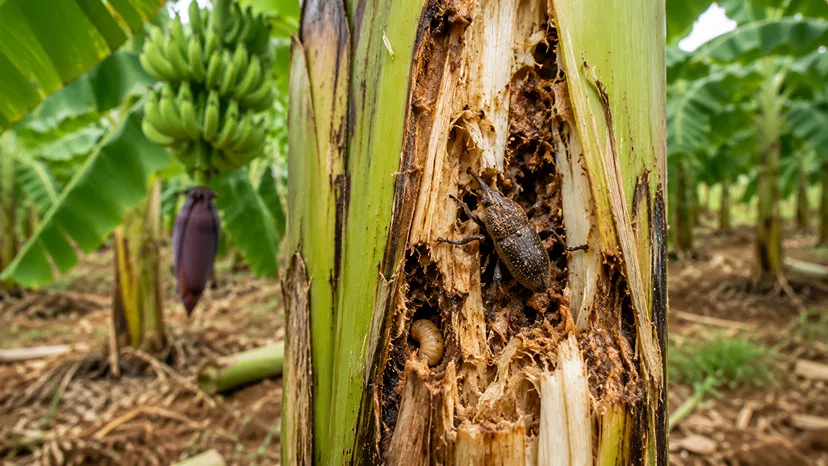
Pseudostem weevil (Odoiporus longicollis)
Jelly like ooze and holes on the stem; stems break
Remove and destroy infested plants and old stems, keep the field clean and use stem traps
Banana aphid
Colonies at the leaf base and crown; spreads bunchy top virus
Remove virus affected plants and control aphids with recommended sprays
Lace wing bug
White speckling and yellowing on the underside of leaves
Recommended insecticide sprays when numbers are high
Thrips
Brown or rusty patches on fingers
Bunch covering and early control at bunch emergence
Nematodes
Root lesions and galls; plants topple easily
Paring and hot water treatment of suckers, neem cake, marigold intercrop and rotation with paddy
For thrips on young bunches, a botanical spray such as Tapas Contsap, which lists banana, can be used in the early stage.
Pseudostem weevil can be hard to spot until the damage is serious. This guide on managing pseudostem weevil in banana explains early signs and control.
Major Diseases of Banana
Disease
Signs to look for
Key management
Fusarium wilt (Panama disease)
Lower leaves turn yellow and hang around the stem; brown streaks inside the stem; stem may split
Disease free tissue culture plants, good drainage, lime in acidic soils, rotation with paddy and bio-agents such as Trichoderma at planting and in early months
Sigatoka leaf spot
Yellow streaks that turn into brown spots with grey centres; leaves dry early
Remove and burn spotted leaves and spray recommended fungicides at intervals
Bunchy top virus
Narrow, upright leaves bunched at the top with dark green streaks
Virus free plants, aphid control and uprooting and destroying infected clumps
Bract mosaic virus
Spindle shaped pinkish streaks on the stem and bracts
Virus indexed planting material and removal of infected plants
Erwinia rhizome rot
Rotting of the corm and collar; young plants topple
Healthy planting material, good drainage and bleaching powder drench as advised
Anthracnose and cigar end rot
Dark lesions on fingers; tip of fingers rots
Remove flower remains from fingers and spray recommended fungicides
Fusarium wilt cannot be cured once a plant is infected, so prevention matters most. Learn more in this guide on Panama wilt in banana.
Bio-inputs that list banana and can support wilt, weevil and nematode management include:
Varsha Agnee (Pseudomonas fluorescens)
FIB-SOL Super-Tri (Trichoderma viride)
Katyayani Beauveria bassiana
Recommended Products for Banana Pests and Diseases
Pest or Disease
Active Ingredient
Product
Dose
Waiting Period
Sigatoka leaf spot
Metiram 55% + Pyraclostrobin 5% WG
BASF Cabrio Top
3 to 3.5 g per litre (about 600 to 700 g in 200 L water per acre)
85 days
Sigatoka leaf spot, cigar end rot and tip rot
Mancozeb 75% WP
Dhanuka M45
2 to 2.7 g per litre (about 600 to 800 g in 300 L water per acre)
Not specified on the pack
Leaf spot and fruit rot
Copper oxychloride 50% WP
Katyayani COC50
About 1 kg in 300 to 400 L water per acre
Not specified on the pack
Lace wing bug (tingid bug)
Quinalphos 25% EC
Syngenta Ekalux
About 1.2 to 1.6 litres in 200 to 400 L water per acre
Not specified on the pack
For Sigatoka, start sprays when the first spots appear, rotate fungicides from different groups and cover both sides of the leaves. This guide on banana Sigatoka control explains spray timing in more detail. Always check the waiting period before harvest, and wear gloves, a mask and full clothing while spraying.
Physiological Disorders
Disorder
Likely cause
What can help
Choke throat
Cold weather at flowering; the bunch gets stuck in the stem
Windbreaks, timely planting so flowering avoids winter, and bunch covers
Chilling injury
Temperatures below about 12°C
Bunch covers, neem cake and good nutrition in winter
Leaf edge scorching
Salt build up in sodic soils
Gypsum, extra potash and a sulphate of potash spray
Toppling
Nematode damage to roots, weak anchorage and heavy bunches
Nematode management and timely propping
Harvesting and Yield
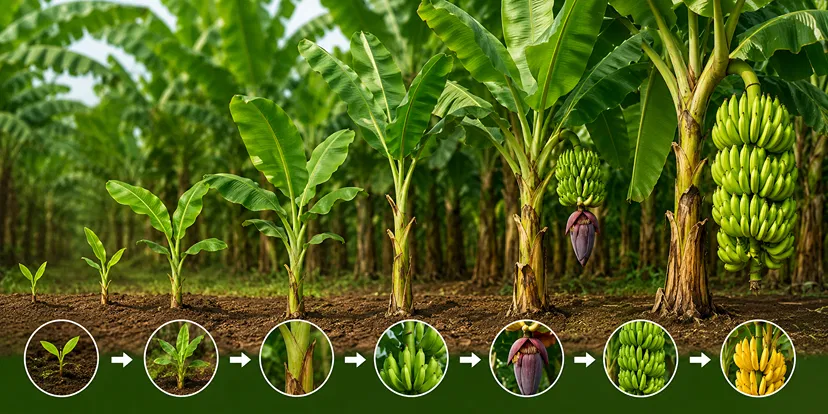
Banana bunches are generally ready about 110 to 130 days after flowering, depending on variety and season. Total crop duration is usually 11 to 16 months.
Mature fingers lose their angles and become round and full.
The colour changes from dark green to light green, and the fruit gives a metallic sound when tapped.
For distant markets, bunches are usually harvested at about 75 to 80% maturity.
Cut the bunch with a sharp knife, leaving a stalk of about 30 cm, and avoid bruising the fingers.
Variety
Approx. yield
Grand Naine, Robusta, Dwarf Cavendish
About 50 to 65 t per ha (20 to 26 t per acre)
Poovan, Rasthali
About 40 to 50 t per ha
Red Banana
About 45 t per ha
Nendran, Monthan
About 30 to 40 t per ha
Tissue culture plantings can generally be ratooned for 2 more crops by keeping one strong follower sucker per plant after the main bunch emerges.
Frequently Asked Questions
What is the best spacing for banana?
Robusta and Nendran are commonly planted at 1.8 x 1.8 m, Dwarf Cavendish at 1.5 x 1.5 m, and tall varieties like Poovan and Rasthali at 2.1 x 2.1 m.
Which is better for planting, suckers or tissue culture plants?
Tissue culture plants are generally preferred, as they are disease free, uniform and give an even harvest. Healthy sword suckers can be used where good plants are not available.
How much fertiliser does a banana plant need?
A banana plant commonly needs about 200 g N, 30 to 50 g P and 300 to 450 g K per crop, along with about 10 kg farmyard manure. Tissue culture plants need a little more.
How much water does a banana plant need per day under drip?
Needs rise with age, from about 4 to 6 litres a day after planting to 20 litres or more a day from shooting to bunch development.
How many days does banana take from flowering to harvest?
Bunches are generally ready about 110 to 130 days after flowering, depending on variety and season.
How can Fusarium wilt be prevented in banana?
Use disease free tissue culture plants, improve drainage, rotate with paddy where possible and apply bio-agents such as Trichoderma at planting and in the early months.
What is the yield of banana per acre?
Grand Naine and Robusta under drip can give about 20 to 26 tonnes per acre, while Nendran and Poovan generally give less.
Disclaimer: This banana guide gives general cultivation advice, and varieties, fertiliser doses and spray needs can differ by region, soil and season. Get your soil tested, follow the current product label for dose and waiting period, and consult your local horticulture officer before spraying.