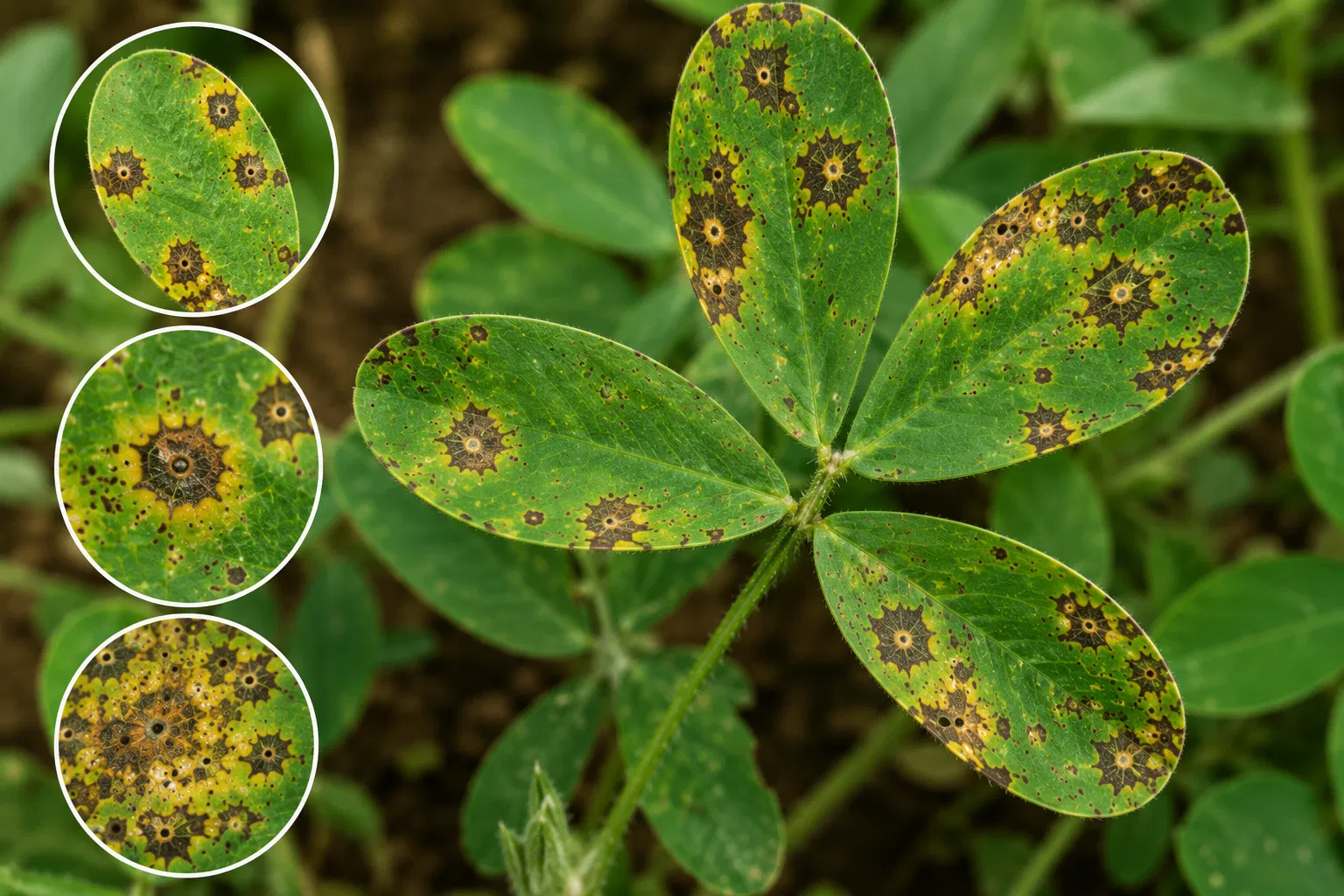
Groundnut growers lose a lot of leaf area to tikka leaf spot every season. It shows up as small brown or black spots ringed with yellow, and within days it can spread across the whole field. Left unmanaged, it can cut yields by 20-50%, especially in humid weather with dense crop growth. Because the fungus survives in old crop residue, spraying on time and rotating fungicide groups protects pod filling and final yield. Here's what works:
1. Mancozeb 75% WP
Mancozeb is a trusted contact fungicide that has protected groundnut crops from tikka leaf spot for decades. It forms a protective film on the leaf surface that stops fungal spores from germinating before they can infect the plant. Since it works only on contact, it is best used preventively or at the very first sign of infection, and pairs well in rotation with systemic fungicides.
Product Recommendations
2. Hexaconazole 5% EC
Hexaconazole is a systemic triazole fungicide that moves inside the plant tissue, giving groundnut both curative and protective action against tikka leaf spot. It works by blocking a key step in fungal cell-wall formation, which helps stop the disease from spreading even after infection has begun, while also keeping the foliage looking greener for longer.
Product Recommendations
3. Tebuconazole 25.9% EC
Tebuconazole is another widely used triazole fungicide that offers strong, long-lasting control of tikka leaf spot and rust in groundnut. Being systemic, it is absorbed quickly into the leaves, so it keeps working even if rain falls a few hours after spraying, and it also gives the crop a visible greening effect.
Product Recommendations
4. Tebuconazole 10% + Sulphur 65% WG
This combination brings together the systemic strength of tebuconazole with the broad contact action of sulphur, making it especially useful where tikka leaf spot and mite pressure occur together. The sulphur component also acts as a secondary miticide and supplies plant-available sulphur, supporting healthier, greener foliage overall.
Product Recommendations
5. Metiram 70% WG
Metiram belongs to the same dithiocarbamate family as mancozeb and works as a broad-spectrum contact fungicide with multi-site activity, which makes resistance build-up unlikely. It forms a protective barrier on the leaves and also supplies zinc to the crop, supporting overall plant health alongside disease control.
Product Recommendations
6. Tebuconazole 38.39% w/w SC
This concentrated tebuconazole formulation offers preventive, curative, and eradicative action against tikka leaf spot, so it can help even after the disease has already appeared. Its liquid SC formulation mixes easily in the spray tank and spreads evenly across the leaf canopy for better coverage.
Product Recommendations
7. Sulphur 80% WP
Sulphur is one of the oldest and most economical fungicides used against tikka leaf spot. It works purely on contact, releasing vapour that stops fungal spores from germinating, and has the added benefit of controlling mites while correcting sulphur deficiency in the crop.
Product Recommendations
8. Thiophanate-methyl 41.7% SC
Thiophanate-methyl is a systemic fungicide that disrupts fungal cell division, giving groundnut crops both preventive and curative protection against tikka leaf spot. Its liquid SC formulation dissolves quickly and evenly in water, giving reliable, long-lasting coverage across the crop.
Product Recommendations
9. Pseudomonas fluorescens 1% WP
Pseudomonas fluorescens is a naturally occurring beneficial bacterium that colonises the root zone and leaf surface, crowding out disease-causing fungi and triggering the plant's own defence response. It is registered for late leaf spot in groundnut as a seed and soil treatment, making it a good fit for growers who want to start disease protection early and reduce chemical spray load through the season.
Product Recommendations
Note: Rotating between these fungicide groups through the season is the most reliable way to keep tikka leaf spot under control while delaying resistance build-up in the pathogen. This includes contact sprays like mancozeb, metiram and sulphur, systemic tebuconazole and hexaconazole-based sprays, and a Pseudomonas fluorescens bio-fungicide used early in the season.
Disclaimer: Always confirm current label registration, approved dosage, water volume, and pre-harvest interval (PHI) for your state before using any product, since labels are periodically revised by regulatory authorities.
This guide is a general advisory. Do your own research and verification before using any product. Always confirm suitability for your crop stage, region, and field conditions before making any purchase, spray, or crop-management decision.