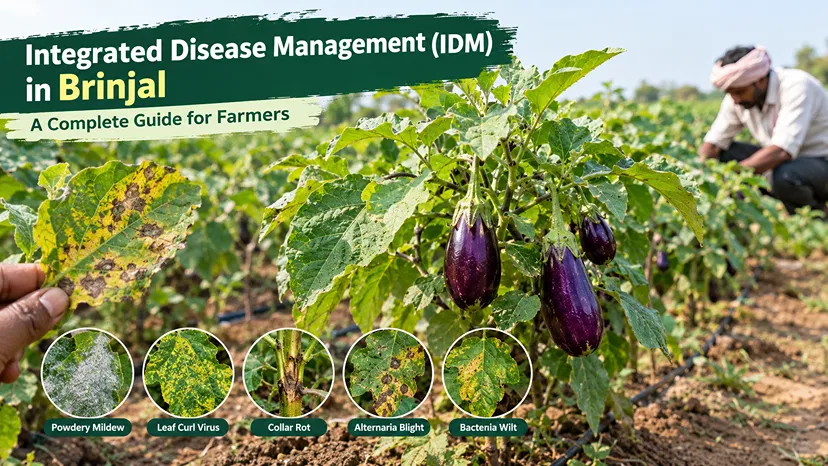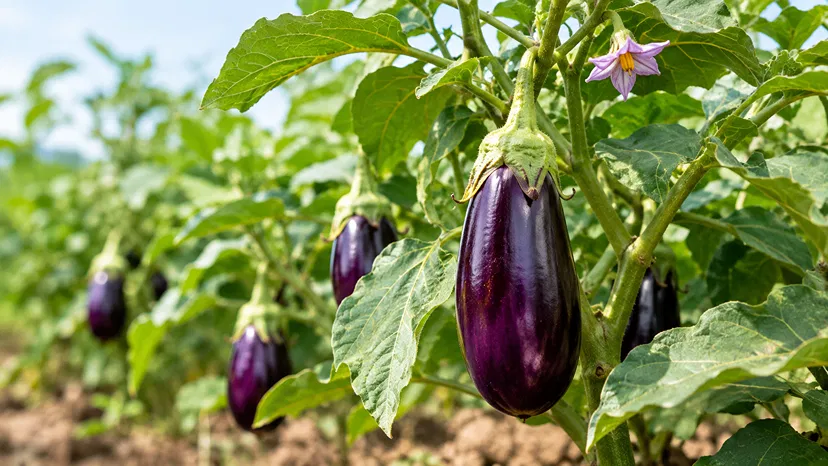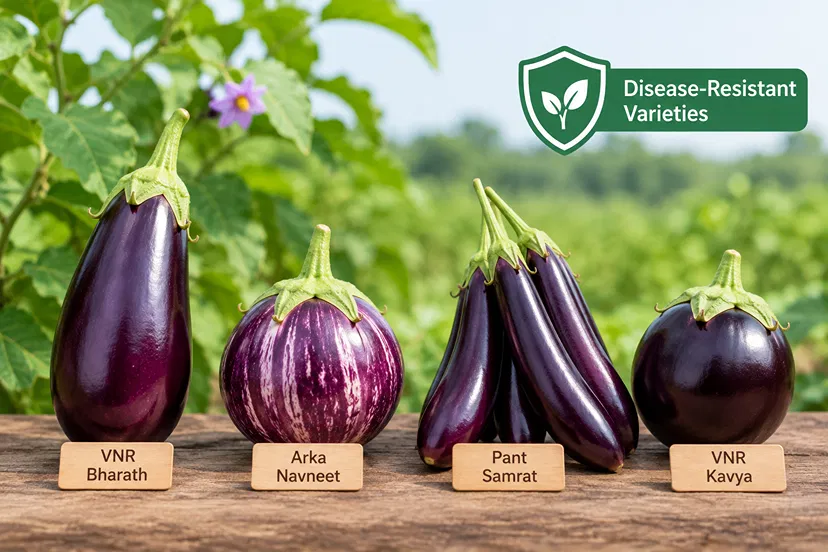
Brinjal (Solanum melongena) is one of India's most dependable vegetable crops grown across kharif, rabi and summer seasons, harvested in repeated pickings over several months, and sold in almost every local mandi. That long, multi-harvest life in the field is also what makes it vulnerable. Soil-borne fungi build up when brinjal or other solanaceous crops are planted back-to-back in the same plot, while humid weather and a dense canopy give leaf and fruit pathogens an easy foothold.
The damage rarely looks serious at first a few collapsed seedlings in the nursery, one drooping plant at the end of a row, some spotted leaves. Left unchecked, the same problems can empty a nursery bed, thin out the field stand, or turn a heavy flush of fruit into produce no trader will buy.
This guide covers the 5 brinjal diseases every farmer should be able to recognise, the field symptoms that set each one apart, and the solutions recommended for managing them.
1. Damping-off (Pythium aphanidermatum, Rhizoctonia solani, Phytophthora spp.)
Damping-off strikes brinjal before the crop ever reaches the main field. It rots seeds in the soil before they emerge, or kills young seedlings within days of sprouting — and in wet, crowded nursery beds it can wipe out whole patches of seedlings in a very short time.
How to Spot It
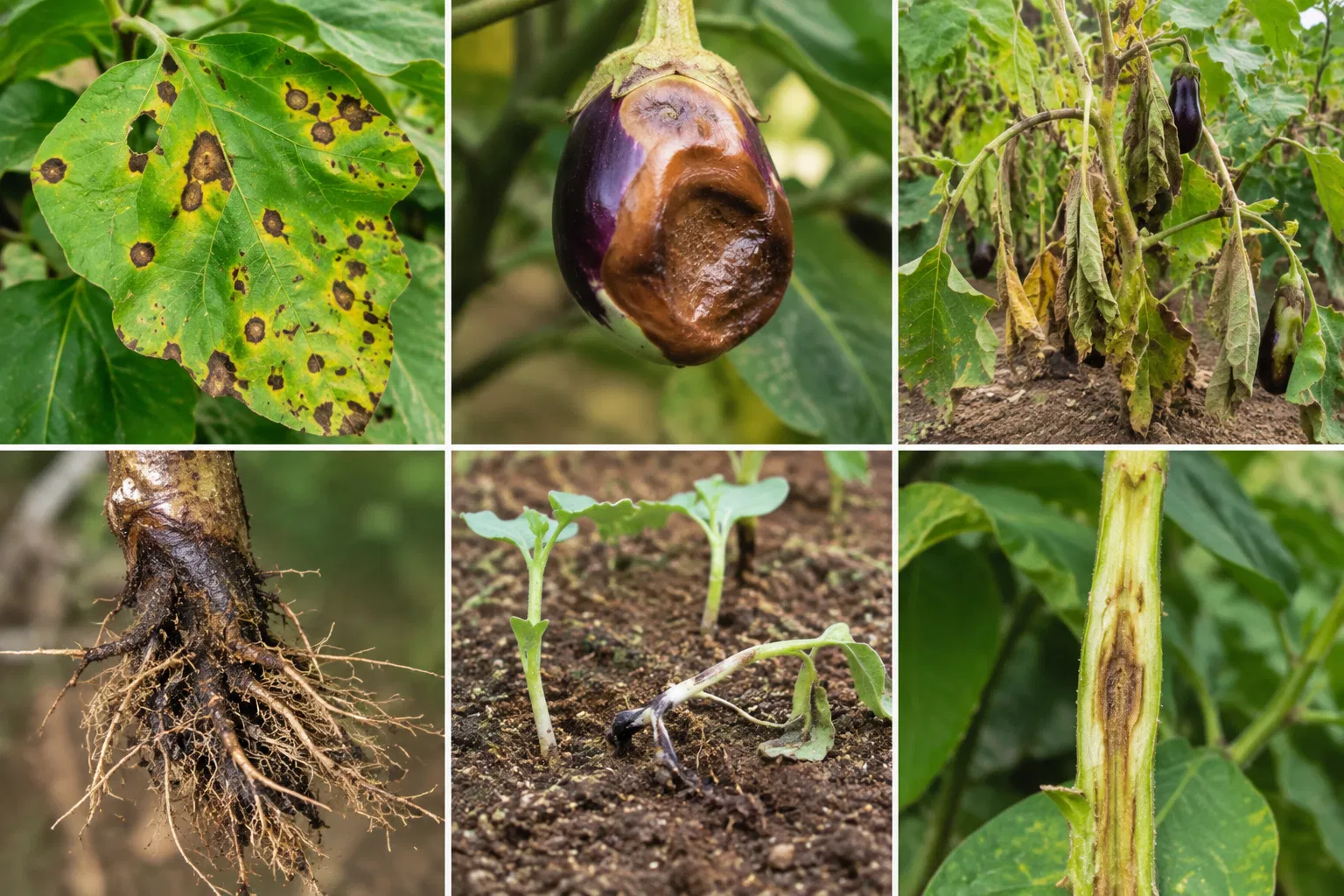
Seeds that fail to come up in patches; seedlings with a soft, water-soaked, shrunken stem at soil level that topple over and wither; losses that spread outward in circular patches and are worst in poorly drained, overwatered or densely sown beds.
Solutions to Manage It
| Product | Active Ingredient |
|---|---|
| IPL Sanjeevni Bio Fungicide | Trichoderma viride 1.0% WP |
2. Root Rot (Rhizoctonia solani, Sclerotium rolfsii)
Root rot works out of sight, decaying the root system and stem base of transplanted brinjal. Once the roots can no longer draw up water and nutrients, affected plants stall, turn pale and eventually die — often in scattered patches that grow larger after heavy irrigation or rain.
How to Spot It
Plants that stay stunted and yellowish despite good nutrition; brown-to-black rotting roots whose outer skin peels away easily; a dark, sunken lesion at the collar, sometimes covered with white cottony fungal growth and tiny mustard-seed-like brown bodies at the soil line; affected plants come out of the soil with very little pull.
Solutions to Manage It
| Product | Active Ingredient |
|---|---|
| IPL Sanjeevni Bio Fungicide | Trichoderma viride 1.0% WP |
3. Wilt (Fusarium oxysporum f. sp. melongenae)
Wilt is a vascular disease — the fungus enters through the roots and blocks the plant's internal water-conducting tissue. Infected plants lose vigour, flower and fruit poorly, and finally collapse, and once a field is infested the fungus can survive in the soil for several years.
How to Spot It
Lower leaves yellow first, often on one side of the plant or on a single branch; leaves droop in the hottest part of the day and recover by evening at first, then stay wilted for good; splitting the stem near the base reveals brown streaks running through the inner woody tissue.
Solutions to Manage It
| Product | Active Ingredient |
|---|---|
| Multiplex Nisarga Bio Fungicide | Trichoderma viride 1.5% WP |
| IPL Sanjeevni Bio Fungicide | Trichoderma viride 1.0% WP |
4. Leaf Spot (Cercospora melongenae, Alternaria melongenae)
Leaf spots eat into the green leaf area the plant relies on to feed its fruit. In a heavy outbreak, leaves yellow and drop early, weakening the plant and cutting both the size and the number of fruits over the picking season.
How to Spot It
Cercospora leaf spot shows up as small, angular to irregular yellowish spots that turn greyish-brown in the centre; Alternaria leaf spot forms larger brown spots with distinct concentric rings in a target-board pattern, often ringed by a yellow halo. Both begin on older, lower leaves and can merge into large dead patches.
Solutions to Manage It
| Product | Active Ingredient |
|---|---|
| Bayer Nativo Fungicide | Tebuconazole 50% + Trifloxystrobin 25% WG |
| Katyayani Plantivo Fungicide | Tebuconazole 50% + Trifloxystrobin 25% WG |
| Crystal Bavistin Fungicide | Carbendazim 50% WP |
| Dhanuka Dhanustin Fungicide | Carbendazim 50% WP |
5. Fruit Rot / Phomopsis Blight (Phomopsis vexans)
Phomopsis blight is one of the most destructive diseases of brinjal because it can attack seedlings, leaves and stems — but it takes its heaviest toll on the fruit, where the rot leaves produce completely unfit for market.
How to Spot It
Pale, sunken, circular spots on the fruit that enlarge and turn soft and brown, later dotted with tiny black specks often arranged in rings; infected fruits rot, shrivel and dry into mummies on the plant; leaves carry round grey-to-brown spots with lighter centres, and dark cankers may form on the stem.
Solutions to Manage It
| Product | Active Ingredient |
|---|---|
| Crystal Bavistin Fungicide | Carbendazim 50% WP |
| Dhanuka Dhanustin Fungicide | Carbendazim 50% WP |
Disclaimer
Always confirm current label registration, approved dosage, water volume, and pre-harvest interval (PHI) for your state before using any product labels are periodically revised by regulatory authorities.
This guide is a general advisory. Do your own research and verification before using any product. Always confirm suitability for your crop stage, region, and field conditions before making any purchase, spray, or crop-management decision.