

Introduction
Yellow mosaic virus is one of the most damaging diseases in moong, also called green gram or mungbean. It is more common during Kharif and humid weather when whitefly activity increases.
The disease is mainly spread by whitefly. Once the virus enters the plant, the infected plant cannot be cured. This is why early identification and fast field action are very important.
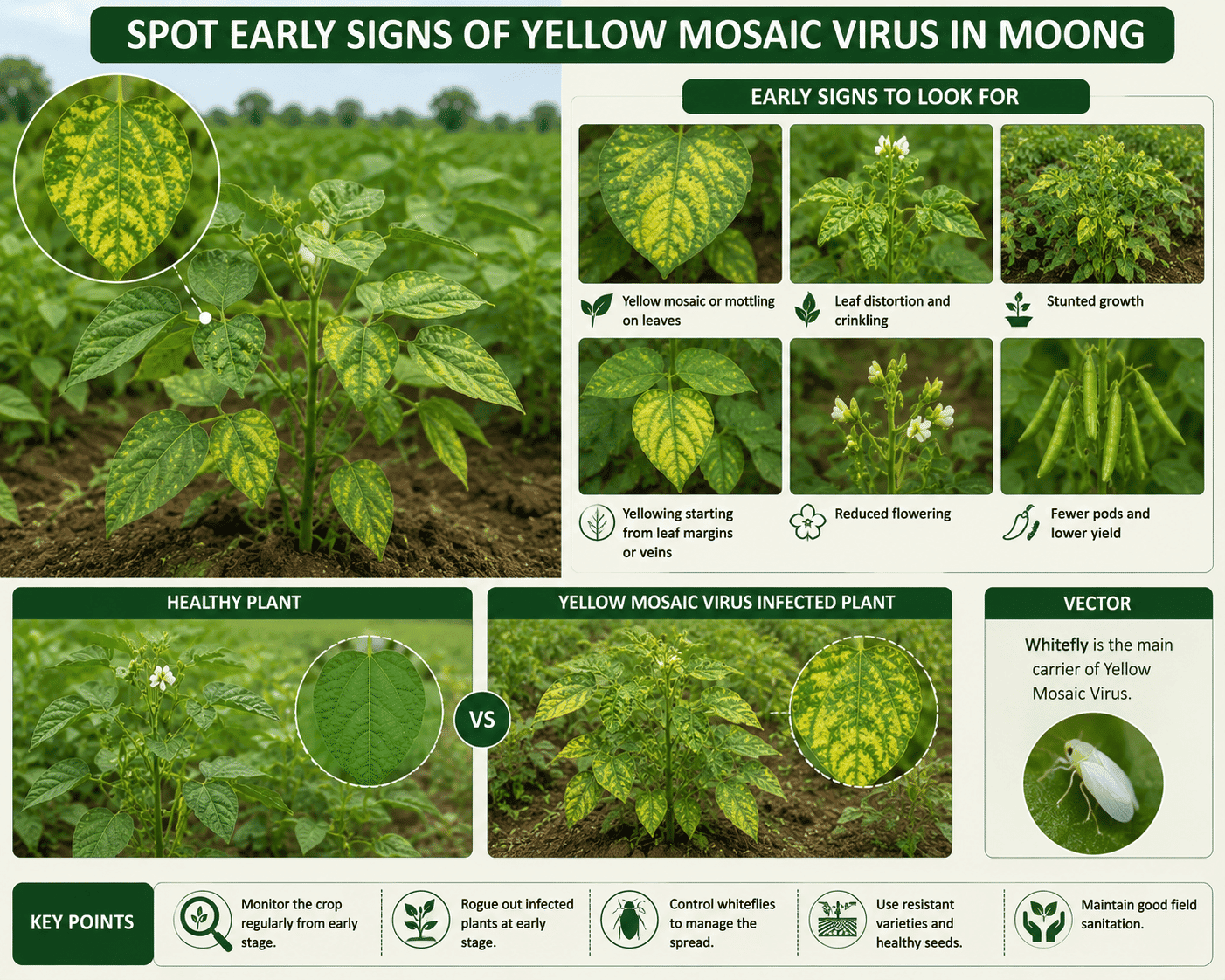
Yellow mosaic disease appears as yellow-green patches on leaves, stunted growth, poor flowering, and reduced pod formation. Scientific reviews describe yellow mosaic disease as a major constraint in mungbean production, and management mainly depends on resistant varieties, whitefly management, sanitation, and early action.
The main goal is simple: identify early symptoms, remove infected plants, control whiteflies, and protect healthy plants.
What is Yellow Mosaic Virus in Moong?
Yellow mosaic virus is a viral disease of moong. It is caused by yellow mosaic viruses such as Mungbean yellow mosaic virus and Mungbean yellow mosaic India virus.
The disease does not spread through ordinary touch like a fungal disease. It spreads mainly when whiteflies feed on an infected plant and then move to a healthy plant.
Why Yellow Mosaic Virus Spreads Fast
Yellow mosaic virus spreads fast when whitefly population is high. Weather does not directly create the virus, but it affects the whitefly population.
Risk increases when:
- Whiteflies are present in the field
- Infected plants are not removed early
- Weeds and alternate hosts are present
- Moong is grown near infected urad, soybean, cowpea, or other host crops
- Crop is sown late in a high whitefly period
- Field borders are not cleaned
- Farmers spray without checking pest stage
- Same pulse crop is grown repeatedly in the area
Research on yellow mosaic disease notes that weather factors mainly influence whitefly population, and whitefly is the important vector for disease spread.
Early Signs of Yellow Mosaic Virus in Moong
Early detection is the most important step. Check the crop from seedling stage to flowering stage.
1. Small Yellow Specks on Young Leaves
At the early stage, small yellow dots or specks may appear on leaves. These spots may look minor in the beginning.
Do not ignore yellow specks if whiteflies are also present in the field.
2. Yellow-Green Mosaic Pattern
As the disease develops, leaves show a yellow and green patchy pattern. This is the main symptom of yellow mosaic disease.
Field signs
- Irregular yellow patches
- Green areas remaining between yellow patches
- Mosaic pattern on leaves
- Symptoms more visible on young leaves
- Patchy infected plants in the field
A recent review describes typical yellow mosaic disease symptoms in mungbean as bright yellow-to-green patches with stunting, downward cupping, and wrinkling.
3. Leaf Curling or Cupping
Some infected plants may show leaf curling, cupping, or wrinkling.
This can be confused with sucking pest damage. Check for whiteflies, aphids, thrips, and mites before deciding.
4. Stunted Plant Growth
Virus-infected plants often remain small and weak. If infection starts early, plants may not grow normally even after pest control.
Field signs
- Short plants
- Poor branching
- Small leaves
- Weak flowering
- Poor pod formation
Early infection usually causes more loss than late infection.
5. Poor Flowering and Pod Setting
If yellow mosaic appears before flowering, the crop may show poor flowering and fewer pods.
Infected plants may produce small pods, fewer seeds, or poor grain quality.
Difference Between Yellow Mosaic Virus and Nutrient Deficiency
Yellow leaves do not always mean yellow mosaic virus. It can also happen due to nutrient deficiency, waterlogging, root rot, or herbicide injury.
|
Symptom |
Yellow Mosaic Virus |
Nutrient Deficiency |
|
Pattern on leaves |
Yellow-green mosaic patches |
More uniform yellowing |
|
Spread in field |
Often starts in patches |
May be more uniform or soil-pattern based |
|
Whitefly presence |
Often present |
Not necessary |
|
New leaves |
Continue showing mosaic |
May improve after nutrient correction |
|
Plant growth |
Stunted if infection is early |
May recover after correction |
|
Cure |
No cure inside plant |
Can improve if deficiency is corrected |
If leaves show a clear yellow-green mosaic pattern along with whitefly presence, suspect yellow mosaic virus.
Difference Between Whitefly Damage and Yellow Mosaic Virus
Whitefly itself also damages moong by sucking sap. But virus damage is different.
|
Symptom |
Whitefly Feeding Damage |
Yellow Mosaic Virus |
|
Pest seen |
Whiteflies on leaf underside |
Whiteflies may or may not be visible at checking time |
|
Leaf symptom |
Curling, yellowing, honeydew |
Yellow-green mosaic pattern |
|
Sooty mould |
May appear due to honeydew |
Not the main symptom |
|
Plant recovery |
May recover after whitefly control |
Infected plant does not become normal |
|
Main action |
Control whitefly |
Remove infected plants and control whitefly |
Both problems can appear together. That is why regular scouting is needed.
Crop Stage Most at Risk
Moong can be infected at any stage, but early infection causes more damage.
High-risk stages include:
- Seedling stage
- Early vegetative stage
- Branching stage
- Pre-flowering stage
- Flowering stage
If plants are infected in the early stage, they often remain stunted and give poor yield. Late infection may cause less damage if the crop has already formed many pods.
Step-by-Step Action Plan to Stop Spread Fast
1. Start Scouting Early
Start checking the crop from 7–10 days after germination. Do not wait for heavy yellowing.
Walk in a zig-zag pattern and check different parts of the field.
Check:
- Young leaves
- Underside of leaves
- Field borders
- Weed patches
- Low-lying areas
- Plants near old pulse or vegetable crops
Early scouting helps find both whiteflies and first infected plants.
2. Check the Underside of Leaves for Whiteflies
Whiteflies are usually found on the underside of leaves. Adults fly when disturbed, while nymphs remain attached to the leaf surface.
How to check
- Turn the leaf gently
- Look for tiny white insects
- Check for small yellowish nymphs
- Tap the plant lightly and observe flying insects
- Check sticky honeydew or black sooty mould
3. Remove Early Infected Plants
This is the most important step when infection is still low.
Remove plants showing clear yellow mosaic symptoms, especially if they are stunted and infected early.
Correct removal method
- Uproot infected plants carefully
- Collect them in a bag or basket
- Destroy them away from the field
- Do not leave them on bunds
- Do not throw infected plants in irrigation channels
Removed plants should not remain near the crop because whiteflies can continue spreading the virus from them.
4. Manage Whiteflies Quickly
Whitefly control helps protect healthy plants. It does not cure already infected plants.
Use integrated management first:
- Remove infected plants
- Remove weeds and alternate hosts
- Use yellow sticky traps where suitable
- Avoid excess nitrogen
- Avoid unnecessary pesticide sprays
- Protect natural enemies
- Use need-based insecticide only as per local advisory
For chemical control, use only recommended and registered insecticides as advised by the local agriculture department, KVK, or state agriculture university. Follow label dose, water volume, spray interval, and waiting period.
5. Use Yellow Sticky Traps for Monitoring
Yellow sticky traps help monitor whitefly movement in the field. They can also reduce some adult whiteflies when used properly.
Place traps slightly above the crop canopy and check them regularly. Replace traps when they are full of insects or dust.
Sticky traps are useful, but they are not enough alone. Combine them with field scouting and vector management.
6. Remove Weeds and Alternate Hosts
Weeds can support whiteflies and virus sources. During Kharif, weeds grow fast, so field sanitation is important.
Remove:
- Weeds on bunds
- Weeds near irrigation channels
- Volunteer pulse plants
- Old infected crop plants
- Unwanted host plants near the field
Clean cultivation helps reduce whitefly shelter and disease spread.
7. Avoid Excess Nitrogen
Excess nitrogen can create soft growth, which attracts sucking pests like whiteflies.
Apply fertilizers as per soil test or local recommendation. Avoid heavy urea application during whitefly activity.
Balanced crop nutrition helps the plant remain stronger, but it cannot cure virus-infected plants.
8. Protect Natural Enemies
Natural enemies such as ladybird beetles, lacewings, spiders, and parasitoids help reduce whitefly and other sucking pests.
Avoid repeated broad-spectrum insecticide sprays. Unnecessary sprays can kill beneficial insects and cause pest resurgence.
Use chemical control only when pest level is increasing and local advisory recommends it.
9. Spray Only When Needed
Do not spray only because some leaves are yellow. First identify whether the problem is virus, whitefly damage, nutrient deficiency, or root stress.
If whitefly population is active and increasing, take need-based control as per local recommendation.
Spray precautions:
- Use clean water
- Cover underside of leaves
- Spray during morning or evening
- Avoid spraying before rainfall
- Avoid spraying during strong wind
- Do not mix many products together
- Do not repeat the same chemical group again and again
Proper coverage is important because whiteflies stay under the leaves.
10. Monitor Again After 3–5 Days
After removing infected plants and managing whiteflies, revisit the field.
Check:
- New infected plants
- Whitefly population
- Fresh mosaic symptoms
- Weed growth
- Crop recovery
- Pest movement from nearby fields
If new infected plants appear, remove them early and continue monitoring.
What to Do When First Yellow Mosaic Plant is Seen
Use this quick field plan:
|
Field Observation |
Action |
|
One or few plants with yellow mosaic |
Remove and destroy immediately |
|
Whiteflies seen under leaves |
Start vector management |
|
Many weeds on bunds |
Clean bunds and field borders |
|
Yellowing without mosaic |
Check nutrient, root, and water condition |
|
Infection near field border |
Check nearby host crops and weeds |
|
Rapid spread in young crop |
Contact local agriculture officer or KVK |
|
Severe infection in early crop |
Assess plant stand and economic recovery |
Fast removal is most useful when infection is still at the beginning.
Management During Kharif Season
Kharif moong needs more attention because whitefly activity and weed growth may increase.
Important practices
- Scout twice a week
- Check underside of leaves
- Remove infected plants early
- Keep field borders clean
- Use yellow sticky traps
- Avoid excess nitrogen
- Maintain drainage after heavy rain
- Protect natural enemies
- Use need-based insecticide only
- Avoid late action after heavy spread
Rain may reduce some adult whiteflies for a short time, but it does not remove the virus from infected plants.
Preventive Measures Before Sowing
Prevention is better than late control because yellow mosaic virus has no cure after infection.
1. Use Resistant or Tolerant Varieties
In areas where yellow mosaic appears every season, choose locally recommended resistant or tolerant varieties.
Scientific reviews highlight resistant varieties as one of the most important management options for yellow mosaic disease in mungbean.
2. Select the Right Sowing Time
Avoid very late sowing if it increases exposure to high whitefly pressure in your area.
Follow the recommended sowing window for your state and season.
3. Keep the Field Clean Before Sowing
Remove weeds and old host plants before sowing. Whiteflies can survive on nearby vegetation and move into the new crop.
4. Follow Crop Rotation
Avoid repeated moong or other susceptible pulse crops in the same field if yellow mosaic is a regular problem.
Rotate with non-host crops such as cereals where suitable and locally recommended.
5. Avoid Nearby Infected Host Crops
If possible, avoid sowing moong close to old infected urad, soybean, cowpea, or other whitefly-host crops.
Nearby infected crops can act as virus and whitefly sources.
Common Mistakes to Avoid
- Waiting until many plants turn yellow
- Spraying repeatedly on virus-infected plants
- Not removing infected plants
- Checking only upper leaf surface
- Ignoring whiteflies under the leaves
- Leaving weeds on bunds
- Applying excess nitrogen
- Using unlabelled insecticides
- Mixing many pesticides together
- Not using resistant varieties in disease-prone areas
- Confusing nutrient deficiency with yellow mosaic virus
Spray alone cannot stop yellow mosaic if infected plants and whiteflies remain in the field.
Can Moong Recover from Yellow Mosaic Virus?
Virus-infected plants usually do not become fully normal. If infection happens early, the plant remains stunted and gives poor yield.
The crop may still give some yield if:
- Infection is late
- Few plants are affected
- Whitefly is controlled early
- Healthy plants are protected
- Crop has good nutrition and moisture
But severely infected early-stage plants should be removed to protect the remaining crop.
Safety Precautions During Spray
- Wear gloves, mask, full-sleeve shirt, and long pants
- Do not eat, drink, or smoke during spraying
- Avoid spray drift to nearby crops and water bodies
- Keep children and animals away from sprayed fields
- Wash hands, face, and sprayer after use
- Follow label waiting period before harvest
- Store pesticides safely away from food, seed, and animal feed
Safe spray practice is important in short-duration crops like moong.
Conclusion
Yellow mosaic virus in moong should be managed at the earliest stage. The key signs are yellow specks, yellow-green mosaic patches, leaf cupping, stunting, and poor flowering.
Since infected plants cannot be cured, the fastest action is to remove infected plants, manage whiteflies, clean weeds, use yellow sticky traps, avoid excess nitrogen, and protect healthy plants.