Introduction
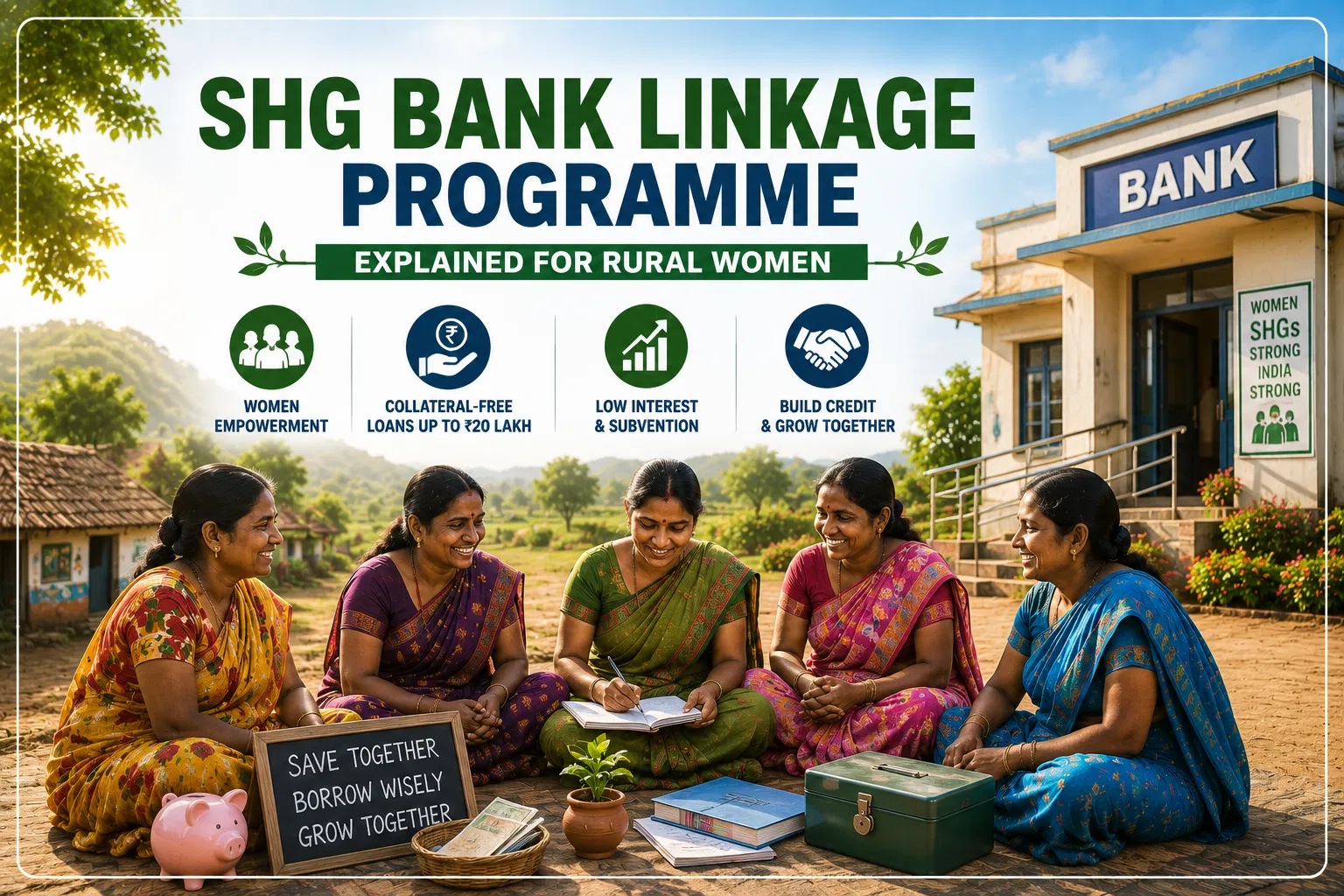
The Self-Help Group Bank Linkage Programme (SHG-BLP) is arguably NABARD's most consequential contribution to rural India — a simple idea, piloted in 1986-87 and formally launched in 1992, that connects informal savings groups of rural women directly to the banking system without requiring collateral. Rather than each woman borrowing individually, a group of typically 10-20 women saves together, lends internally, and builds a credit history that a bank can then recognise and extend with a loan. As of late 2023, cumulative bank loans to SHGs under this programme had crossed ₹7.68 lakh crore, reaching well over 10 crore rural families — making it one of the largest microfinance movements in the world.
SHG-Bank Linkage Programme Overview
- Launched — 1992, by NABARD in collaboration with the Reserve Bank of India and commercial banks, following pilot projects from 1986-87
- Collateral-Free Loan Ceiling — Enhanced by RBI from ₹10 lakh to ₹20 lakh for Women SHGs under DAY-NRLM (August 2021); no collateral or margin on loans up to ₹10 lakh, no collateral (with CGFMU cover) up to ₹20 lakh
- Interest Subvention — 7% effective rate on loans up to ₹3 lakh for Women SHGs under DAY-NRLM, with an additional 3% subvention for prompt repayment in 250 identified districts, bringing the effective rate to 4%
- Loan-to-Savings Ratio — Typically 1:1 to 1:4 of group savings, extendable further at the bank's discretion for well-performing groups
- Nodal Mission — Deendayal Antyodaya Yojana – National Rural Livelihoods Mission (DAY-NRLM), Ministry of Rural Development, with NABARD as key financial architect
- Digital Backbone — NABARD's e-Shakti initiative digitises SHG bookkeeping and credit history for faster, more transparent bank assessment
Objectives of the SHG-Bank Linkage Programme
- Give rural women access to formal, collateral-free credit that was historically unavailable to them individually.
- Build financial discipline and credit history through regular group savings, internal lending, and structured repayment.
- Reduce dependence on informal moneylenders charging exploitative interest rates.
- Strengthen women's economic participation and decision-making within the household and community.
- Create a scalable, low-default microfinance model that mainstream banks are willing to lend into at normal interest rates.
How the Programme Works
- A group of rural women (commonly 10-20 members) forms a Self-Help Group, often facilitated by an NGO or Self-Help Promoting Institution (SHPI), and begins regular savings and internal lending among members.
- After a track record of at least 6 months — following the ""Panchasutras"": regular meetings, regular savings, regular inter-lending, timely repayment, and up-to-date books — the group opens a savings account and becomes eligible for bank credit linkage.
- Banks assess the group's savings discipline, meeting regularity, and internal fund rotation before sanctioning a loan, typically starting at a multiple of the group's own savings (1:1 up to 1:4, sometimes higher for mature groups).
- Loan repayment performance over successive cycles allows the group to graduate to larger loan amounts, up to the collateral-free ceiling of ₹20 lakh.
- NABARD supports the ecosystem through refinance to banks, Village Level Programmes connecting SHGs, SHPIs, and banks, and digitisation of SHG records via e-Shakti.
Benefits to Rural Women
- Genuinely collateral-free credit up to ₹20 lakh, removing the single biggest obstacle women without property in their own name typically face.
- A significantly subsidised effective interest rate — as low as 4% in the most distressed 250 districts for loans up to ₹3 lakh with prompt repayment.
- A structured path to build credit history collectively, which individual women without prior bank relationships could rarely establish alone.
- Evidence from an independent 2019 impact evaluation found a 19% income boost and a 28% increase in household savings for DAY-NRLM participants across nine states.
- Beyond credit, participation builds financial literacy, negotiating confidence, and social capital that extends well beyond the loan itself.
Limitations to Understand
- The programme is specifically structured for group lending — an individual woman cannot access SHG-BLP terms outside a functioning, bank-linked group.
- Groups need a genuine 6-month track record of regular savings and internal lending before becoming credit-linked; a newly formed group cannot access a bank loan immediately.
- The enhanced ₹20 lakh collateral-free ceiling and interest subvention specifically target Women SHGs under DAY-NRLM in rural areas — terms can differ for SHGs outside this specific framework.
- Loan sizing still depends on the bank's assessment of the group's savings, repayment discipline, and fund management — it isn't an automatic entitlement regardless of group performance.
- Success depends heavily on the quality of the promoting NGO/SHPI and the group's own internal governance; poorly managed groups can struggle to graduate to larger credit lines.
Documents and Process to Get Started
- Identity and address proof (Aadhaar) for each member, and a resolution documenting the group's formation and office bearers.
- A savings bank account opened in the group's name, typically facilitated by the promoting NGO/SHPI or the local bank branch.
- Minutes book and passbook recording regular meetings, savings, and internal loan transactions — the primary basis on which a bank assesses credit-worthiness.
- Bank loan application, submitted once the group has a demonstrated savings and internal-lending track record.
How to Join or Form an SHG
- Connect with the local Self-Help Promoting Institution, NGO, or the state Rural Livelihoods Mission (SRLM) office active in the area for guidance on forming a new group.
- Begin regular group savings and internal lending, maintaining meeting minutes and financial records from day one.
- After roughly 6 months of consistent activity, approach the group's bank branch (often the same branch where the savings account is held) for credit linkage assessment.
- On sanction, use the loan for income-generating activities as planned by the group, and maintain timely repayment to support future credit graduation.
- Bank Sakhis — trained SHG members acting as local intermediaries — and Financial Literacy Community Resource Persons are often available to help with transactions and applications.
Conclusion
The SHG-Bank Linkage Programme has quietly become one of the most effective financial inclusion tools for rural women in India, precisely because it works with how rural communities already organise themselves rather than against it. For a woman without collateral or a prior banking relationship, joining or forming a well-run SHG is often the most realistic path to formal credit — and with the collateral-free ceiling now at ₹20 lakh and meaningful interest subvention in place, the programme has genuine room to fund real income-generating activity, not just token microloans.
Disclaimer: Loan ceilings, interest subvention rates, and eligibility criteria under DAY-NRLM and the SHG-Bank Linkage Programme are subject to periodic revision by RBI, NABARD, and the Ministry of Rural Development. Readers are advised to verify current details with the local SRLM office, NABARD (nabard.org), or their nearest bank branch before forming a group or applying for credit.
"