Introduction
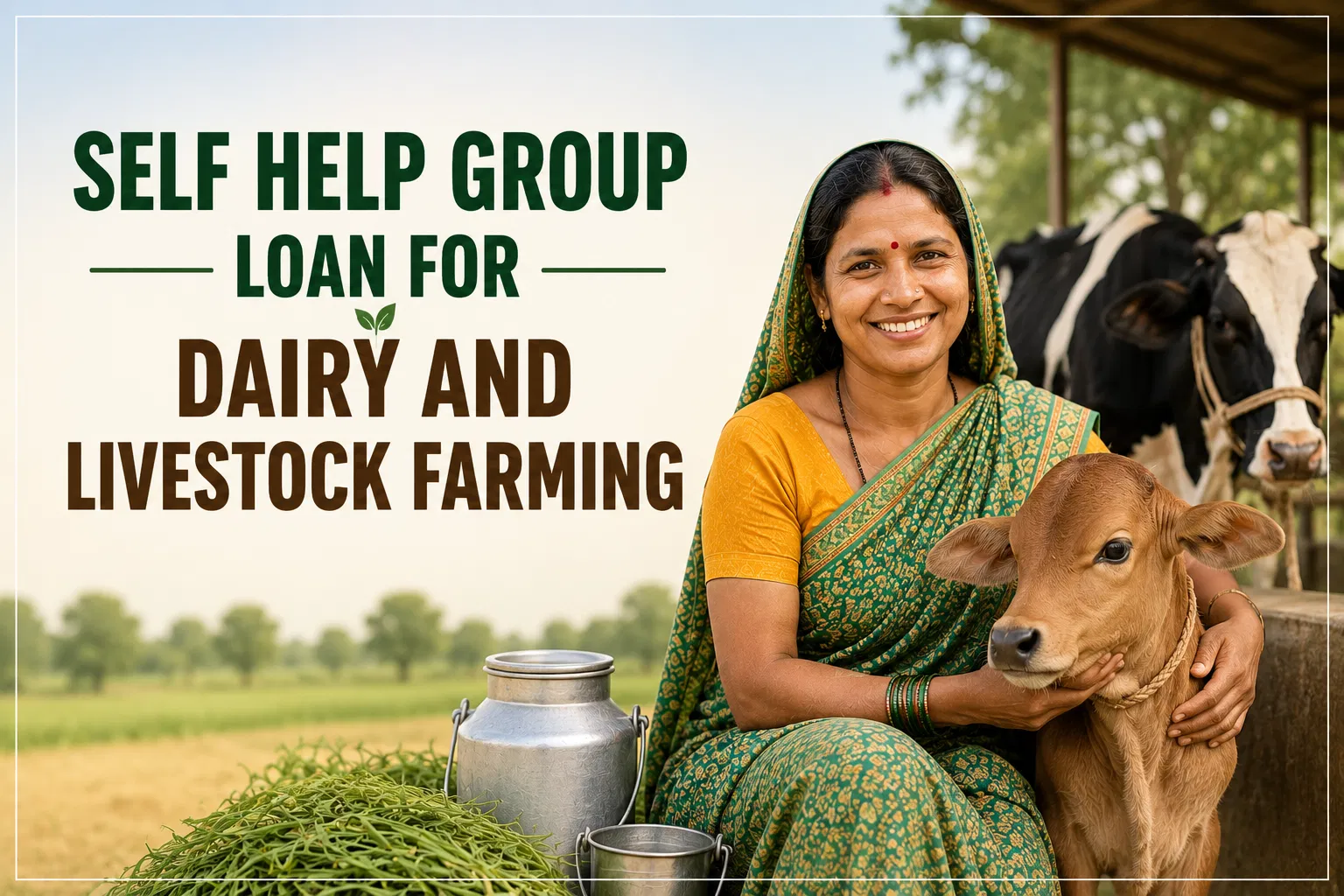
Dairy and livestock are, by a wide margin, the most common individual enterprise funded through Self-Help Group loans in rural India — and for good reason. Unlike crop farming, which is seasonal and often tied to land a woman doesn't own, livestock provides steady daily income and can be managed on a small homestead plot. What's changed in recent years is that this isn't just informal group lending anymore: a formal convergence between the Department of Animal Husbandry and Dairying (DAHD) and the National Rural Livelihoods Mission (NRLM), through the Pashu Sakhi (A-HELP) model, now channels structured veterinary support, training, and market linkage directly through the SHG platform.
SHG Dairy & Livestock Financing: Overview
- Loan Route — General SHG-Bank Linkage Programme credit line, collateral-free up to ₹20 lakh at the group level, allocated internally for individual members' dairy/livestock activities
- Pashu Sakhi / A-HELP Model — A DAHD-NRLM convergence (MoU signed September 2021) that trains an SHG member as a Community Animal Care Service Provider offering doorstep veterinary support and livestock advisory
- Interest Subvention — Standard DAY-NRLM Women SHG interest subvention applies — 7% effective rate on loans up to ₹3 lakh, down to 4% with prompt repayment in 250 identified districts
- Related Sub-Scheme — Mahila Kisan Sashaktikaran Pariyojana (MKSP), the NRLM sub-component under which the Pashu Sakhi model was originally piloted
- Complementary Institutional Models — Women Dairy Cooperative Societies (WDCS) and federated milk unions (e.g., Amul-model cooperatives) that SHG-linked dairy producers can eventually sell into
Objectives of SHG-Linked Dairy and Livestock Support
- Give rural women a steady, daily-cash-flow livelihood that doesn't depend on land ownership or seasonal cropping cycles.
- Formalise what was historically informal, unorganised livestock labour into a recognised micro-enterprise with proper credit and market access.
- Bring basic veterinary and animal health services to the doorstep in areas where formal clinical support is scarce or unaffordable.
- Build a scalable pathway from individual livestock rearing to organised women-led dairy cooperatives and milk unions.
- Strengthen household nutrition and income security through consistent milk and livestock-product income.
How SHG Loans Fund Dairy and Livestock Activity
- Purchase of milch animals — cows, buffaloes, or goats — as an individual member's income-generating activity within the group's overall bank-linked credit line.
- Construction or improvement of livestock housing, feeding troughs, and basic hygiene infrastructure at the homestead level.
- Feed, fodder, and veterinary/vaccination costs, particularly important given how directly animal health affects milk yield and income.
- Working capital to bridge the gap between animal purchase and the point at which milk or livestock income becomes steady.
- Because SHG credit is not livestock-specific, the amount and timing depend on the group's overall savings, credit cycle, and how members collectively prioritise individual needs.
The Pashu Sakhi (A-HELP) Model Explained
- Pashu Sakhi — formally called A-HELP (Accredited Agent for Health and Extension of Livestock Production) — is a trained SHG member who becomes a Community Animal Care Service Provider for her area.
- She typically already owns some livestock (commonly cited eligibility includes having reared at least 1-2 cattle, 2-3 sheep/goats, or similar) and undergoes structured training by livestock experts under the state Rural Livelihoods Mission.
- Her role includes basic animal health support, awareness building on livestock-based livelihoods, and acting as the link between rural households and the nearest veterinary aid centre.
- She is not a government employee but a Community Agriculture/Animal Care Service Provider selected by the Village Organisation/Cluster Level Federation, earning task-based income for services rendered — commonly a few hours a day, several days a week, serving up to around 100 households.
- This model, under the Rashtriya Gokul Mission and MKSP, effectively formalises what individual SHG members were already doing informally, giving both better technical support and a modest independent income stream.
Benefits to Rural Women in Dairy and Livestock
- Livestock income tends to be more stable and less seasonal than crop income, complementing a household's broader farming activity.
- The Pashu Sakhi model brings genuinely useful doorstep veterinary access to areas where clinical services were previously unavailable or unaffordable.
- Structured convergence between DAHD and NRLM means SHG-linked dairy activity increasingly connects to formal schemes — Rashtriya Gokul Mission, state dairy development programmes — rather than remaining purely informal.
- Women-led dairy cooperatives and milk unions offer SHG-linked producers an eventual path from individual livestock rearing to organised, better-priced collective marketing.
- Research comparing formal Women Dairy Cooperative structures to unorganised private milk supply chains found significantly better social participation and access to technical training for women in the formal structure.
Limitations to Understand
- SHG credit for livestock is still bounded by the group's overall savings-linked loan size — it isn't a dedicated, larger dairy infrastructure loan like AHIDF or NABARD's dairy-linked schemes.
- The Pashu Sakhi role has fairly specific eligibility (age 20-45, resident in the same Gram Panchayat, minimum educational qualification, existing livestock-rearing experience), so not every SHG member can take it up.
- Task-based Pashu Sakhi income is modest and depends on local demand for her services, not a fixed salary.
- For larger-scale dairy infrastructure — a bigger herd, milk chilling, or processing equipment — a member will typically need to graduate beyond SHG credit to a dedicated dairy loan (via Mudra, AHIDF, or a bank term loan) rather than relying on the group's general credit line alone.
How to Access This Support
- For SHG dairy/livestock credit: raise the specific need at a group meeting, since fund allocation happens through the group's own decision-making within its bank-linked credit line.
- For the Pashu Sakhi role: connect with the local Cluster Level Federation or Village Organisation under the state Rural Livelihoods Mission (SRLM) to learn about current openings and training cycles.
- For formal dairy cooperative linkage: enquire with the nearest Women Dairy Cooperative Society or state milk federation about membership and milk collection/pricing terms.
- For larger dairy infrastructure needs beyond SHG credit: consider a dedicated Mudra dairy loan or NABARD-linked AHIDF financing once the enterprise has outgrown group-level credit.
Conclusion
Dairy and livestock remain the backbone of individual income generation within India's SHG movement, and the Pashu Sakhi (A-HELP) model represents a genuine step toward formalising and professionalising that activity — bringing real veterinary support and structured training to a space that was often left to informal knowledge alone. For a woman starting out, the SHG's own credit line is usually the first, most accessible funding route; as the enterprise grows, formal dairy cooperatives and dedicated livestock loans become the natural next step.
Disclaimer: Loan ceilings, interest subvention, and Pashu Sakhi eligibility/compensation vary by state and are subject to periodic revision by NABARD, NRLM, and the Department of Animal Husbandry and Dairying. Readers are advised to verify current details with the local SRLM/state livelihoods mission office, NABARD (nabard.org), or their nearest bank branch.