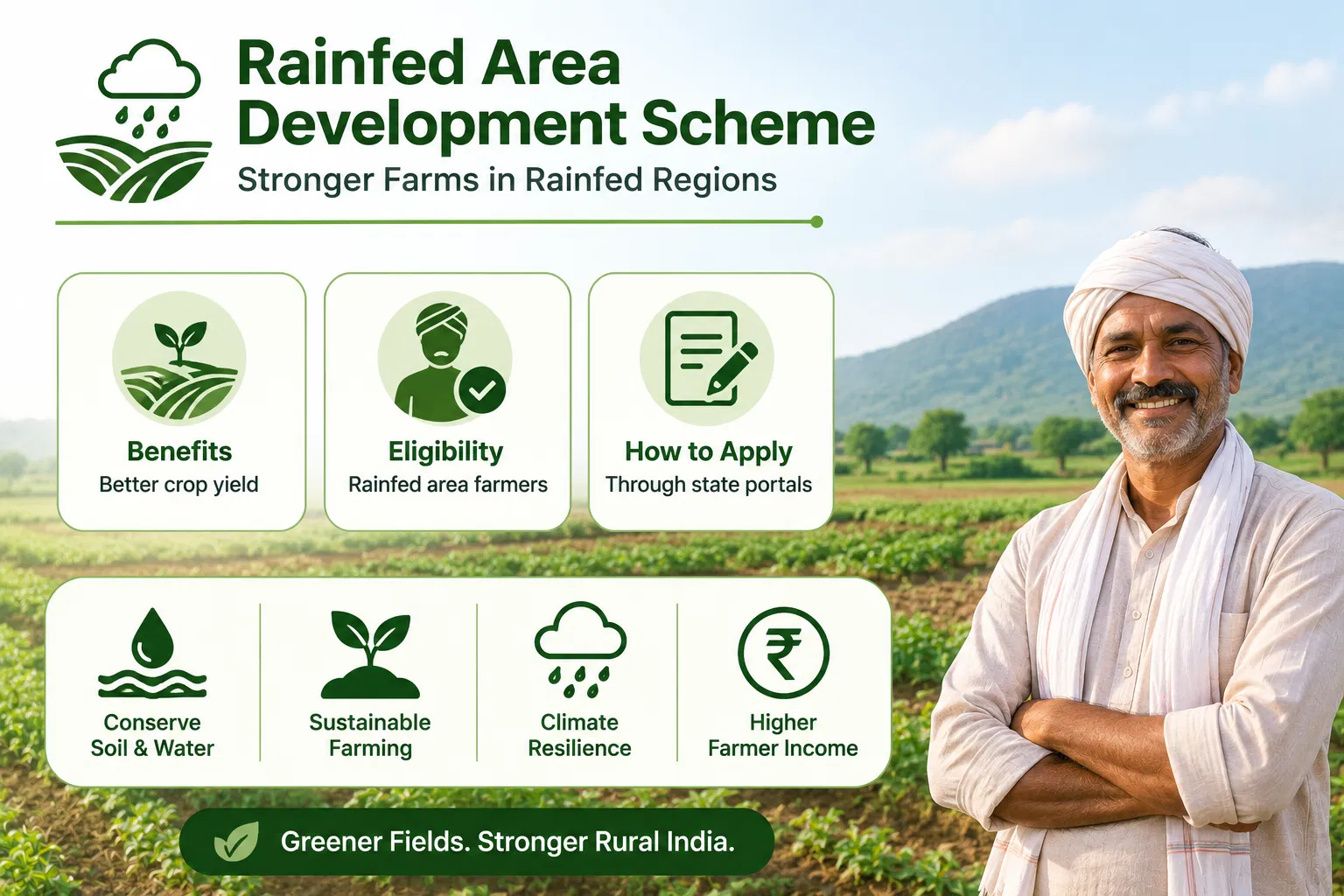
The Rainfed Area Development (RAD) scheme was launched by the Department of Agriculture, Cooperation and Farmers Welfare in 2011-12 as a sub-scheme under the Rashtriya Krishi Vikas Yojana (RKVY), and later brought under the National Mission for Sustainable Agriculture (NMSA). It was introduced because a large share of India's farmland depends entirely on rainfall rather than assured irrigation, leaving farmers in these regions far more exposed to drought, flood, and erratic weather. RAD addresses this by promoting Integrated Farming Systems (IFS) — combining crop cultivation with allied activities like horticulture, livestock, and fisheries — so farmers have multiple income sources to fall back on when the monsoon fails or a single crop underperforms.
Rainfed Area Development Scheme Overview
- Scheme Name – Rainfed Area Development (RAD), a component of the National Mission for Sustainable Agriculture (NMSA), implemented through RKVY funding channels
- Scheme Launch Date – Launched 2011-12 as a sub-scheme of RKVY; several states, including Madhya Pradesh, adopted their own RAD components from 2014-15 onward
- Scheme Fund Allocated – Funded through the RKVY Division after project approval by the State Level Sanctioning Committee (SLSC); assistance amount varies by state and scheme component (for example, Madhya Pradesh offers up to ₹30,000 per family for Integrated Farming System adoption)
- Type of Scheme – Centrally Sponsored Scheme, implemented by State Agriculture Departments as the nodal agency for RKVY
- Helpline No – Kisan Call Centre, 1800-180-1551; farmers can also contact their District Agriculture Office, local Krishi Vigyan Kendra (KVK), or State Agricultural University for guidance
- States Covered – All-India, with priority given to arid, semi-arid, and sub-humid districts having less than 60% of cultivated area under irrigation (31 arid, 133 semi-arid, and 175 sub-humid districts identified); backward districts in Kerala and North-Eastern states with under 30% irrigated area are also covered
Objectives of the Scheme
- Increase agricultural productivity in rainfed areas sustainably through farming-system-based approaches
- Improve the quality of life of small and marginal farmers by maximising farm returns through Integrated Farming Systems
- Mitigate the impact of drought, flood, and other extreme weather events by diversifying income sources
- Conserve natural resources through appropriate soil and moisture conservation measures
- Build farmer and stakeholder capacity in climate change adaptation, in coordination with missions like NICRA
Key Features of the Rainfed Area Development Scheme
- Centred on Integrated Farming Systems (IFS) that combine crop cultivation with horticulture, livestock, fisheries, agro-forestry, apiculture, mushroom cultivation, and vermicomposting
- Uses an area-based, cluster approach — projects are typically proposed on clusters of 100 hectares or more for better convergence and local participation
- Leverages and converges with other schemes and missions, including MGNREGA, PMKSY-Watershed Development Component, RKVY, National Food Security Mission (NFSM), Mission for Integrated Development of Horticulture (MIDH), and NICRA
- Farmers' Companies, Registered Farmers' Societies, and Farmers' Cooperatives are eligible to develop a cluster under the scheme
- Assistance amount is generally kept uniform for all farmers, irrespective of landholding size, within a given scheme component
- Selected farmers receive a Beneficiary Card recording all assistance provided and returns from the investment
- Progress is monitored through the online RKVY progress monitoring system and a dedicated Management Information System (RDMIS)
- Comprehensive pilot blocks demonstrate rainfed technologies and coordination with flagship programmes like the Accelerated Irrigation Benefit Programme (AIBP)
RAD Scheme Eligibility
- Farmers cultivating land in identified rainfed districts — prioritising arid, semi-arid, and sub-humid agro-ecosystems with low irrigation coverage
- Land should have sustainable rainfed farming potential
- Small and marginal farmers are given particular focus, though many state components extend eligibility to all farmers in covered rainfed areas
- Farmers' Companies, Registered Farmers' Societies, and Cooperatives can apply to develop and manage a cluster project
- Farmers already benefiting from related schemes like PMKSY-WDC may still receive supplementary, gap-filling support under RAD
Benefits to Farmers
- Financial assistance for adopting Integrated Farming System components — crop, horticulture, livestock, fishery, and agro-forestry combined
- Diversified income sources that cushion farmers when a single crop fails due to drought or erratic rainfall
- Better resource conservation through soil and moisture conservation measures suited to rainfed conditions
- Access to climate-resilient farming technologies developed under research initiatives like AICRPDA-NICRA
- Credit support to help meet any balance funding required for adopting the integrated system
- Convergence with other schemes means farmers can often combine RAD support with irrigation, insurance, and credit benefits from related programmes
Limitations of the Scheme
- Benefit amounts and specific components vary significantly by state, since implementation is state-led under the RKVY framework
- Priority is given to identified rainfed districts, so farmers outside the notified arid, semi-arid, or sub-humid zones may not be covered
- Cluster-based projects (often 100 hectares or more) mean individual farmers typically need to be part of a larger group or society application, not a standalone one
- Because the scheme converges with multiple other missions, the actual benefit a farmer receives can depend on how well those linked programmes are functioning locally
- Approval depends on the State Level Sanctioning Committee, which can add processing time before funds are released
Documents Required
- Aadhaar Card
- Land ownership or cultivation proof for the rainfed land in question
- Bank account passbook
- Passport-size photograph
- Registration proof, if applying through a Farmers' Company, Society, or Cooperative
How to Apply for the Rainfed Area Development Scheme
- Check with your District Agriculture Office or local Krishi Vigyan Kendra (KVK) whether your area falls under a notified rainfed district for RAD coverage.
- Connect with a Farmers' Company, Registered Farmers' Society, or Cooperative in your area, since cluster-based projects are typically proposed collectively.
- Submit the required documents — Aadhaar, land proof, bank passbook, and photograph — along with the cluster or individual application as guided by your State Agriculture Department.
- The project proposal is reviewed and approved by the State Level Sanctioning Committee (SLSC) under the RKVY framework.
- On approval, funds are released through the RKVY Division as per the scheme's funding pattern.
- Approved beneficiaries receive a Beneficiary Card recording the assistance provided, and progress is tracked through the RKVY monitoring system.
Conclusion
For farmers in India's drought-prone and rain-dependent regions, the Rainfed Area Development scheme offers a practical way to reduce risk by not depending on a single crop or a single season. By supporting Integrated Farming Systems that blend crops with livestock, horticulture, and allied activities, RAD helps stabilise farm income even when the rains are unpredictable. Farmers in eligible districts should reach out to their local agriculture office or a registered farmers' society to explore how this scheme can support a more resilient, diversified farming model.
Disclaimer: This article is for informational purposes only. Scheme details, interest rates, and subvention amounts are subject to periodic revision by the Government of India, RBI, and NABARD. Farmers are advised to verify the latest terms and eligibility criteria with their bank, NABARD, or official government sources before applying.