Choosing between a power tiller and a tractor can shape your farm’s productivity, operating costs, and long-term efficiency. The right machine depends on your land size, crop type, soil conditions, and budget. If you are comparing a power tiller vs tractor, the best choice is the one that matches your farm’s actual workload—not just the bigger machine.
Power Tiller vs Tractor: The Core Difference
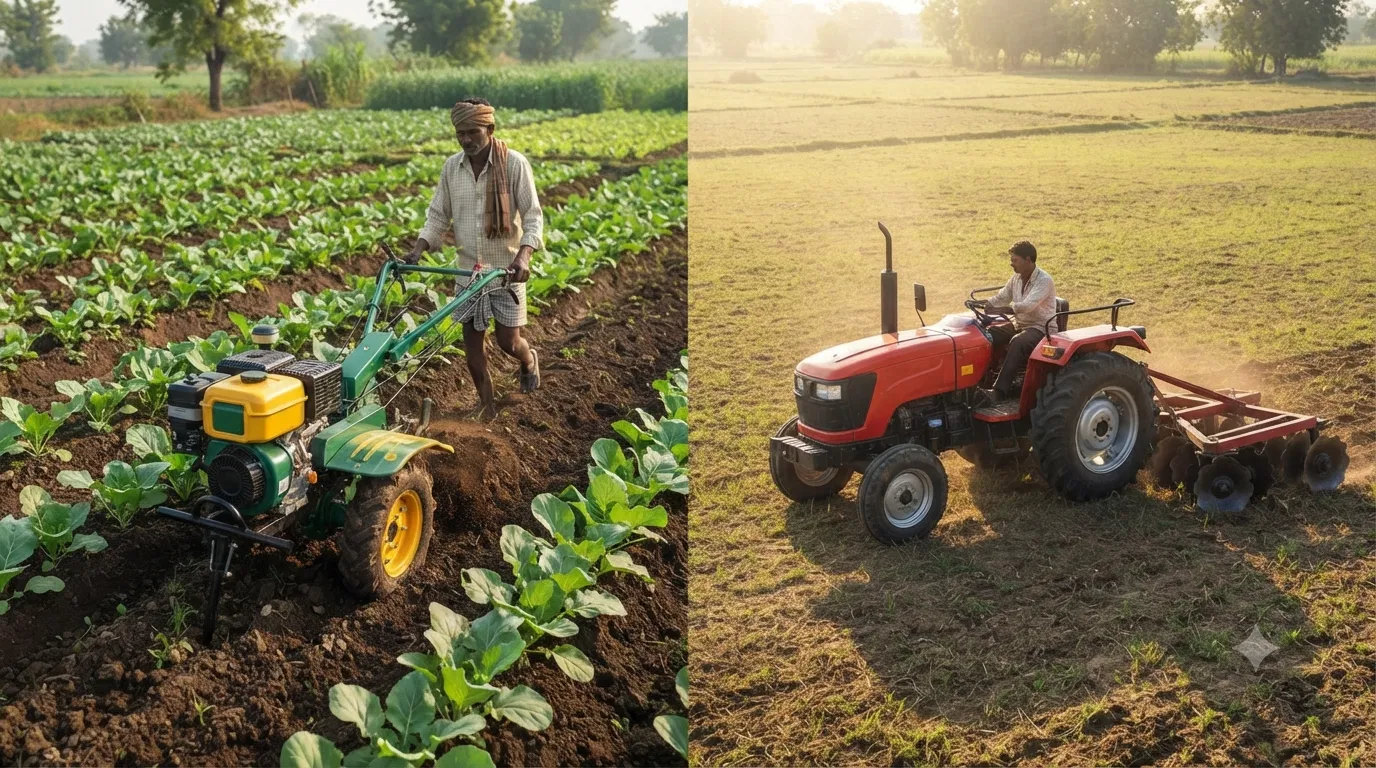
A power tiller is a compact, walk-behind machine designed for small farms, gardens, orchards, and narrow fields. It is commonly used for tilling, weeding, puddling, and light hauling. A tractor is a larger, seated machine built for heavier farm tasks, larger acreage, and a wider range of implements.
Quick rule: If your farm is small and maneuverability matters, a power tiller may be ideal. If you manage larger fields and need more pulling power, a tractor is usually the better investment.
What Is a Power Tiller?
A power tiller is a compact agricultural machine powered by a small engine and guided by an operator walking behind it. It is highly useful for small-scale and specialized farming operations. Farmers often choose it for its affordability, ease of use, and ability to work in tight spaces.
Key Benefits of a Power Tiller
- Lower purchase cost compared to most tractors
- Fuel-efficient for light to moderate farm work
- Easy maneuverability in narrow plots and small fields
- Ideal for wetland and paddy work in many regions
- Suitable for orchards and vegetable farms
Best Uses for a Power Tiller
- Land preparation
- Inter-row cultivation
- Weeding
- Puddling rice fields
- Small-scale transport
- Spraying attachments in some models
What Is a Tractor?
A tractor is a powerful agricultural vehicle designed to pull, power, and operate a variety of farm implements. It is the preferred choice for large farms, commercial operations, and heavy-duty fieldwork. Tractors come in different horsepower ranges, allowing farmers to select a model based on acreage and workload.
Key Benefits of a Tractor
- High power output for demanding tasks
- Works with multiple implements such as plows, seeders, harvesters, and loaders
- Speeds up large-scale operations
- Better for deep tillage and heavy soil
- More productive for commercial farming
Best Uses for a Tractor
- Plowing large fields
- Hauling heavy loads
- Seedbed preparation
- Spraying and fertilizing
- Baling, mowing, and harvesting support
- Using advanced attachments
Power Tiller vs Tractor: Side-by-Side Comparison
1. Farm Size
A power tiller is usually better for small farms, often under a few acres, where space is limited. A tractor is better suited for medium to large farms where time efficiency and coverage matter more than compact size.
2. Cost
Power tillers are significantly cheaper to buy and maintain. Tractors require a larger upfront investment, more fuel, and higher repair costs, but they can deliver greater output over time on larger farms.
3. Fuel Efficiency
Power tillers generally consume less fuel because they are smaller and lighter. Tractors use more fuel, especially when working with heavy implements or on tough terrain.
4. Ease of Use
Power tillers are simpler to handle in small fields, though the operator must walk behind the machine. Tractors are easier on the operator physically because of the seated driving position, but they may require more training.
5. Versatility
Tractors are more versatile overall because they can run a broader range of implements. Power tillers are versatile within their category, but their application is more limited compared to tractors.
6. Soil and Terrain
For wet soil, terraced land, narrow rows, and small plots, a power tiller can be highly effective. For rough terrain, larger acreage, and deep tillage, a tractor performs better.
7. Maintenance
Power tillers usually have lower maintenance costs and simpler mechanical systems. Tractors, while more durable for heavy work, often need more expensive servicing and parts.
When a Power Tiller Makes More Sense
A power tiller is the smarter choice if your farm has any of the following characteristics:
- Small or fragmented landholdings
- Vegetable, orchard, or rice farming
- Limited budget for equipment
- Narrow field access
- Light to moderate farm tasks
- Need for a compact machine with low operating costs
If your main focus is routine soil preparation and cultivation on a smaller scale, a power tiller can offer excellent value without the financial burden of a tractor.
When a Tractor Is the Better Choice
A tractor is the better option if your farm requires high output and heavy-duty performance. It is especially useful when:
- You manage larger acreage
- You need to complete fieldwork quickly
- You rely on multiple attachments
- You work with tough or compact soil
- You run a commercial or mechanized farm
- You need transport and hauling capabilities
For farmers looking to scale up operations and reduce labor dependency, a tractor can be a long-term productivity investment.
Which Is More Cost-Effective?
Cost-effectiveness depends on how often and how intensively the machine will be used. A power tiller is more cost-effective for small farms because it matches the workload without unnecessary expense. A tractor becomes more cost-effective when it is used regularly across large fields and multiple tasks.
In other words, buying a tractor for a small plot may lead to wasted capacity, while buying a power tiller for a large commercial farm may slow operations and increase labor demands.
How to Choose the Right Machine for Your Farm
- Measure your land size and determine how much area must be cultivated regularly.
- List your daily farm tasks such as tilling, hauling, spraying, or plowing.
- Check your soil type and terrain conditions.
- Set a realistic budget for purchase, fuel, maintenance, and repairs.
- Consider future expansion if your farm is likely to grow.
- Review available attachments and how versatile the machine will be.
Power Tiller vs Tractor: Final Verdict
The decision between a power tiller and a tractor comes down to scale, budget, and farming goals. A power tiller is best for small farms, tight spaces, and lower operating costs. A tractor is best for larger farms, heavier workloads, and greater versatility.
If you want efficiency on a small-to-medium plot, choose a power tiller. If you want power, speed, and multi-purpose performance for larger operations, choose a tractor. The right machine is the one that saves you time, lowers your costs, and supports your farm’s growth.
Final insight: Before you buy, compare your farm’s real needs against the machine’s strengths. The best investment is not the most powerful machine—it is the one that works hardest for your specific land.