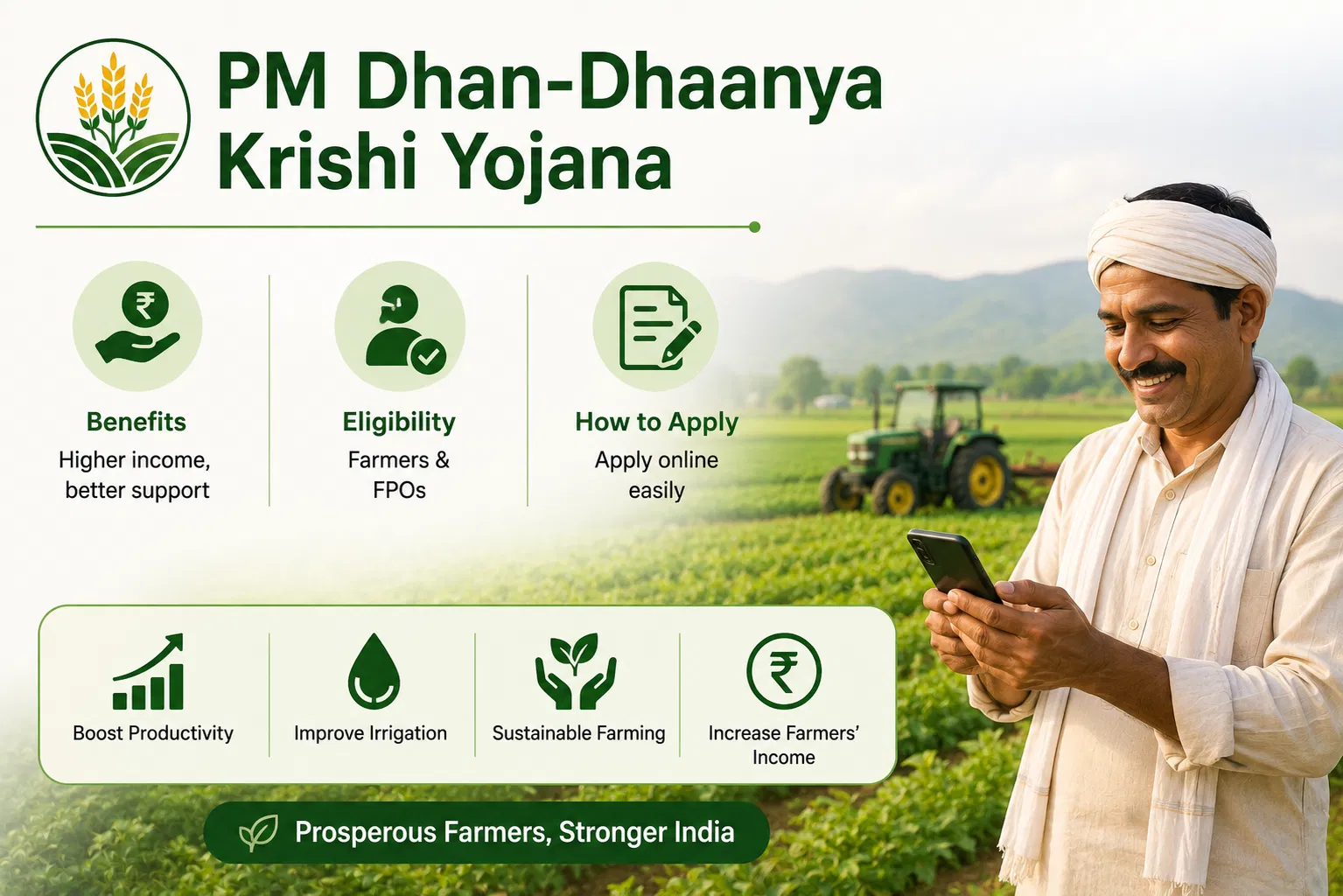
The Pradhan Mantri Dhan-Dhaanya Krishi Yojana (PMDDKY) was announced by Finance Minister Nirmala Sitharaman during the Union Budget on 1 February 2025, and approved by the Union Cabinet on 16 July 2025. It was launched because agricultural productivity in India varies sharply across regions, with many districts held back by low crop yields, poor credit access, and limited irrigation. Rather than running dozens of separate schemes in isolation, PMDDKY converges 36 existing central schemes across 11 ministries into one coordinated, district-focused plan — inspired by NITI Aayog's Aspirational Districts Programme — to lift farm productivity and farmer income in the country's most underperforming agricultural districts.
PM Dhan-Dhaanya Krishi Yojana Overview
- Scheme Name – Pradhan Mantri Dhan-Dhaanya Krishi Yojana (PMDDKY)
- Scheme Launch/Modification Date – Announced 1 February 2025 (Union Budget 2025-26); Cabinet approval 16 July 2025; formally inaugurated by the Prime Minister on 11 October 2025
- Scheme Fund Allocated – ₹24,000 crore annually, over a six-year period (2025-26 to 2030-31), totalling ₹1.44 lakh crore
- Type of Scheme – Central Government (Centrally Sponsored Scheme), converging 36 existing schemes from 11 ministries, coordinated by NITI Aayog
- Helpline No – Kisan Call Centre, 1800-180-1551; farmers can also contact their District Collector's office or nearest Krishi Vigyan Kendra (KVK)
- States Covered – All-India, targeting 100 selected low-productivity districts, with at least one district per state and Union Territory; Uttar Pradesh has the most districts covered (12), followed by Maharashtra (9)
Objectives of the Scheme
- Promote farm productivity through modern techniques and sustainable practices in low-performing districts
- Encourage crop diversification to improve income stability and nutritional security
- Expand access to institutional agricultural credit, especially for small and marginal farmers
- Strengthen irrigation, storage, and value-addition infrastructure at the district level
- Improve monitoring and accountability through district-specific plans and a digital KPI dashboard
Key Features of PMDDKY
- Covers 100 districts selected based on low productivity, poor credit flow, and low cropping intensity, with selection proportional to each state's share in net cropped area and operational holdings
- District Dhan-Dhaanya Samitis, made up of officials, agriculture experts, and progressive farmers, prepare Local Agriculture and Allied Activities Plans tailored to each district's soil, water, and crop conditions
- Governance runs through a three-tier structure: District Samitis, State Committees, and a National Committee coordinated by NITI Aayog
- Progress is tracked through 117 key indicators on a digital dashboard, updated monthly, with regular third-party evaluations
- Financial support includes input subsidies, expanded Kisan Credit Card loans (up to ₹3 lakh), and crop insurance coverage under the Pradhan Mantri Fasal Bima Yojana (PMFBY)
- Large farmers and private companies can participate through public-private partnerships for infrastructure like storage units and processing plants
- Tenant farmers can be included with valid local certification or lease agreements
PMDDKY Benefits to Farmers
- Higher crop yields and incomes through scientific, district-focused agricultural planning
- Direct support for irrigation, storage, and value-addition facilities in the covered districts
- Improved access to institutional credit, particularly benefiting small and marginal farmers
- Growth in value addition and food processing opportunities in rural areas
- More job creation and rural livelihood opportunities linked to agricultural development
- Potential income gains of 20–30% in targeted areas through better yields and market access, according to scheme estimates
Limitations of the Scheme
- Benefits are restricted to the 100 identified districts; farmers outside these districts are not covered under PMDDKY
- Farmers with pending government loan defaults are not eligible
- Eligibility and benefit disbursal depend on verification by the District Dhan-Dhaanya Samiti, which can add processing time
- Tenant farmers need proper local certification or lease agreements to be included, which may exclude informal cultivators without documentation
- Since the scheme converges 36 existing programmes, actual on-ground benefit can depend on how well each of those underlying schemes is implemented in a given district
Documents Required
- Aadhaar Card
- Land ownership records or lease/tenancy certification
- Khatauni or other land revenue record
- PM-KISAN ID, where applicable
- Bank account passbook
- Passport-size photograph
How to Apply for PM Dhan-Dhaanya Krishi Yojana
- Confirm whether your district is among the 100 selected districts by checking with your District Collector's office, local Krishi Vigyan Kendra (KVK), or the state agriculture department portal.
- Visit your state agriculture portal or the PMDDKY application channel, and select the PMDDKY application option.
- Enter your Aadhaar number and mobile number for verification, then provide your name, address, land records, and crop details.
- Upload the required documents, including Aadhaar, land revenue records, and your PM-KISAN ID if you have one.
- Alternatively, apply through your nearest Common Service Centre (CSC) or block-level agriculture office, where an operator can help fill and submit the form.
- The District Dhan-Dhaanya Samiti will verify your application and recommend it for benefits, which typically takes a few weeks after submission.
Conclusion
PM Dhan-Dhaanya Krishi Yojana takes a different approach from most farmer welfare schemes — instead of a single benefit delivered uniformly nationwide, it targets India's 100 most underperforming agricultural districts with a coordinated package of credit, irrigation, storage, and productivity support. By converging 36 existing schemes under one district-level plan and tracking progress through a transparent digital dashboard, PMDDKY aims to close the productivity gap in the regions that need it most. Farmers in the covered districts stand to gain meaningfully if implementation stays on track through its six-year run.
Disclaimer: This article is for informational purposes only. Scheme details, interest rates, and subvention amounts are subject to periodic revision by the Government of India, RBI, and NABARD. Farmers are advised to verify the latest terms and eligibility criteria with their bank, NABARD, or official government sources before applying.