Plants may look still, but inside them, a constant stream of chemical signals is directing every stage of growth. From seed germination to flowering and fruit development, one of the most important groups of signals is known as plant growth regulators, or PGRs. These powerful compounds control how plants grow, respond to stress, and adapt to their environment.
If you've ever wondered what PGRs are in plants and how they work, the short answer is this: they are natural or synthetic substances that influence plant processes in very small amounts. Understanding them is essential for gardeners, growers, agronomists, and anyone interested in plant science.
What Are PGRs in Plants?
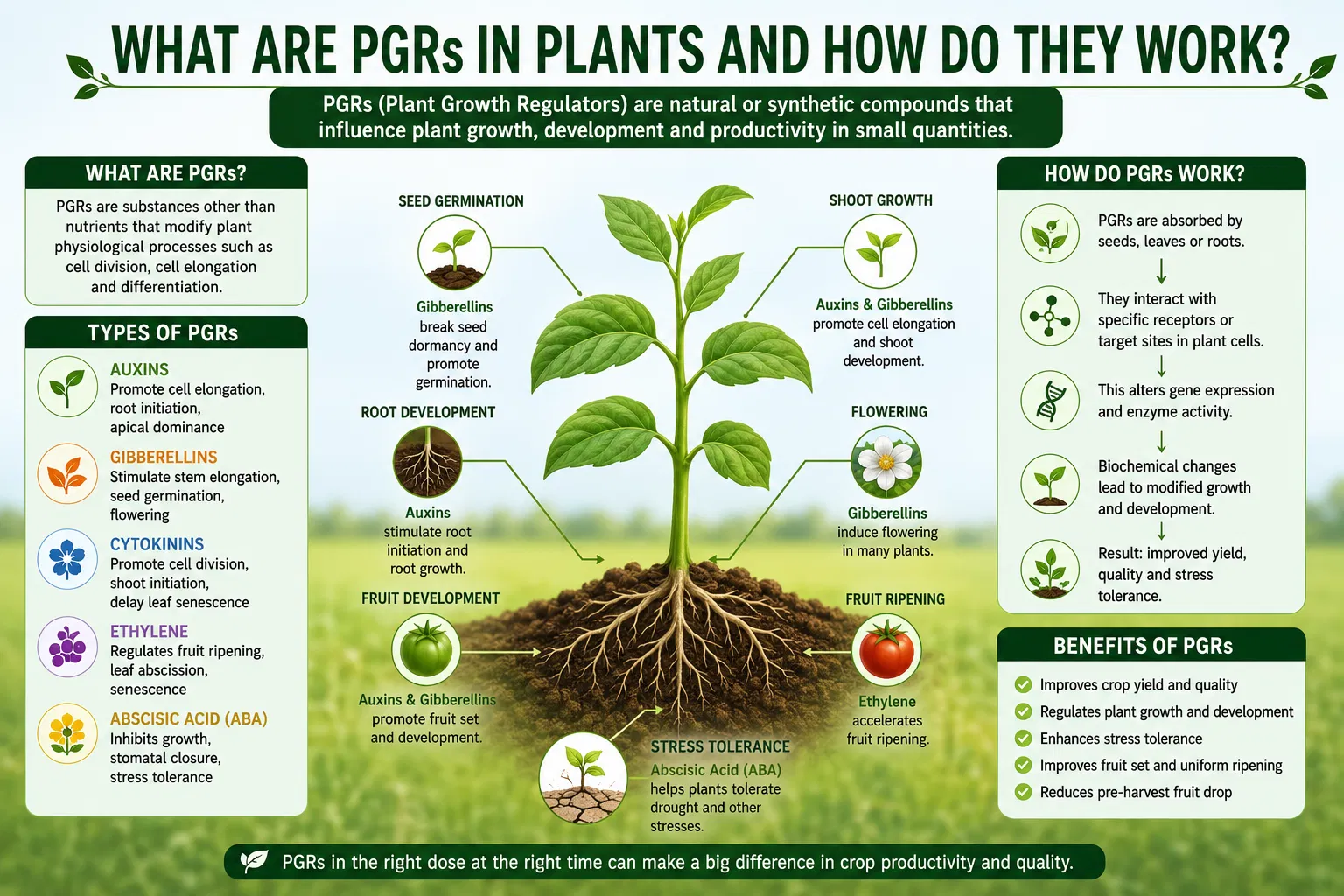
PGRs stands for plant growth regulators. These are organic compounds that regulate plant development and physiological processes. They are often called plant hormones, although the term PGRs can include both naturally occurring hormones and synthetic compounds that mimic or modify their effects.
Unlike nutrients such as nitrogen or potassium, PGRs do not serve as building blocks for plant structure. Instead, they act like signals or messengers, telling the plant when to grow, when to slow down, when to flower, and how to respond to changes in its environment.
PGRs work in tiny amounts, yet their effects on plant growth and development can be dramatic.
The Main Types of Plant Growth Regulators
There are five major classes of plant growth regulators commonly discussed in plant biology. Each has a specific role, and together they help maintain balance in the plant.
1. Auxins
Auxins are best known for promoting cell elongation, root development, and apical dominance. They help plants grow upward by encouraging the main stem to dominate over side shoots.
- Stimulate root formation in cuttings
- Support cell elongation
- Control fruit development
- Influence phototropism, the bending of plants toward light
2. Gibberellins
Gibberellins are associated with stem elongation, seed germination, and flowering. They are especially important when a plant needs to break dormancy and begin active growth.
- Promote seed germination
- Encourage stem elongation
- Support flowering in some species
- Help fruit grow larger
3. Cytokinins
Cytokinins stimulate cell division and help delay leaf aging. They often work together with auxins to shape how plants develop.
- Promote cell division
- Delay senescence, or aging
- Encourage shoot growth
- Support nutrient movement within the plant
4. Abscisic Acid (ABA)
Abscisic acid is mainly a stress hormone. It helps plants survive difficult conditions such as drought by slowing growth and conserving water.
- Triggers stomatal closure during water stress
- Helps seeds remain dormant
- Supports stress responses
- Prevents premature growth in unfavorable conditions
5. Ethylene
Ethylene is a gaseous plant hormone involved in fruit ripening, leaf drop, and stress responses. It is unique because it moves easily as a gas through plant tissues and the surrounding air.
- Promotes fruit ripening
- Triggers leaf and flower drop
- Supports stress signaling
- Influences seedling growth patterns
How Do PGRs Work in Plants?
PGRs work by sending chemical signals that affect gene expression, enzyme activity, and cell behavior. In simple terms, they tell specific plant cells what to do and when to do it.
Here is how the process generally works:
- Production: The plant produces a hormone or a PGR in a specific tissue, such as young leaves, roots, seeds, or developing fruits.
- Transport: The compound moves through the plant via vascular tissues or by diffusion, depending on the type of PGR.
- Recognition: Target cells have receptors that detect the PGR.
- Response: Once the receptor is activated, the cell changes its activity by turning genes on or off.
- Growth effect: These changes influence processes like elongation, division, flowering, or dormancy.
The key point is that PGRs do not act alone. Their effects depend on concentration, timing, location, and interaction with other hormones. A tiny shift in balance can produce a very different outcome.
Why PGR Balance Matters
Plant growth is not driven by one hormone at a time. It is controlled by the balance between multiple PGRs. For example, auxins and cytokinins often work in opposition or coordination depending on the tissue and growth stage.
A few examples of hormone balance in action:
- Auxin vs. cytokinins: This balance influences whether roots or shoots develop more strongly.
- Gibberellins vs. ABA: Gibberellins encourage germination, while ABA helps maintain dormancy.
- Ethylene and auxin: These can interact to regulate fruit development and leaf drop.
When this balance is disrupted, plants may grow too slowly, stretch too much, fail to flower properly, or respond poorly to stress.
Natural vs. Synthetic Plant Growth Regulators
PGRs can be either natural or synthetic. Natural PGRs are produced by the plant itself. Synthetic PGRs are man-made compounds designed to mimic or modify plant hormone activity.
In agriculture and horticulture, synthetic PGRs are used to manage plant growth more precisely. They may be applied to:
- Encourage rooting in cuttings
- Reduce excessive stem growth
- Improve fruit set or size
- Control ripening
- Support uniform flowering
Because PGRs are so potent, they must be used carefully. Too much can damage plants or cause undesirable growth patterns.
Common Uses of PGRs in Agriculture and Gardening
PGRs are widely used in commercial farming, greenhouses, orchards, and ornamental plant production. Their ability to fine-tune plant development makes them valuable tools in crop management.
In agriculture
- Improve crop yield and quality
- Promote uniform flowering and fruiting
- Control plant height in dense plantings
- Enhance harvest timing
In horticulture
- Help ornamental plants stay compact
- Encourage rooting in propagated plants
- Extend shelf life of flowers and foliage
- Improve the appearance of potted plants
In fruit production
- Manage ripening speed
- Reduce fruit drop
- Increase fruit size in some crops
- Improve harvest consistency
Factors That Affect PGR Function
The effects of plant growth regulators are not fixed. Several factors determine how a plant responds:
- Concentration: Small doses may stimulate growth, while higher doses may inhibit it.
- Plant species: Different plants react differently to the same PGR.
- Growth stage: Seedlings, mature plants, and fruiting plants respond in distinct ways.
- Environmental conditions: Light, temperature, water availability, and stress levels all matter.
- Application method: Sprays, dips, soil treatments, and seed treatments can produce different results.
This is why PGR use requires precision. The same compound can help one crop and harm another if misapplied.
Why PGRs Are Important in Plant Science
Plant growth regulators are essential because they explain how plants coordinate complex life processes without a nervous system. Instead of brains or nerves, plants rely on chemical signaling networks to adapt and survive.
They are important for:
- Understanding plant development
- Improving agricultural productivity
- Managing stress tolerance
- Controlling flowering and fruiting
- Supporting propagation and crop uniformity
In modern crop production, PGRs are more than a scientific concept. They are practical tools that help growers improve efficiency and quality while responding to market demands and environmental challenges.
Conclusion
PGRs in plants are powerful chemical regulators that control growth, development, and stress response in remarkably precise ways. From auxins and gibberellins to cytokinins, abscisic acid, and ethylene, each plays a distinct role in shaping how plants live and thrive.
Whether you are studying plant biology or managing crops, understanding how plant growth regulators work gives you a clearer picture of what drives plant behavior. The next time you see a plant sprout, flower, ripen, or bend toward the light, remember that PGRs are behind the scenes, quietly directing the process.
Final insight: mastering PGRs means mastering one of the most fundamental systems in plant life.