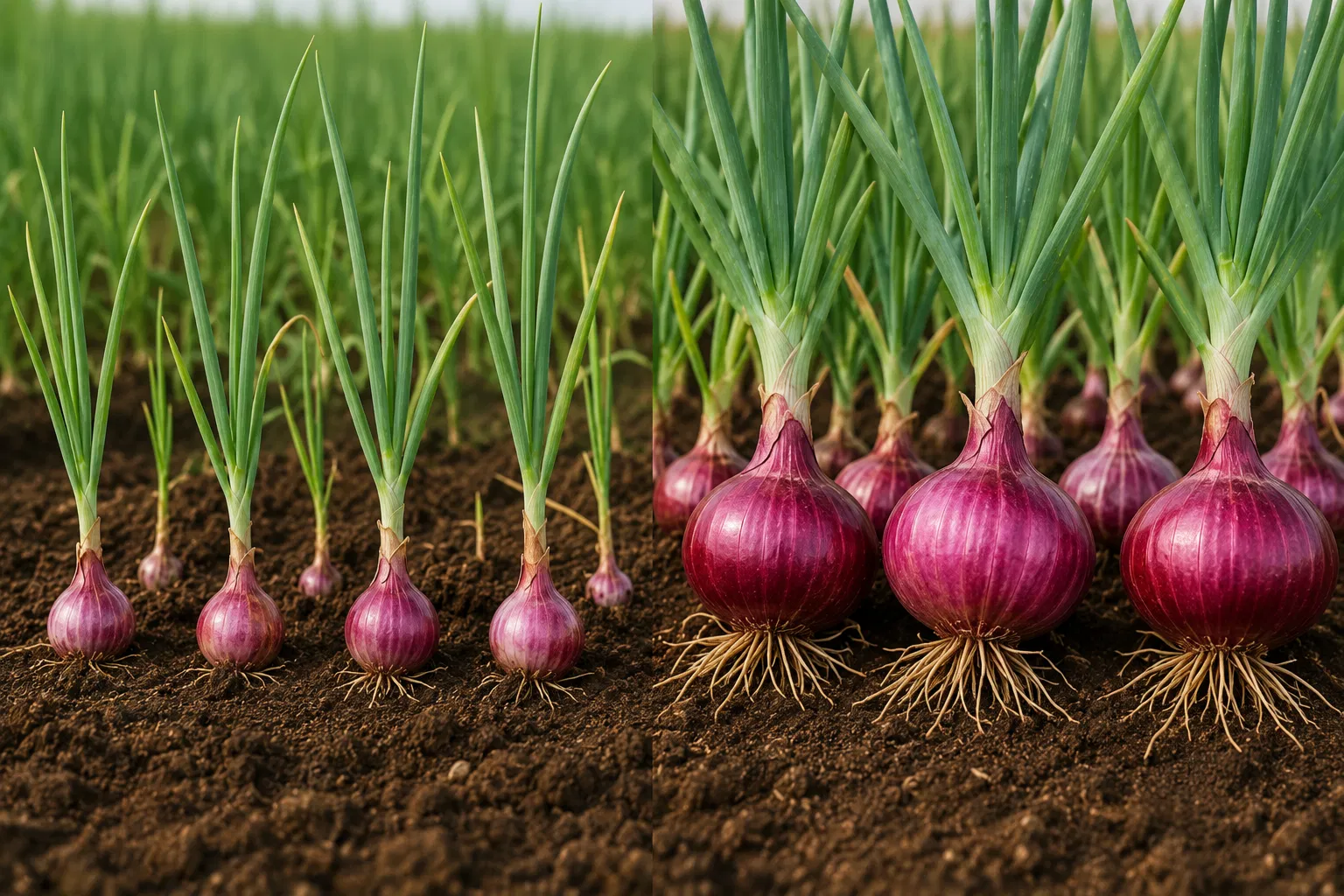
If onion plants produce healthy foliage but the bulbs remain small, the problem may be linked to nutrient timing and balance. Successful onion bulb size increase depends on supplying nitrogen, phosphorus, potassium, sulphur, and important micronutrients according to each stage of crop growth.
Onions need adequate nutrition early in the season to develop strong leaves and roots. Once bulb formation begins, the nutrient programme must shift from promoting foliage to supporting bulb swelling, firmness, and storage quality. Excess nitrogen late in the crop cycle can delay maturity and produce thick necks instead of large, marketable bulbs.
Why Nutrient Timing Matters for Onion Bulb Enlargement
Onions develop in distinct growth stages, and their nutritional requirements change throughout the season. During early growth, the crop needs nutrients that support root establishment and leaf development. Healthy leaves capture sunlight and produce the energy required for bulb formation.
As day length and temperature trigger bulbing, the crop shifts from vegetative growth to bulb enlargement. At this stage, excessive nitrogen can prolong leaf production and slow bulb development.
Key principle: Feed onions for healthy leaves during early growth, then adjust the nutrient programme to support bulb swelling and maturity.
Factors That Influence Onion Bulb Size
Nutrition is important, but bulb size also depends on several other factors:
- Variety and day-length suitability
- Seed and seedling quality
- Plant population and spacing
- Soil fertility and pH
- Irrigation consistency
- Temperature and planting season
- Pest and disease pressure
- Timing of nutrient applications
Begin with suitable, high-quality vegetable seeds adapted to the region and intended planting season. Even an excellent fertilizer schedule cannot fully compensate for a variety that is unsuitable for local day length or climate.
Stage 1: Pre-Planting Soil Preparation
Soil testing is the foundation of an effective onion nutrition programme. Onions generally perform best in fertile, loose, well-drained soil with a slightly acidic to neutral pH.
Before planting, focus on:
- Phosphorus: Supports early root establishment.
- Potassium: Improves plant strength, bulb development, and stress tolerance.
- Organic matter: Improves soil structure, microbial activity, and nutrient retention.
- Soil pH: Influences nutrient availability and root growth.
- Sulphur: Supports onion flavour and several metabolic processes.
Apply well-decomposed farmyard manure or compost during land preparation. Avoid using undecomposed manure close to planting because it may damage young roots, encourage pests, or release nutrients unevenly.
Stage 2: Nutrient Schedule During Early Growth
During the first few weeks after emergence or transplanting, onions establish roots and begin producing leaves. Moderate nitrogen is important at this stage because every healthy leaf contributes to future bulb development.
Early-Stage Nutrient Priorities
- Nitrogen: Encourages steady leaf development.
- Phosphorus: Supports root establishment and early crop vigour.
- Potassium: Strengthens plants and supports water regulation.
- Sulphur: Contributes to plant metabolism and bulb quality.
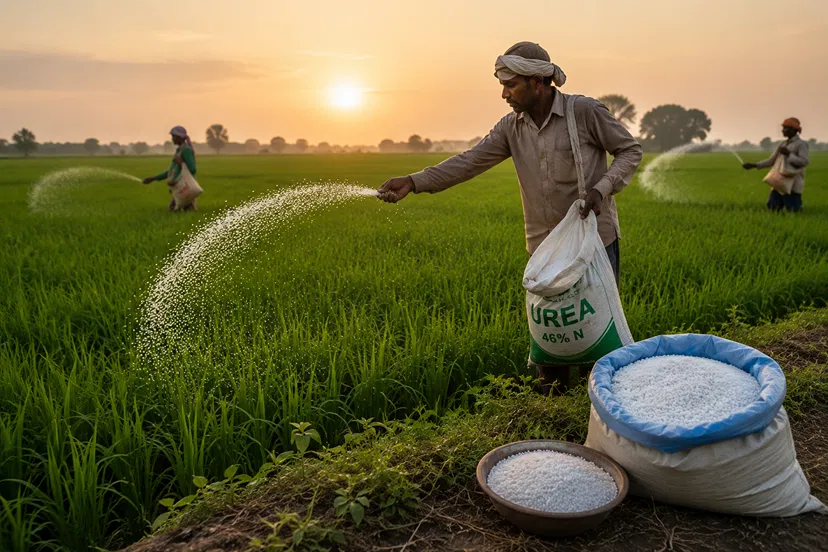
Apply nutrients in moderate amounts rather than using one heavy dose. Onion roots are relatively shallow, so excessive fertilizer concentration can damage roots and reduce nutrient-use efficiency.
Stage 3: Feeding During Vegetative Growth
During vegetative growth, onion plants rapidly develop foliage. This stage is critical because the number and health of leaves influence the crop's potential bulb size.
Depending on soil-test results and crop condition, nitrogen may be applied in split doses during early vegetative development. Split applications reduce nutrient losses and provide a steadier supply to the crop.
Important Nutrients During Vegetative Growth
- Nitrogen: Supports healthy foliage when applied in controlled quantities.
- Potassium: Helps regulate water balance and strengthens plant tissues.
- Sulphur: Supports flavour development and crop growth.
- Zinc: Supports enzyme activity and plant development where deficient.
- Boron: Supports cell development but must be applied carefully.
Healthy onion leaves should appear upright and uniformly green. Pale foliage may indicate nitrogen deficiency, while unusually lush or soft growth can indicate excessive nitrogen.
Stage 4: Nutrient Management at Bulb Initiation
Bulb initiation begins when the variety receives the required day length under suitable temperatures. This is the most important transition in the nutrient schedule.
Once bulbing begins, reduce nitrogen applications and increase attention to potassium. Continuing heavy nitrogen feeding at this stage may delay bulb formation, increase neck thickness, and reduce storage quality.
Nutrient Priorities During Bulb Initiation
- Reduced nitrogen: Maintains crop health without encouraging excessive new foliage.
- Adequate potassium: Supports carbohydrate movement, bulb filling, and stress tolerance.
- Sulphur: Supports bulb quality and characteristic onion flavour.
- Micronutrients: Correct only where deficiency is confirmed.
Select suitable fertilizers according to soil-test results, crop stage, and the recommendations for the chosen onion variety.
Stage 5: Bulb Swelling and Enlargement
During bulb swelling, developing bulbs become a major destination for sugars produced by the leaves. Consistent potassium availability and steady soil moisture support this movement and encourage uniform enlargement.
Important practices during this stage include:
- Maintain even soil moisture without waterlogging.
- Avoid heavy nitrogen applications.
- Prevent moisture stress during rapid bulb development.
- Monitor crops for potassium and sulphur deficiency.
- Avoid damaging roots during intercultural operations.
Irregular irrigation can interfere with nutrient uptake and result in uneven bulb size, splitting, or reduced quality.
Stage 6: Maturation and Finishing
As onions approach harvest, nutrient applications should taper off. The crop must shift naturally toward maturity, neck softening, and leaf drying.
Applying nitrogen too close to harvest may cause thick necks, delayed maturity, poor curing, and shorter storage life.
Final-Stage Best Practices
- Stop nitrogen applications before harvest.
- Avoid unnecessary late fertilizer treatments.
- Reduce irrigation gradually as the crop matures.
- Allow leaves to yellow and fall naturally.
- Harvest when bulbs are mature and necks have softened.
Sample Onion Nutrient Schedule
The following general schedule can be adapted according to soil tests, variety, climate, and local agronomic recommendations:
- Before planting: Apply well-decomposed organic matter and the recommended basal phosphorus and potassium.
- At planting or transplanting: Provide starter nutrition for root establishment.
- Early vegetative stage: Begin controlled nitrogen applications where required.
- During leaf development: Apply nitrogen in split doses based on crop condition.
- At bulb initiation: Reduce nitrogen and ensure adequate potassium.
- During bulb swelling: Maintain potassium availability and consistent irrigation.
- Before harvest: Stop fertilization and gradually reduce irrigation.
This schedule is a general framework rather than a fixed recommendation. Exact fertilizer quantities should be based on soil analysis, expected yield, and regional guidance.
Role of Nitrogen in Onion Bulb Size
Nitrogen is necessary for early leaf growth, but both deficiency and excess can reduce bulb yield.
Too little nitrogen may cause:
- Pale and weak foliage
- Slow growth
- Fewer functional leaves
- Small bulbs
Excess nitrogen may cause:
- Excessive leaf growth
- Delayed bulb initiation
- Thick necks
- Late maturity
- Poor curing and storage
Role of Potassium in Bulb Enlargement
Potassium supports water regulation, carbohydrate movement, stress tolerance, bulb firmness, and storage quality. It becomes especially important during bulb initiation and enlargement.
Inadequate potassium may result in:
- Slow bulb filling
- Reduced bulb weight
- Poor stress tolerance
- Weak bulb quality
- Reduced storage performance
However, potassium applications should still be based on soil-test results. Excessive or imbalanced fertilizer use can interfere with the uptake of other nutrients.
Importance of Sulphur for Onion Crops
Onions have a relatively high sulphur requirement. Sulphur supports protein formation, enzyme activity, crop vigour, and the compounds responsible for onion flavour and pungency.
Deficiency may cause pale young leaves, slow growth, and reduced bulb development. Because sulphur symptoms can resemble nitrogen deficiency, proper diagnosis is important before correction.
Micronutrients That Support Onion Development
Onions may also require small amounts of micronutrients such as zinc, boron, iron, manganese, and copper. Their availability depends on soil pH, organic matter, moisture, and previous fertilizer use.
Micronutrients should not be applied without diagnosis. Boron, in particular, has a narrow range between deficiency and toxicity.
Common Nutrient Mistakes That Limit Onion Bulb Size
- Applying too much nitrogen after bulb initiation
- Using one large fertilizer dose instead of split applications
- Ignoring soil-test results
- Failing to supply adequate potassium during bulb swelling
- Overlooking sulphur requirements
- Applying micronutrients without confirming deficiency
- Allowing irregular soil moisture
- Selecting a variety unsuitable for local day length
Best Fertilizer Strategy for Bigger Onion Bulbs
The most effective fertilizer strategy is a stage-based, split-application programme. Begin with balanced basal nutrition, provide controlled nitrogen during early leaf development, and reduce nitrogen as bulb initiation begins.
During bulb enlargement, maintain adequate potassium, sulphur, and moisture. Stop late fertilizer applications so bulbs can mature and cure properly.
Remember: The best onion fertilizer programme is one based on crop stage, soil-test results, variety, expected yield, and local growing conditions.
Conclusion
Increasing onion bulb size is not simply a matter of applying more fertilizer. It requires supplying the correct nutrients at the right stage of crop development.
Build healthy roots and leaves early, use nitrogen carefully, maintain adequate potassium during bulb formation, and stop late nitrogen applications. Combine balanced nutrition with suitable varieties, proper spacing, and consistent irrigation to produce larger, more uniform bulbs with improved storage quality.
A soil-test-based, stage-specific nutrient schedule helps farmers improve nutrient-use efficiency, marketable yield, and overall profitability.