Mites are the pest most often misdiagnosed in chilli, and the reason is simply that nobody can see them. They are a fraction of a millimetre long, invisible to the naked eye, and they hide on the underside of leaves and inside the growing tip. What the farmer sees is a crop with leaves curling downward, hardening and turning brittle, and the usual conclusion is thrips or a virus. The spray that follows is aimed at the wrong pest, and in the case of a pyrethroid it makes the mite problem considerably worse. Getting the diagnosis right, with a hand lens, is worth more here than anything else in this article.
Symptoms
- Downward curling of leaves with the margins rolling under, giving the leaf an inverted-boat shape, which is the signature of the yellow mite
- Leaves turning thick, leathery and brittle, with a dull bronzed or coppery cast on the underside
- Abnormally long, thin petioles on small distorted leaves, so the plant looks stretched at the top
- Growing tips stunted and bunched, with shortened internodes and a stiff, hardened appearance
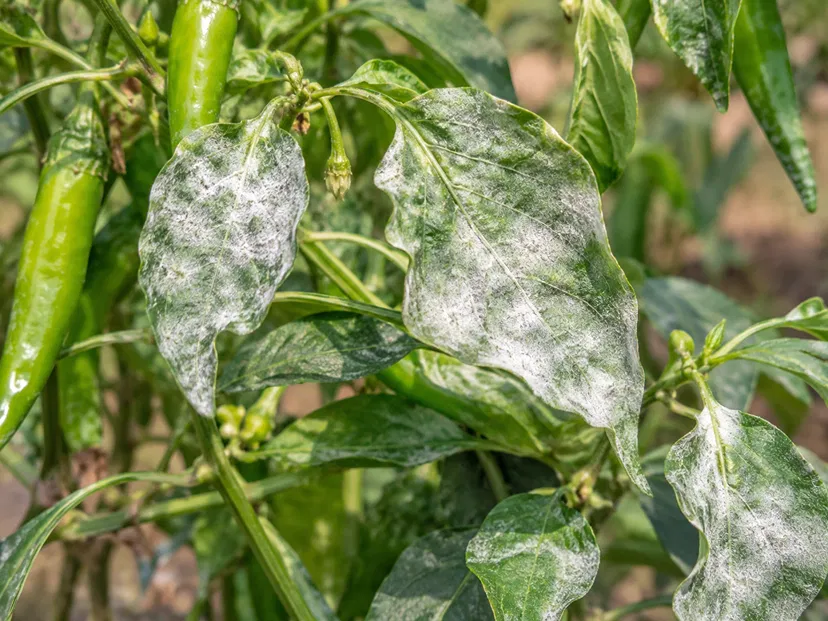
- Fine pale stippling and speckling on the leaf, and in the case of spider mites a faint webbing on the underside and along the midrib
- Russeted, corky scarring on the fruit surface where mites have fed on the developing fruit
- Heavy flower and bud drop, with yield falling well before any insect is visible
Causes
- Polyphagotarsonemus latus, the yellow or broad mite, which is the main mite of chilli in India and causes the downward curling and brittle leaves; it works inside the growing tip where sprays rarely reach
- Tetranychus species, the red spider and two-spotted mites, which feed on older leaves and produce stippling, bronzing and fine webbing
- Hot, dry weather with low humidity, which allows a generation to complete in under a week, so populations multiply far faster than most insect pests
- Pyrethroid and organophosphate sprays applied for other pests, which kill the predatory mites and anthocorid bugs that hold mite numbers down and regularly trigger a worse outbreak a fortnight later
- Dust on the foliage from field roads and dry cultivation, which favours mites and reduces the effect of any spray
- Water-stressed plants and long gaps between irrigations, which raise mite survival and breeding
- Excess nitrogen, producing the soft tender growth in the shoot tips that the yellow mite prefers
- Dense canopies with poor air movement, which shelter the pest and block spray from reaching leaf undersides
- Infested seedlings carried in from the nursery, and a wide host range across cotton, brinjal, okra, cucurbits and many weeds that keeps a reservoir nearby
How to Identify
Use a hand lens of at least 10x, and look at the underside of a curled leaf and inside the growing tip. Yellow mites appear as tiny, translucent, straw-coloured specks that seem to move slowly; their eggs are oval and studded with distinctive small white bumps on the surface. Spider mites are larger and easier to spot as moving reddish or greenish dots, often with fine webbing and cast skins around them. Without a lens the diagnosis is guesswork, and a ten-rupee lens carried in the pocket settles it in seconds.
The direction of leaf curl is the field shortcut. Mites curl the leaf downward, with the margins rolling under and the leaf turning thick and brittle. Thrips curl it upward with crinkled margins and leave silvery feeding scars along the veins. Leaf curl virus puckers the leaf and severely shortens the internodes but produces no bronzing and no webbing. Where both mites and thrips are present at once, which is common and is what growers call the murda complex, the plant shows curling in both directions along with hardened, distorted growth.
Scout twice a week from transplanting, checking the growing tips and the undersides of both young and older leaves, and step up checks during hot dry spells. Populations explode within days in that weather, so a field that was clean on Monday can be badly infested by the weekend.
Control Methods
Chemical Control
1. Diafenthiuron 50% WP
Diafenthiuron is a thiourea that is converted on the leaf surface into its active form, which blocks energy production in the mite by inhibiting mitochondrial ATP synthesis. It works by contact and ingestion and also has vapour action, so it reaches mites on surfaces the spray droplets missed, which matters against a pest hidden in the growing tip. It stops feeding quickly, controls mites and whitefly in the same pass, and is comparatively soft on predatory mites.
Product Recommendation
2. Propargite 57% EC
Propargite is a dedicated acaricide that disrupts energy metabolism in the mite, killing the motile stages on contact with a long residual effect. It has no insecticidal activity to speak of, which is an advantage rather than a drawback: it leaves the predatory insects in the field intact while removing the mites. It is most effective where the population is already established and needs bringing down.
Product Recommendation
3. Cyenopyrafen 30% SC
Cyenopyrafen is a purpose-built miticide that blocks mitochondrial electron transport, and it is effective across every stage of the mite including the eggs, which most products are not. Feeding stops almost immediately on contact and residual control runs for two to three weeks. Because its mode of action is unrelated to the older acaricides, it works where propargite or ethion have begun to fail, and it spares beneficial insects.
Product Recommendation
4. Chlorfenapyr 10% SC
Chlorfenapyr is a pro-insecticide activated inside the pest, where it uncouples oxidative phosphorylation and shuts down the mite's ability to produce energy. It controls mites and caterpillars alike, with translaminar movement that carries it through the leaf to the underside where mites feed. It has no cross-resistance with the conventional acaricide groups, which makes it useful where resistance is suspected.
Product Recommendation
5. Cyantraniliprole 7.3% + Diafenthiuron 36.4% w/w SC
A dual-action systemic combination. Diafenthiuron handles the mites through contact, ingestion and vapour action as described above, while cyantraniliprole binds ryanodine receptors to control the caterpillars, thrips and whitefly that usually share the crop. The systemic movement reaches pests inside curled leaves, and a single spray covering both mites and the sucking pest complex saves a pass in a season that is already spray-heavy.
Product Recommendation
6. Fenpropathrin 30% EC
Fenpropathrin is unusual among the synthetic pyrethroids in having genuine acaricidal activity alongside its insecticidal action, working on sodium channels in the nervous system for rapid contact knockdown. It suits a field carrying mites together with other sucking pests and needing immediate suppression. Use it sparingly and not as a routine spray, since like all pyrethroids it is hard on the predatory mites that were helping.
Product Recommendation
If leaves are curling downward and a broad-spectrum insecticide has just gone on, assume the spray is part of the cause. Switch to a dedicated acaricide from the list above, and reserve the broad-spectrum products for the pests they are actually registered against.
Getting the Spray to Where the Mites Are
Coverage decides the result more than the choice of product. Mites live on the underside of leaves and inside the growing tip, so a spray aimed down over the canopy misses almost all of them. Use a hollow cone nozzle, direct the lance upward into the canopy from below, and keep the water volume full rather than reducing it to save time. Wash dust off the foliage with a light irrigation before spraying where field dust has built up, since a dusty leaf both shelters mites and blocks the spray from reaching them.
Cultural Control
- Raise seedlings under insect-proof net and inspect transplants with a lens before planting, since mites carried in from the nursery start the infestation before the crop is in the ground
- Irrigate on time and avoid long dry spells, because water-stressed plants support far heavier mite populations
- Keep field dust down with timely irrigation and by avoiding dry cultivation close to the crop, as dust on the leaves favours mites directly
- Keep nitrogen at the recommended dose and split it, since soft growth in the shoot tips is what the yellow mite feeds on
- Maintain wider spacing so the canopy stays open, both to discourage the pest and to let spray reach the lower leaf surfaces
- Avoid planting beside cotton, brinjal, okra or an older chilli crop, which release mites into a young field as they mature
- Clear weed hosts and crop residue from the field and bunds, where mites survive between crops
- Remove and destroy severely curled, hardened shoots during scouting rather than leaving them as a breeding base
- Protect the natural enemies already present by avoiding calendar sprays; predatory mites, anthocorid bugs and lacewings suppress a substantial share of the population when left alone
Mechanical Control
Carry a 10x hand lens and use it at every scouting round. It is the single most useful tool against this pest, because no decision about mites can be made correctly without seeing them. Beyond that, a strong jet of water directed at the leaf undersides dislodges spider mites and washes dust off the foliage at the same time, which is worth doing on small holdings before reaching for a spray. Pull out and destroy plants that are severely stunted and hardened beyond recovery, since they will not yield and continue to supply mites to the rest of the field.
Conclusion
Mites in chilli come down to three things. Look with a lens, because the pest is invisible and the damage is routinely blamed on thrips or virus. Read the curl: downward and brittle means mites, upward and crinkled means thrips, and the two often occur together. And stop using broad-spectrum insecticides as a default answer, because they remove the predators without removing the mites and reliably produce a bigger problem two weeks later. A dedicated acaricide, aimed upward into the canopy at full water volume, on a crop that is irrigated on time and not covered in dust, is what actually works.
Disclaimer: Always confirm current label registration, approved dosage, water volume, and pre-harvest interval (PHI) for your state before using any product, since labels are periodically revised by regulatory authorities.
This guide is a general advisory. Do your own research and verification before using any product. Always confirm suitability for your crop stage, region, and field conditions before making any purchase, spray, or crop-management decision.