

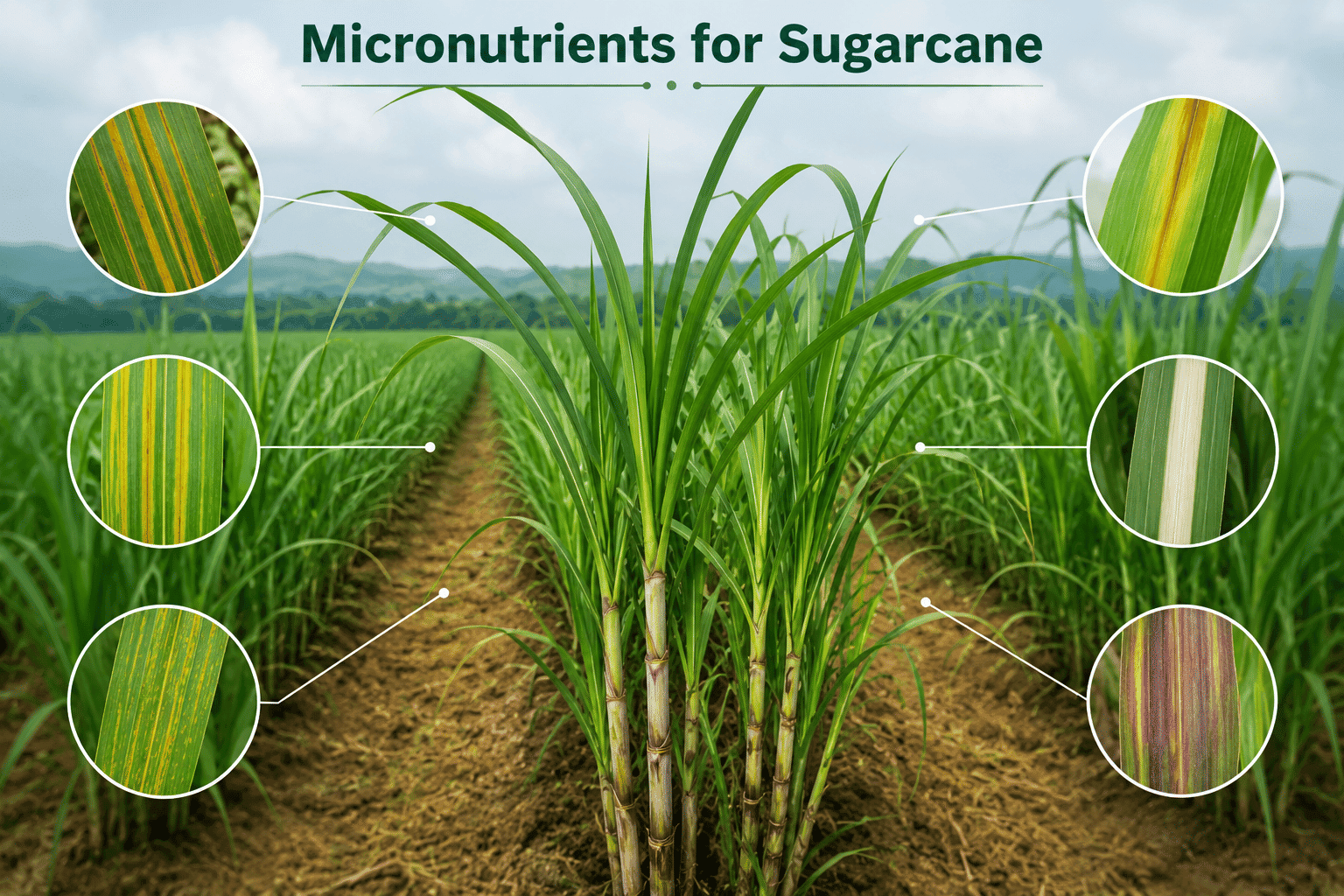
Introduction
Sugarcane is a long-duration and nutrient-demanding crop. It stays in the field for many months and removes large quantities of nutrients from the soil. Most farmers focus on nitrogen, phosphorus, and potassium, but micronutrients are also important for healthy growth, tillering, cane development, and sugar recovery.
Micronutrient deficiency is more common in intensively cultivated sugarcane fields, alkaline soils, low-organic-matter soils, waterlogged fields, and areas where only NPK fertilizers are used for many years.
Why Micronutrients Matter in Sugarcane
Even though micronutrients are needed in small quantities, their role is very important.
Deficiency may cause:
- Poor tillering
- Yellowing of leaves
- Slow growth
- Weak root system
- Short internodes
- Thin canes
- Poor juice quality
- Reduced sugar recovery
- Lower yield potential
5 Important Micronutrients for Sugarcane
|
Sr. No. |
Micronutrient |
Main Role |
Common Deficiency Sign |
|
1 |
Zinc |
Tillering, enzyme activity, growth |
Pale stripes or banding on leaves, poor growth |
|
2 |
Iron |
Chlorophyll formation |
Yellowing of young leaves with greener veins |
|
3 |
Manganese |
Photosynthesis and enzyme function |
Interveinal chlorosis and weak growth |
|
4 |
Boron |
Cell wall strength, sugar movement, growing point health |
Poor cane growth, brittle tissues, malformed young leaves |
|
5 |
Copper |
Lignin formation and plant strength |
Stunted growth, weak leaves, poor root growth |
How to Identify Micronutrient Deficiency
Zinc Deficiency
- Pale yellow or whitish stripes on young to middle leaves
- Short internodes
- Poor tillering
- Stunted crop growth
Iron Deficiency
- Young leaves turn yellow
- Veins may remain comparatively green
- More common in alkaline or poorly drained soils
Manganese Deficiency
- Interveinal yellowing
- Pale leaves
- Reduced vigour
Boron Deficiency
- Poor development of growing points
- Brittle or distorted young leaves
- Poor cane elongation
- Internal tissue problems in severe deficiency
Copper Deficiency
- Stunted growth
- Weak root system
- Leaf discoloration
- Reduced tillering in severe cases
How to Apply Micronutrients Correctly
Micronutrients should be applied based on soil test, leaf test, or clear deficiency symptoms. Overuse can be harmful, especially in the case of boron and copper.
Soil Application
- Apply zinc sulphate only where zinc deficiency is confirmed or commonly recommended.
- Apply boron carefully and only at recommended dose, because excess boron can injure the crop.
- Mix micronutrients with FYM or compost for better distribution.
- Avoid direct contact of concentrated micronutrient fertilizer with setts.
- Follow local agriculture university or KVK recommendations for dose.
Foliar Spray
- Foliar spray gives quicker correction when deficiency symptoms are visible.
- Spray in the morning or evening.
- Avoid spraying during hot sun, rain, or strong wind.
- Use clean water.
- Do not combine micronutrients with incompatible pesticides or alkaline products.
- Repeat only if recommended.
Conditions That Increase Micronutrient Deficiency
- High soil pH
- Low organic matter
- Continuous sugarcane cropping
- Heavy NPK use without micronutrients
- Waterlogging
- Poor drainage
- Calcareous soils
- Sandy or degraded soils
- Imbalanced irrigation water quality
Final Thoughts
Sugarcane needs balanced nutrition for strong growth and better cane quality. Zinc, iron, manganese, boron, and copper are important micronutrients, but they should be applied based on deficiency symptoms, soil test, and local recommendation.
Do not use micronutrient mixtures blindly every season. A soil-test-based plan, combined with FYM, balanced NPK, drainage, and good agronomic practices, gives better and safer results in sugarcane.