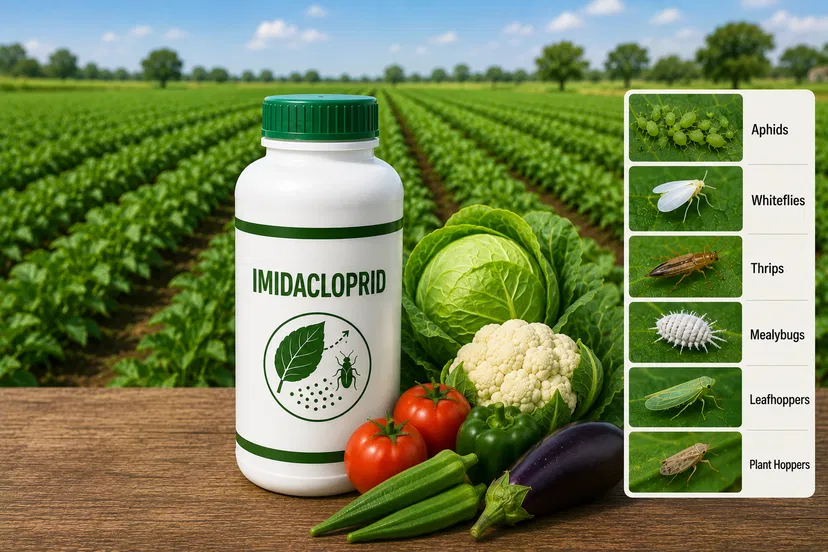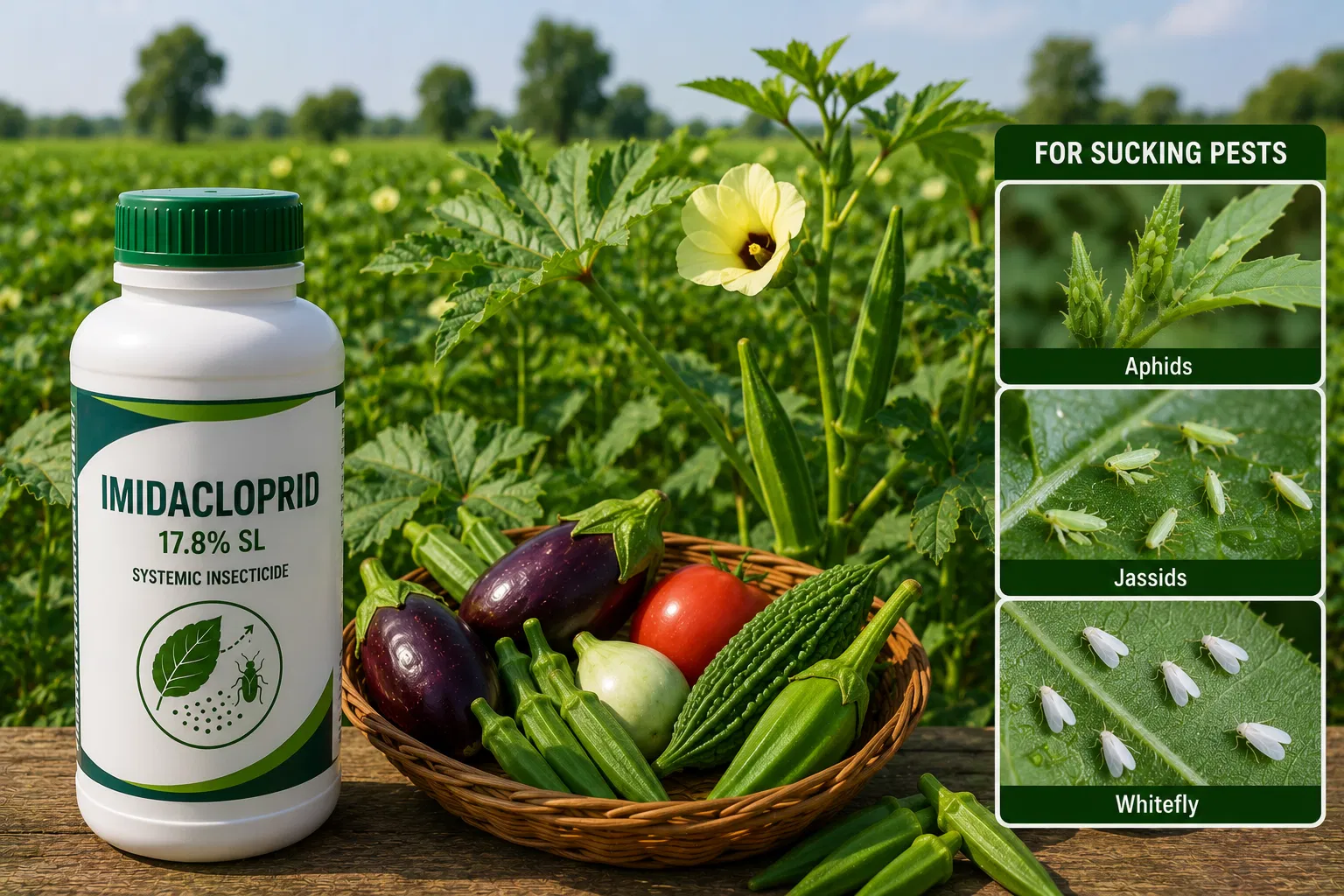
Aphids, jassids, and whiteflies remove plant sap, weaken young growth, produce honeydew, and may transmit plant viruses. Imidacloprid is widely used against these pests because it has systemic activity, but successful control depends on early detection, a registered crop claim, and resistance management.
Imidacloprid products belong to a specific mode-of-action group. They should not be treated as general-purpose insecticides for every pest in the field.
How the Three Pest Groups Differ
Aphids
Aphids form colonies on young shoots and the lower leaf surface. They cause curling, sticky honeydew, sooty mould, and virus transmission. Populations can increase rapidly under favourable conditions.
Jassids
Jassids or leafhoppers feed on leaf sap and inject toxic saliva. Symptoms include yellowing, reddening, marginal curling, and “hopper burn.” Nymphs often remain on the underside of leaves.
Whiteflies
Whitefly adults fly when plants are disturbed, while immobile nymphs remain attached to the lower leaf surface. They cause honeydew, sooty mould, weakening, and virus transmission.
Why Imidacloprid Can Work
After suitable foliar or root-zone application, the active ingredient moves into plant tissue. Sap feeders ingest it while feeding. This makes it useful when pests are difficult to hit directly, but systemic action does not remove the need for correct timing.
Very heavy infestations with overlapping life stages may require a complete integrated plan rather than repeated imidacloprid sprays.
Crop-Specific Label Examples
For imidacloprid 17.8% SL, Indian label examples include:
- Cotton: aphid, whitefly, jassid and thrips at 100–125 ml/ha in 500–700 L water, with a 40-day waiting period.
- Okra: aphid, jassid and thrips at 100 ml/ha in 500 L water, with a 3-day waiting period.
- Groundnut: aphid and jassid at 100–125 ml/ha in 500 L water, with a 40-day waiting period.
- Tomato: whitefly at 150–175 ml/ha in 500 L water, with a 3-day waiting period.
These examples demonstrate that pest names alone do not determine the dose. Crop, formulation, and waiting period matter.
Scouting Before Treatment
- Walk the field in a representative pattern.
- Inspect upper, middle, and lower canopy leaves.
- Turn leaves over to count nymphs and colonies.
- Record natural enemies such as ladybird beetles, lacewings, and parasitoids.
- Check for virus symptoms and alternate weed hosts.
- Use economic thresholds or local recommendations.
Use in Cotton
In cotton, sucking-pest complexes may include aphids, jassids, whiteflies, and thrips. Avoid early routine sprays that destroy predators and accelerate resistance. Treat only when monitoring supports action.
Use in Tomato
For tomato, imidacloprid 17.8% SL has a label example for whitefly. Whitefly management must also include clean seedlings, weed-host control, yellow sticky traps, removal of virus-infected plants where appropriate, and rotation of modes of action.
Coverage and Timing
Apply when sucking-pest populations are beginning to build, not after severe leaf damage and virus spread. Calibrated sprayers help distribute the correct field dose evenly.
Avoid spraying during the hottest part of the day, strong wind, or impending rain. Follow the label for rainfastness and re-entry.
Resistance Warning
Aphids and whiteflies can develop resistance quickly. Repeated applications of imidacloprid or closely related Group 4 insecticides may give progressively weaker control.
- Do not use consecutive Group 4A sprays against the same pest generation.
- Rotate with an effective, registered mode of action.
- Do not apply below the label rate.
- Use non-chemical tactics to reduce the starting population.
- Stop using the product when field performance indicates resistance.
Protect Beneficial Insects and Pollinators
Avoid spraying flowering crops when bees are active. Preserve predators and parasitoids that naturally suppress sucking pests. Broad disruption of beneficial insects may cause secondary outbreaks.
Integrated Crop Protection
A complete crop protection plan may include insect-proof nursery structures, healthy seedlings, reflective mulch where suitable, sticky traps, weed management, balanced nitrogen, natural enemies, and selective insecticides.
Common Reasons for Control Failure
- Wrong pest identification
- Using a rate from another crop or formulation
- Application after severe virus spread
- Resistance caused by repeated Group 4 use
- Poor calibration or uneven coverage
- Rain or irrigation soon after application
- Reinfestation from nearby untreated hosts
Final Thoughts
Imidacloprid can manage labelled aphids, jassids, and whiteflies when used early and correctly. Confirm the exact crop-pest claim, use the formulation-specific rate, respect the waiting period, and rotate modes of action.