Getting drip irrigation right starts with one essential question: how much water do your plants actually need? Too little water can stress crops and reduce growth, while too much can waste water, increase costs, and even damage roots. The good news is that calculating water requirement for drip irrigation is straightforward once you understand a few key factors.
Whether you’re managing a vegetable garden, orchard, greenhouse, or field crop, this guide will help you estimate irrigation needs accurately and apply water more efficiently. By the end, you’ll know how to calculate water requirement for drip irrigation using crop type, soil conditions, weather, and system efficiency.
Why Accurate Water Calculation Matters
Drip irrigation is one of the most efficient watering methods because it delivers water directly to the root zone. But even the best system needs the right amount of water at the right time. Accurate water calculation helps you:
- Prevent overwatering and root rot
- Reduce water waste and utility costs
- Improve plant health and yield
- Maintain consistent soil moisture
- Maximize drip system performance
Instead of guessing, you can use a simple formula to estimate daily or weekly irrigation requirements.
Understand the Main Factors That Affect Water Requirement
Before calculating drip irrigation water needs, consider the factors that influence how much water your plants use.
1. Crop Type
Different crops have different water demands. Leafy vegetables, fruiting crops, lawns, and trees all use water at different rates. Young plants usually need less water than mature plants with larger root systems.
2. Growth Stage
A plant’s water requirement changes as it grows. Seedlings may need frequent but light irrigation, while flowering or fruiting crops often require more water to support development.
3. Soil Type
Soil affects how fast water moves and how much it holds.
- Sandy soil drains quickly and may need shorter, more frequent irrigation.
- Clay soil holds water longer but absorbs it more slowly.
- Loam soil is balanced and usually ideal for drip irrigation.
4. Weather and Climate
Hot, dry, windy conditions increase evapotranspiration, meaning plants lose more water. Cool or humid weather reduces water demand. Seasonal changes also matter, so irrigation needs in summer are often much higher than in winter.
5. Root Zone Depth
Drip irrigation should supply enough water to reach the active root zone, not beyond it. Shallow-rooted crops require less water depth than deep-rooted trees or vines.
Basic Formula for Calculating Water Requirement
The general formula for water requirement is:
Water Requirement = Crop Water Use × Area × Irrigation Frequency
However, for practical drip irrigation planning, the most useful starting point is daily water need based on evapotranspiration and system efficiency.
A common calculation is:
Net Water Requirement = Evapotranspiration (ET) × Crop Coefficient (Kc) × Area
Then adjust for system efficiency:
Gross Water Requirement = Net Water Requirement ÷ Irrigation Efficiency
This tells you how much water must be applied through the drip system to meet the crop’s actual needs.
Step-by-Step Method to Calculate Drip Irrigation Water Requirement
Step 1: Determine the Crop Water Use
Crop water use is often estimated using evapotranspiration, or ET. ET measures how much water is lost from soil and plant surfaces through evaporation and transpiration.
You can get ET data from local weather stations, agricultural extension services, or irrigation scheduling tools. The value is usually given in millimeters per day or inches per day.
Step 2: Apply the Crop Coefficient
The crop coefficient, or Kc, adjusts ET based on the crop’s stage of growth. For example:
- Young crops: lower Kc
- Mid-season crops: higher Kc
- Late-season crops: moderate to lower Kc
This helps you estimate the actual water use for your specific plant type and stage.
Step 3: Measure the Irrigated Area
Calculate the area being watered by the drip system. This could be in square meters, acres, or hectares. Accurate area measurement is important because the larger the area, the more water you need.
Step 4: Calculate Net Water Requirement
Use the formula:
Net Water Requirement = ET × Kc × Area
This gives the amount of water the plants need, not yet adjusted for irrigation losses.
Step 5: Adjust for Drip System Efficiency
Drip irrigation is highly efficient, often ranging from 85% to 95%. Still, some water is lost due to evaporation, pressure variation, or leakage. Divide the net requirement by your system efficiency to find the gross water requirement.
Gross Water Requirement = Net Water Requirement ÷ Efficiency
For example, if your system efficiency is 90%, use 0.90 in the formula.
Example Calculation
Let’s walk through a simple example.
Suppose you have a vegetable plot of 100 square meters. The daily ET is 5 mm, the crop coefficient is 0.8, and your drip system efficiency is 90%.
Step 1: Calculate net water requirement.
Net water requirement = 5 × 0.8 × 100
Net water requirement = 400 liters per day
Step 2: Adjust for efficiency.
Gross water requirement = 400 ÷ 0.90
Gross water requirement = 444.4 liters per day
So, your drip irrigation system should apply about 444 liters per day to meet the crop’s water requirement.
How to Convert Millimeters to Liters
When working with irrigation, it helps to know a simple conversion:
- 1 mm of water over 1 square meter = 1 liter
This makes calculations easier. For example, if a crop needs 6 mm of water over 50 square meters, the net requirement is:
6 × 50 = 300 liters
If irrigation efficiency is 85%, the gross amount becomes:
300 ÷ 0.85 = 353 liters
How Often Should You Irrigate?
The frequency of irrigation depends on soil type, crop stage, and weather. Drip irrigation usually works best with frequent, smaller applications rather than occasional heavy watering.
- Sandy soil: irrigate more often
- Clay soil: irrigate less often but longer each time
- Hot weather: increase frequency
- Cool weather: reduce frequency
The goal is to keep moisture in the root zone without saturating the soil.
Tips for More Accurate Drip Irrigation Planning
Once you know the basic calculation, these practical tips can improve results even more:
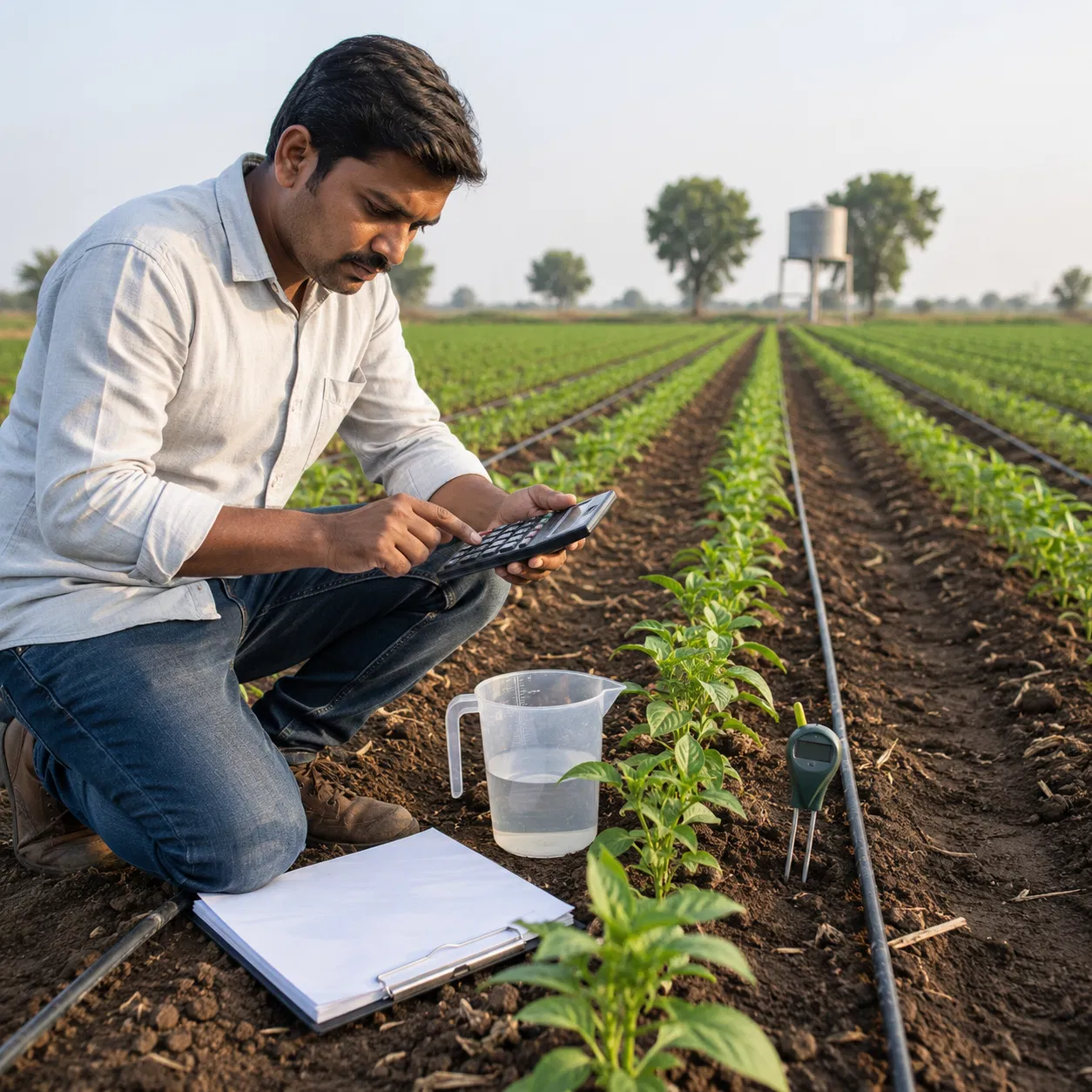
- Check soil moisture regularly using your hand, a probe, or sensors
- Observe plant signs like wilting, leaf curling, or slowed growth
- Adjust irrigation based on seasonal weather changes
- Group plants with similar water needs together
- Test drip emitters to confirm uniform water delivery
- Mulch around plants to reduce evaporation
These small adjustments can make a big difference in water savings and crop performance.
Common Mistakes to Avoid
Even with a drip system, mistakes can lead to poor irrigation results.
- Ignoring crop stage and using the same water amount all season
- Failing to account for soil type
- Not adjusting for rain or cooler weather
- Assuming all emitters deliver exactly the same flow
- Overwatering shallow-rooted crops
Accurate irrigation is not just about the formula. It also requires observation and regular adjustment.
Final Thoughts
Learning how to calculate water requirement for drip irrigation is one of the smartest steps you can take for healthier plants and better water management. With a simple formula, a few measurements, and regular monitoring, you can apply the right amount of water exactly where it’s needed.
Start with crop water use, adjust for soil and weather, and always account for system efficiency. That approach will help you save water, improve growth, and get the most from your drip irrigation system.
If you’re planning a new irrigation setup or improving an existing one, use these calculations as your foundation and fine-tune them as your plants grow.