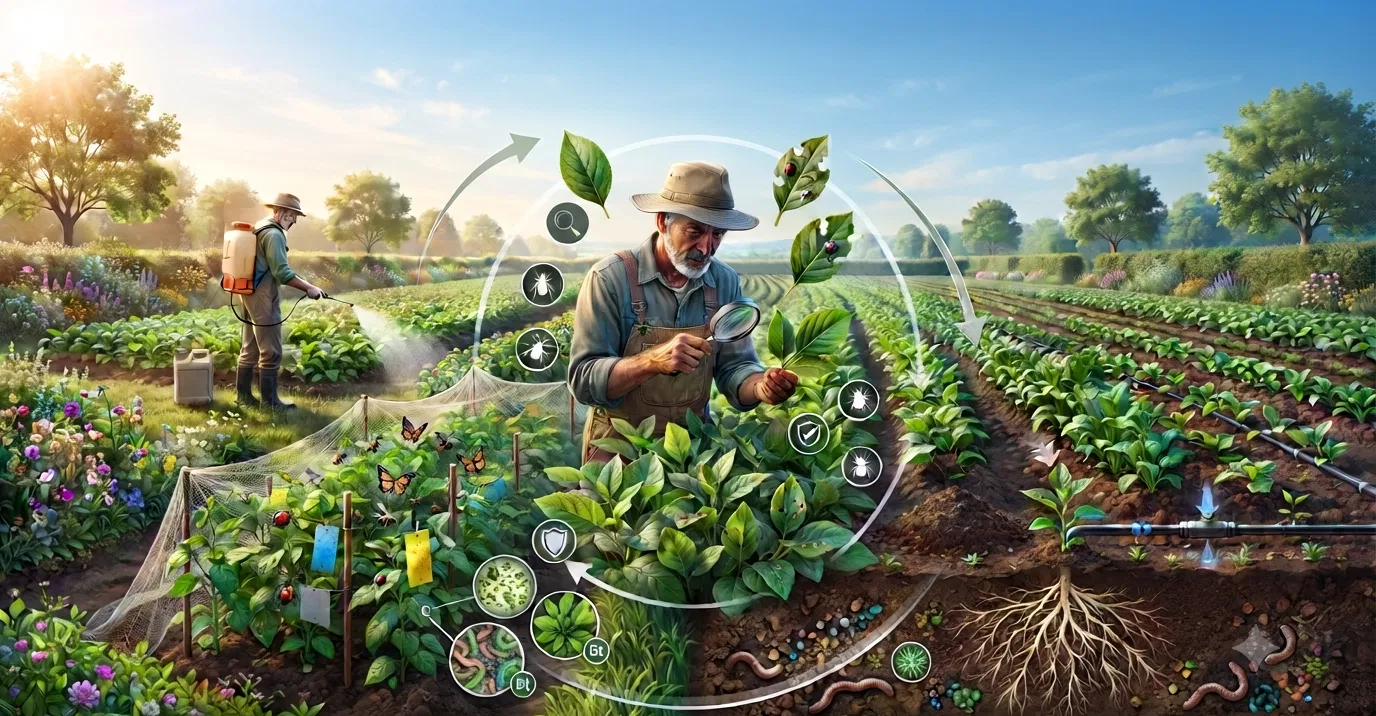
Every growing season brings the same challenge: how do you protect crops from pests without relying too heavily on chemicals? For farmers today, the answer is Integrated Pest Management (IPM). This practical, science-based approach helps reduce pest damage, protect yields, and support long-term farm health. At the heart of IPM are four essential pillars that every farmer should understand and apply.
When used together, these four pillars create a smarter, more sustainable pest control strategy. They help farmers make informed decisions, lower input costs, and use pesticides only when truly necessary. If you want healthier crops and a more resilient farm, these are the IPM principles to know.
What Is Integrated Pest Management?
Integrated Pest Management is a pest control system that combines multiple methods to manage insects, weeds, diseases, and other pests in the most effective and least risky way. Instead of depending on a single solution, IPM uses monitoring, prevention, thresholds, and targeted interventions.
The goal is not to eliminate every pest. The goal is to keep pest populations below damaging levels while protecting people, crops, beneficial organisms, and the environment.
The Four Pillars of IPM
1. Prevention
Prevention is the foundation of effective pest management. It focuses on reducing the chances that pests will become a problem in the first place. This is one of the most cost-effective parts of IPM because it helps farmers avoid expensive outbreaks before they start.
Strong prevention starts with good farm practices. Healthy plants are less likely to suffer severe pest damage, and a clean, well-managed field is less attractive to many pests.
- Choose resistant varieties when available.
- Rotate crops to break pest and disease cycles.
- Manage weeds because they can harbor pests.
- Improve soil health to support vigorous plant growth.
- Use proper spacing and irrigation to reduce stress and disease pressure.
- Clean equipment and tools to avoid spreading pests between fields.
Prevention also includes planting at the right time and choosing field locations carefully. When farmers build prevention into their routine, they lower the likelihood of major infestations and reduce the need for emergency treatments later.
2. Monitoring and Identification
You cannot manage what you do not measure. Monitoring is the process of regularly checking crops for pests, damage, and signs of disease. Accurate identification is just as important, because different pests require different responses.
Not every insect is harmful. In fact, some are beneficial predators or pollinators. That is why correct pest identification is a critical part of IPM. Mistaking a helpful insect for a destructive one can lead to unnecessary spraying and wasted money.
Monitoring methods may include:
- Field scouting on a regular schedule
- Sticky traps or pheromone traps
- Checking leaf undersides and stems for eggs or larvae
- Inspecting soil and roots for hidden pests
- Recording weather conditions that favor pest outbreaks
Good records matter. Notes on pest type, severity, location, and crop stage help farmers spot patterns over time. That makes future decisions faster and more accurate.
IPM works best when farmers scout often, identify pests correctly, and respond based on real field conditions rather than guesswork.
3. Action Thresholds
One of the most important ideas in IPM is the action threshold. This is the point at which pest levels become high enough that action is needed to prevent economic damage. In other words, not every pest sighting justifies treatment.
Action thresholds help farmers avoid unnecessary interventions. They save money, reduce chemical use, and protect beneficial insects. The threshold may vary depending on crop type, pest species, growth stage, weather, and market value.
For example, a few aphids on a field edge may not require treatment. But if population levels rise quickly and begin to threaten yield or quality, control measures may be needed.
Using thresholds helps farmers answer a key question: Is this pest problem serious enough to act on now?
Common factors that influence thresholds include:
- Crop value and expected yield
- Stage of crop growth
- Level of pest infestation
- Presence of natural enemies
- Weather and environmental conditions
- Cost of treatment compared with potential loss
This pillar makes IPM more strategic. Instead of reacting emotionally to every pest, farmers respond with data and timing.
4. Control Methods
When pests reach a damaging level, IPM uses the least risky effective control method first. The best programs combine several control strategies rather than depending on one tool alone.
There are four main types of control methods in IPM:
- Cultural control: crop rotation, sanitation, planting date changes, and irrigation management
- Mechanical control: hand removal, traps, barriers, tillage, and pruning
- Biological control: using natural enemies such as predators, parasites, and beneficial microbes
- Chemical control: targeted pesticide use when needed and at the correct time
The key principle is to start with the safest effective option. For example, if a pest can be reduced by removing infected plant material or encouraging beneficial insects, that may be preferable to immediate spraying. When pesticides are necessary, they should be selected carefully, applied correctly, and used according to label directions.
Rotating pesticide modes of action is also important. This helps slow resistance, which is a major concern in modern agriculture. A strong IPM program always considers long-term sustainability, not just short-term knockdown.
Why the Four Pillars of IPM Matter
The four pillars of IPM work together to create a balanced system. Prevention reduces risk. Monitoring and identification provide information. Action thresholds guide decision-making. Control methods solve problems efficiently when action is needed.
Together, these pillars help farmers:
- Protect crop yield and quality
- Lower input costs
- Reduce pesticide resistance
- Preserve beneficial insects and pollinators
- Improve environmental stewardship
- Build a more resilient farming operation
Perhaps most importantly, IPM gives farmers more control. Instead of constantly reacting to pest pressure, they can plan ahead, make smarter decisions, and respond with confidence.
How to Put IPM Into Practice
Getting started with IPM does not require a complicated system. It begins with observation and consistency. Even small changes can make a big difference over time.
- Scout your fields regularly and keep detailed notes.
- Learn to identify major pests and beneficial insects in your crops.
- Set threshold levels for the pests you face most often.
- Use prevention first through rotation, sanitation, and healthy crop management.
- Select the right control method only when the situation truly calls for it.
- Review results after each season to improve next year’s plan.
Farmers who make IPM part of their regular decision-making process often see better long-term results than those who treat pests only after damage is obvious. The earlier you act, the more options you have.
Final Thoughts
The four pillars of IPM—prevention, monitoring and identification, action thresholds, and control methods—form a practical roadmap for smarter pest management. They help farmers protect crops while using resources more efficiently and responsibly.
If you want stronger yields and fewer pest surprises, start by building these pillars into your daily farm routine. Over time, IPM becomes more than a pest control method. It becomes a better way to farm.
Take the next step: begin scouting more regularly, track pest pressure closely, and use IPM decisions to guide every treatment choice this season.