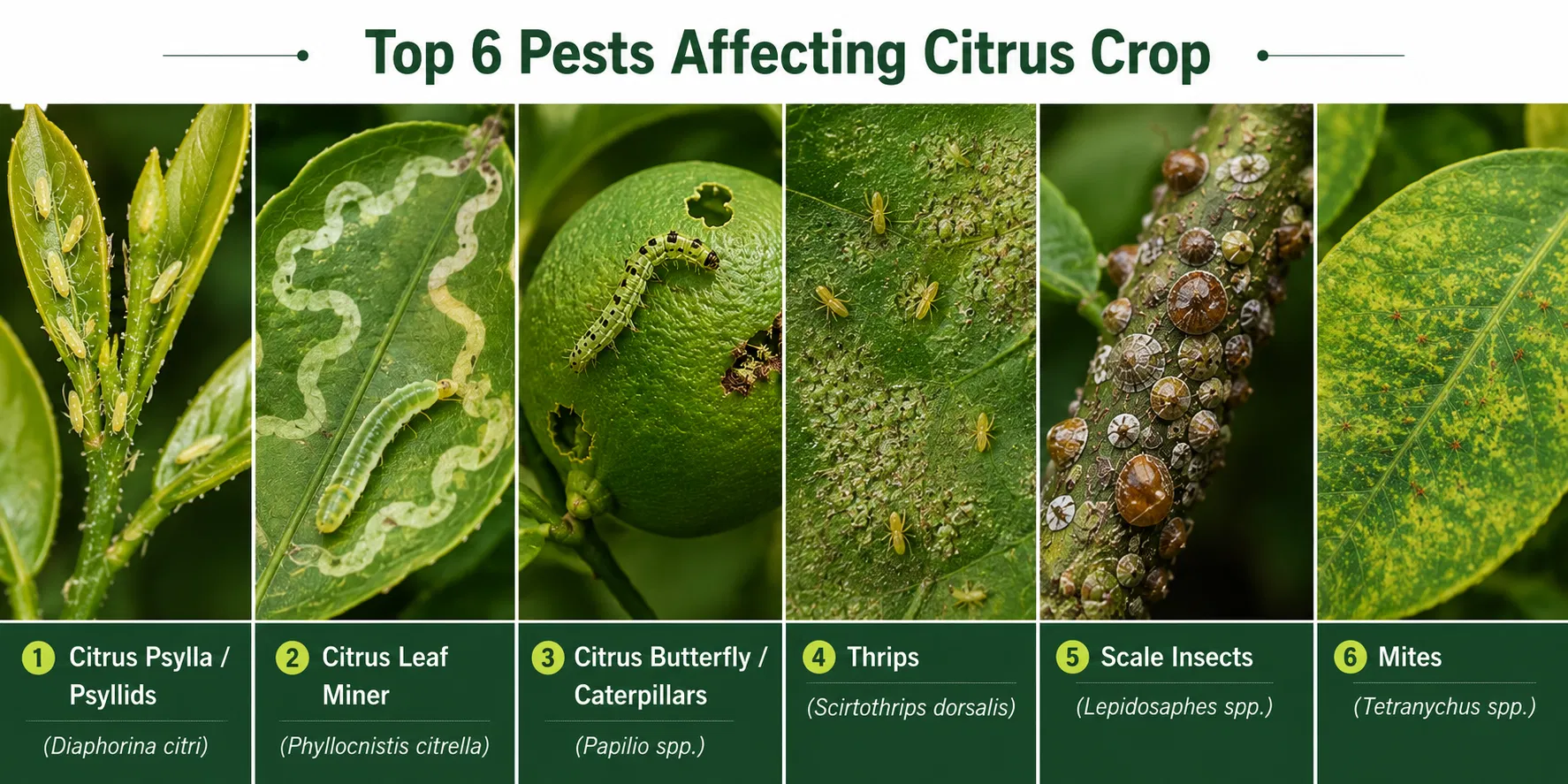
Citrus — oranges, mandarins, lemons and sweet limes — supports its yield and fruit quality on a fairly small window of healthy flush growth and clean fruit rind each season, which is exactly what most citrus pests target. Sap-suckers like psylla and thrips scar fruit and spread disease, leaf miners and caterpillars set back young flush and nursery plants, and scales and mites quietly drain tree vigour over time. This guide walks through the six pests every citrus grower should be able to recognise, how to spot each one early, and the registered insecticide options to manage them.
1. Citrus Psylla / Psyllids (Diaphorina citri)
Citrus psylla feeds on tender shoots and secretes honeydew that invites sooty mould, but its greater threat is as the main vector of citrus greening disease (Huanglongbing), which can eventually kill an infected tree.
How to Spot It
Look for small, brownish, wedge-shaped insects resting at a 45-degree angle on new flush growth, along with curled and distorted young leaves, sticky honeydew with black sooty mould, and waxy tube-like secretions on shoot tips.
Solutions to Manage/Control It
| Product | Active Ingredient |
|---|---|
| Benevia Insecticide by FMC | Cyantraniliprole 10.26% w/w OD |
| Confidor Insecticide by Bayer | Imidacloprid 17.8% SL |
| Actara Insecticide by Syngenta | Thiamethoxam 25% WG |
2. Leaf Miner (Phyllocnistis citrella)
Citrus leaf miner larvae tunnel just beneath the leaf surface of young flush growth, leaving winding trails that curl and distort leaves, weakening young trees and creating entry points that can let citrus canker take hold.
How to Spot It
Look for shiny, winding silvery trails on the underside and top of young leaves, with the leaf curling along the mine and new flush growth appearing stunted or twisted.
Solutions to Manage/Control It
| Product | Active Ingredient |
|---|---|
| Confidor Insecticide by Bayer | Imidacloprid 17.8% SL |
| Furadan 3G Insecticide by FMC | Carbofuran 3% CG |
| Alika Insecticide by Syngenta | Thiamethoxam 12.6% + Lambda-cyhalothrin 9.5% ZC |
3. Citrus Butterfly (Papilio demoleus)
Citrus butterfly caterpillars, especially in nurseries and young plantings, chew through tender leaves and can strip a small tree of foliage quickly during a heavy infestation.
How to Spot It
Look for large, ragged holes in young leaves, greenish-brown caterpillars that resemble bird droppings in their early stages, and a forked orange scent organ (osmeterium) that pops out from behind the caterpillar's head when disturbed.
Solutions to Manage/Control It
| Product | Active Ingredient |
|---|---|
| Ekalux Insecticide by Syngenta | Quinalphos 25% EC |
4. Thrips (Scirtothrips dorsalis)
Thrips scrape and feed on young fruit rind and leaves, causing silvery scarring and ring-like marks on developing fruit that permanently lower the fruit's market grade, even though the pulp inside stays unaffected.
How to Spot It
Look for silvery-grey scarring or ring marks around the stem end of young fruit, tiny slender yellow-to-brown insects on the underside of leaves and inside flower buds, and curled or distorted young leaves.
Solutions to Manage/Control It
| Product | Active Ingredient |
|---|---|
| Benevia Insecticide by FMC | Cyantraniliprole 10.26% w/w OD |
| Alika Insecticide by Syngenta | Thiamethoxam 12.6% + Lambda-cyhalothrin 9.5% ZC |
5. Scales (Lepidosaphes beckii and related species)
Scale insects attach to leaves, twigs and fruit and feed by sucking sap, weakening the tree over time, causing yellowing and leaf drop, and leaving fruit visibly blemished and less marketable.
How to Spot It
Look for small, flat, oyster-shell or shield-shaped brown or grey bumps clustered along twigs, leaf undersides and fruit rind that don't move when touched, often accompanied by yellowing foliage nearby.
Solutions to Manage/Control It
| Product | Active Ingredient |
|---|---|
| Ekalux Insecticide by Syngenta | Quinalphos 25% EC |
6. Mites (Panonychus citri)
Citrus mites feed on leaf and fruit surfaces, causing a dull bronze or silvery discoloration that reduces photosynthesis in leaves and leaves a rough, blemished ""silvering"" on the fruit rind.
How to Spot It
Look for a fine bronze or silvery sheen on leaves and fruit surfaces, tiny reddish specks visible with a hand lens on the underside of leaves, and fine webbing in heavy infestations.
Solutions to Manage/Control It
| Product | Active Ingredient |
|---|---|
| Movento Insecticide by Bayer | Spirotetramat 15.31% w/w OD |
| Pegasus Insecticide by Syngenta | Diafenthiuron 50% WP |
Frequently Asked Questions
What is the biggest threat from citrus psylla?
Citrus psylla is the main vector of citrus greening disease (Huanglongbing), a serious bacterial disease with no cure, which makes controlling psylla populations one of the most important steps in protecting a citrus orchard.
How can I tell leaf miner damage from other leaf problems?
Citrus leaf miner leaves a distinctive shiny, winding silvery trail just under the leaf surface, unlike leaf spot diseases or nutrient deficiencies, which show up as discoloured patches rather than tunnel-like trails.
Does thrips damage on citrus fruit go away as the fruit matures?
No, thrips scarring on young fruit is permanent and stays visible through harvest, though it's mostly a cosmetic issue that lowers the fruit's market grade rather than affecting the pulp inside.
When should citrus trees be sprayed for scale and mite control?
Sprays generally work best when applied at the first sign of infestation on new flush growth or young fruit, since scale and mite populations become much harder to control once they've built up heavy coverage.
- Always confirm the current label registration, recommended dosage, and pre-harvest interval (PHI) for your state and crop stage before using any product mentioned here.
- This is general advisory content only — please do your own research and verify with a local agronomist or dealer before making any purchase, spray, or crop-management decision.