Downy mildew, caused by Plasmopara viticola, is the most destructive disease of grapevines in India, especially in Maharashtra, Karnataka, Andhra Pradesh, and Telangana. A single outbreak during flowering or berry set can destroy a crop. Choosing the right fungicide and applying it at the right time decides whether the vineyard survives the season.
How to Identify Downy Mildew in Grapes
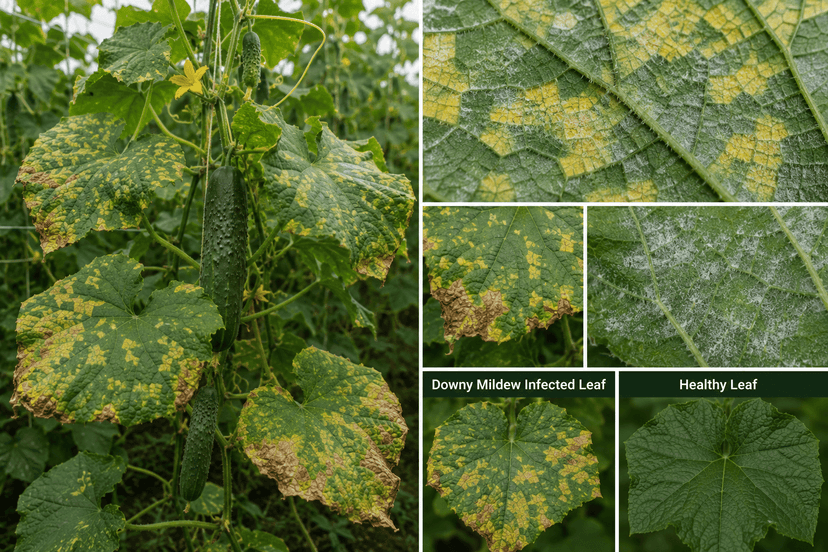
- Yellow oily spots on the upper surface of leaves (often called 'oil spots').
- White, fluffy fungal growth on the lower leaf surface in humid mornings.
- Brown necrotic patches and leaf fall later in the infection.
- Cluster infection turns berries brown, leathery, and shrivelled.
Conditions That Trigger Downy Mildew
- Continuous leaf wetness for more than 10 hours.
- Temperatures between 18 and 25 °C.
- High humidity (above 85 percent) and dense canopy.
- Unseasonal rains during flowering and berry development.
Best Fungicides for Downy Mildew in Grapes
1. Protectant (Contact) Fungicides
These form a barrier on the leaf surface and prevent infection. They must be sprayed before disease appears or just at first symptoms. They have low resistance risk.
- Mancozeb 75 WP at 2 g per litre.
- Copper oxychloride 50 WP at 2.5 g per litre.
- Captan 50 WP at 2 g per litre.
- Bordeaux mixture (1 percent) — traditional but very effective in early stages.
2. Systemic Fungicides (Curative)
These move inside the leaf and stop established infections. Use only when disease pressure is high, and rotate to delay resistance.
- Metalaxyl 8 percent + Mancozeb 64 percent at 2.5 g per litre.
- Cymoxanil 8 percent + Mancozeb 64 percent at 3 g per litre.
- Fosetyl-Aluminium 80 WP at 2 to 2.5 g per litre.
- Dimethomorph 50 WP at 1 g per litre.
- Azoxystrobin 23 SC at 1 ml per litre (broad spectrum).
Spray Schedule for Downy Mildew
Stage | Recommended Spray |
|---|---|
Bud burst to 4-leaf stage | Mancozeb / Copper oxychloride (protectant) |
Pre-bloom | Metalaxyl + Mancozeb or Fosetyl-Al (preventive systemic) |
Flowering | Cymoxanil + Mancozeb or Dimethomorph if rain expected |
Pea-size berry | Azoxystrobin or Fosetyl-Al |
Berry development | Rotate protectant + systemic depending on weather |
Spraying Best Practices
- Spray as soon as the weather turns cloudy or rainy.
- Use 200 to 250 litres of spray solution per acre for full coverage.
- Direct spray on the under-surface of leaves where the fungus develops.
- Repeat protectant spray after heavy rain washes it off.
- Rotate FRAC fungicide groups every 2 to 3 sprays to prevent resistance.
Cultural and Preventive Measures
- Prune to maintain open canopy for sunlight and airflow.
- Remove and destroy fallen infected leaves and berries.
- Avoid evening irrigation that leaves canopy wet overnight.
- Plant only certified, disease-free rootstocks and saplings.
- Maintain balanced nutrition; avoid excess nitrogen.
Conclusion
The best fungicide for downy mildew in grapes is the one applied early, rotated wisely, and supported by good canopy management. Always follow label instructions, observe pre-harvest interval, and consult your local KVK or grape research station for the latest recommended molecules.