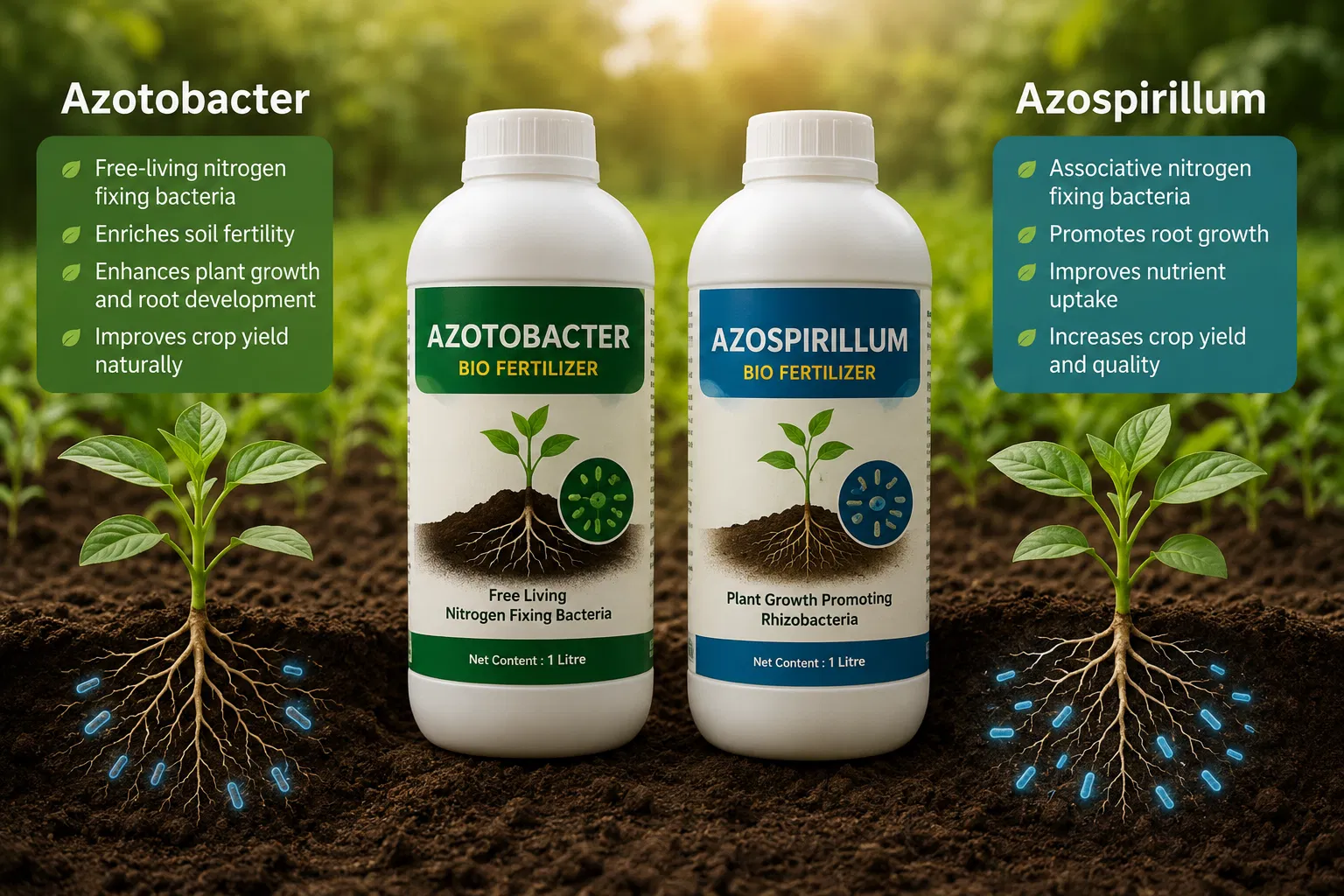
Healthy soil is the foundation of productive farming, and few inputs matter more than nitrogen. Yet synthetic nitrogen fertilizers are costly, energy-intensive, and often inefficient. That is why Azotobacter and Azospirillum have become important names in modern agriculture. These two powerful nitrogen-fixing biofertilizers help crops access natural nitrogen, improve soil health, and support sustainable yield increases without overreliance on chemicals.
Whether you grow cereals, vegetables, fruits, or commercial crops, understanding how these beneficial microbes work can help you make smarter crop nutrition decisions. In this article, we’ll explore what makes Azotobacter and Azospirillum so valuable, how they differ, their benefits, and how farmers can use them effectively.
What Are Azotobacter and Azospirillum?
Azotobacter and Azospirillum are free-living nitrogen-fixing bacteria used as biofertilizers. They live in the soil and help plants by converting atmospheric nitrogen into forms that plants can absorb more easily.
Unlike chemical fertilizers, which directly supply nutrients, these microorganisms work biologically. They enrich the root zone, support microbial activity, and contribute to long-term soil fertility. They are especially useful in sustainable agriculture, organic farming, and integrated nutrient management.
How Nitrogen-Fixing Biofertilizers Work
Plants need nitrogen to build proteins, enzymes, chlorophyll, and DNA. Although nitrogen is abundant in the atmosphere, most plants cannot use it directly. Nitrogen-fixing bacteria solve this problem by converting atmospheric nitrogen into usable compounds.
Azotobacter and Azospirillum live near roots or in the rhizosphere, where they benefit from root exudates. In return, they provide plants with biologically fixed nitrogen and other growth-promoting substances.
Key functions of these biofertilizers include:
- Fixing atmospheric nitrogen
- Producing plant growth hormones
- Improving root development
- Enhancing nutrient uptake
- Supporting soil microbial balance
Azotobacter: A Free-Living Soil Improver
Azotobacter is a free-living, aerobic nitrogen-fixing bacterium commonly found in neutral to alkaline soils. It is widely used as a biofertilizer for many non-leguminous crops. One of its major strengths is its ability to survive independently in the soil while still benefiting plant growth.
Azotobacter does more than fix nitrogen. It also produces biologically active compounds such as auxins, gibberellins, and cytokinins, which stimulate root growth and improve plant vigor.
Benefits of Azotobacter
- Fixes atmospheric nitrogen in the rhizosphere
- Enhances seed germination and root elongation
- Produces growth-promoting substances
- Improves soil fertility and biological activity
- Supports better nutrient absorption
Best suited for
- Wheat
- Maize
- Vegetables
- Cotton
- Oilseed crops
- Orchard crops
Azospirillum: A Powerful Associate of Plant Roots
Azospirillum is another important nitrogen-fixing biofertilizer, especially known for its association with the roots of grasses and cereal crops. Unlike Azotobacter, Azospirillum is often classified as an associative nitrogen fixer because it lives very close to plant roots and benefits from their exudates.
This bacterium is highly valued for promoting root branching, increasing root surface area, and improving plant access to water and nutrients. It is especially effective in crops that respond strongly to root stimulation.
Benefits of Azospirillum
- Fixes nitrogen in association with roots
- Promotes root proliferation and root hair development
- Improves uptake of nitrogen, phosphorus, and other nutrients
- Increases drought tolerance in some crops
- Boosts yield through better plant growth
Best suited for
- Rice
- Wheat
- Maize
- Sorghum
- Millets
- Sugarcane
Azotobacter vs Azospirillum: What Is the Difference?
Both are excellent nitrogen-fixing biofertilizers, but they differ in habitat, crop preference, and mode of action. Knowing these differences helps farmers choose the right one for the right crop.
| Feature | Azotobacter | Azospirillum |
|---|---|---|
| Life style | Free-living | Associative, root-associated |
| Crop suitability | Many non-legumes | Cereals and grasses |
| Nitrogen fixation | Soil-based | Rhizosphere-based |
| Additional effect | Improves soil fertility and growth hormones | Strong root stimulation and nutrient uptake |
In simple terms, Azotobacter is often used as a broad soil enhancer, while Azospirillum is especially useful for crops that benefit from stronger root systems and close root association.
Why Farmers Use Nitrogen-Fixing Biofertilizers
The popularity of biofertilizers is growing because they offer practical and ecological advantages. Azotobacter and Azospirillum can reduce the dependency on synthetic nitrogen fertilizers while maintaining productivity.
Major advantages include:
- Lower fertilizer costs: Reduces the need for excessive chemical nitrogen inputs
- Better soil health: Supports beneficial microbial populations
- Improved crop growth: Enhances root and shoot development
- Eco-friendly farming: Minimizes nutrient runoff and pollution
- Higher nutrient-use efficiency: Helps crops use nutrients more effectively
“Biofertilizers do not replace good agronomy, but they can significantly improve the efficiency of nutrient management in sustainable farming systems.”
How to Apply Azotobacter and Azospirillum
To get the best results, these biofertilizers should be used correctly. They are usually applied as seed treatments, root dips, or soil applications depending on the crop and formulation.
Common application methods
- Seed treatment: Coat seeds with the biofertilizer before sowing.
- Root dip: Dip seedlings in a suspension before transplanting.
- Soil application: Mix with compost or farmyard manure and apply to the field.
Application tips
- Use fresh, quality formulations from reliable sources
- Store biofertilizers in cool, shaded conditions
- Avoid mixing with strong chemical pesticides or fungicides unless compatible
- Apply during sowing or transplanting for best root colonization
- Use along with balanced organic or chemical nutrition for maximum benefit
Factors That Influence Performance
The effectiveness of Azotobacter and Azospirillum depends on several field conditions. These microbes perform best when soil and crop management practices support their survival and activity.
Important factors include:
- Soil pH: Neutral to slightly alkaline soils often favor Azotobacter
- Moisture: Adequate moisture supports microbial activity
- Organic matter: Higher organic content improves bacterial survival
- Temperature: Moderate temperatures are usually ideal
- Compatible crop: Crop choice strongly affects results
Good field management, proper irrigation, and integrated nutrient practices can greatly improve the response to biofertilizer use.
Role in Sustainable Agriculture
As agriculture moves toward more sustainable systems, nitrogen-fixing biofertilizers are becoming essential tools. They help maintain productivity while reducing environmental pressure from synthetic fertilizers. Azotobacter and Azospirillum fit perfectly into organic farming, low-input farming, and climate-smart agriculture.
They also contribute to better root health, improved nutrient cycling, and healthier soil ecosystems. Over time, this can lead to more resilient crops and more stable yields.
Conclusion
Azotobacter and Azospirillum are more than just beneficial bacteria; they are practical, science-backed biofertilizers that help farmers grow healthier crops while protecting soil resources. By fixing nitrogen naturally and stimulating root development, they support sustainable productivity in a cost-effective way.
If you want better crop performance with lower fertilizer dependence, consider integrating Azotobacter and Azospirillum biofertilizers into your nutrient management plan. The future of agriculture depends on solutions that are both productive and sustainable, and these microbes are a smart step in that direction.