

Introduction
Cotton is one of the most important commercial crops grown by farmers for fiber production and income generation. Healthy cotton plants with good vegetative growth are essential for better boll formation and higher yield. However, sucking pests like aphids can seriously affect cotton crop growth if not managed at the right time.
Aphids are small sap-sucking insects that attack tender leaves, shoots, and young plant parts. They multiply rapidly and spread quickly under favorable weather conditions. Severe infestation weakens the crop, affects plant growth, reduces boll development, and lowers overall yield. Aphids also produce honeydew, which leads to black sooty mold formation on leaves and affects photosynthesis. Therefore, early detection and proper management are very important for protecting cotton crops.
What are Aphids in Cotton?
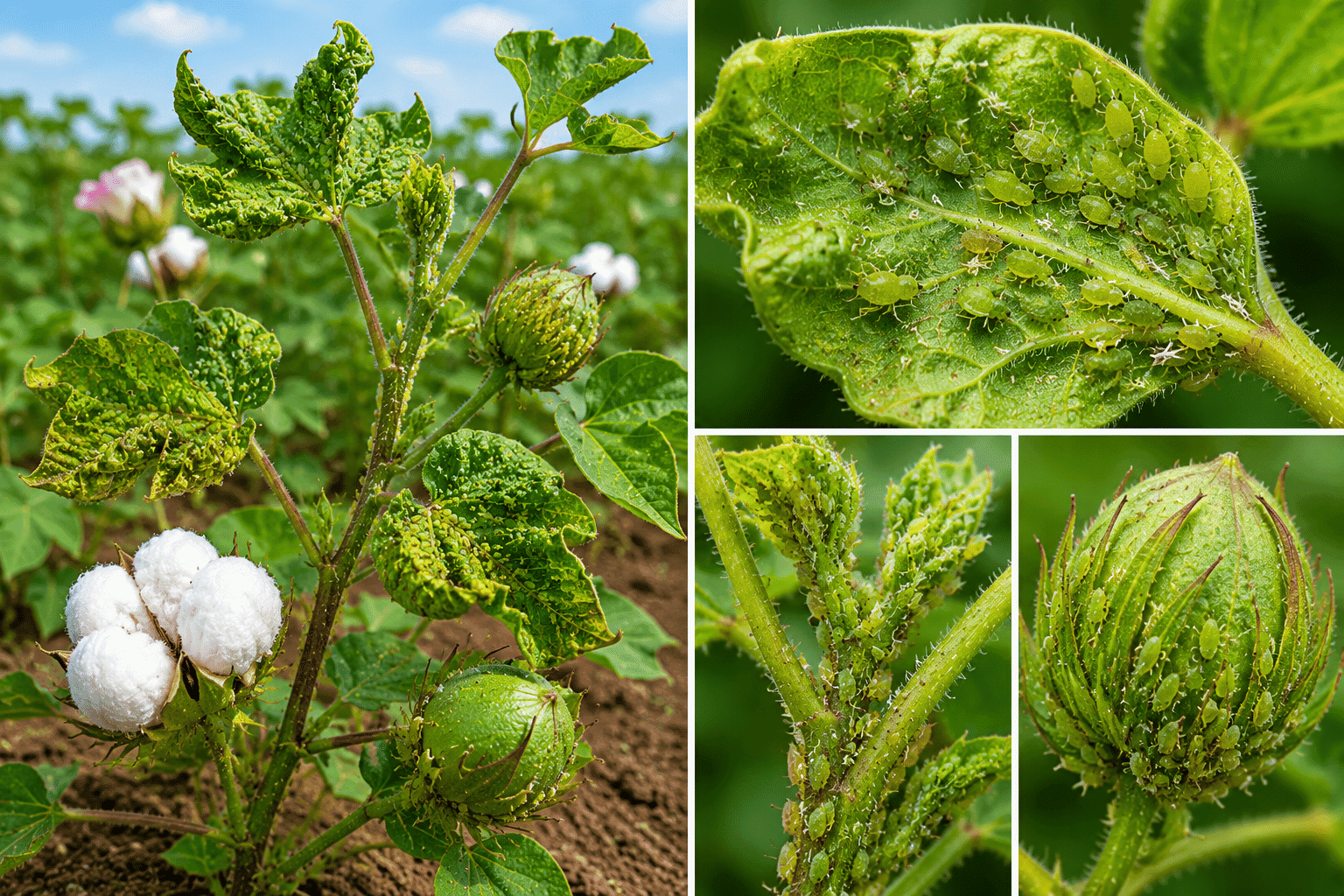
Aphids are tiny soft-bodied insects commonly found on the lower surface of leaves, tender shoots, flower buds, and growing points of cotton plants. They may appear green, yellow, black, or brown in color depending on the species and crop stage.
Both nymphs and adult aphids suck plant sap continuously, which weakens the plant and reduces its growth. Aphids reproduce very quickly, especially during cool and humid weather conditions, and large colonies may develop within a short time.
Apart from direct feeding damage, aphids also secrete sticky honeydew, which encourages the growth of black sooty mold fungus on leaves and plant surfaces.
Symptoms of Aphid Infestation in Cotton
Farmers should regularly inspect cotton fields to identify early signs of aphid infestation. Common symptoms include:
- Curling and crinkling of tender leaves
- Yellowing of leaves
- Sticky honeydew secretion on leaves and stems
- Development of black sooty mold on leaves
- Weak and stunted plant growth
- Drying of tender shoots in severe cases
- Reduced vigor and poor plant appearance
- Heavy ant movement on plants
- Clusters of small insects on the lower side of leaves
In severe infestation, leaves may lose their green color and photosynthesis gets affected due to honeydew and sooty mold formation.
Damage Caused by Aphids in Cotton
Aphids damage cotton crops mainly by sucking plant sap from tender plant parts. Continuous sap sucking weakens the plants and reduces nutrient availability for healthy growth.
Major losses caused by aphids include:
- Reduced vegetative growth
- Poor flowering and boll formation
- Weak plant development
- Reduced photosynthesis due to sooty mold
- Delayed crop growth
- Reduced boll size and yield
- Lower fiber quality in severe infestation
Young cotton plants are more vulnerable because early infestation affects proper crop establishment and branching.
Favorable Conditions for Aphid Development
Aphids multiply rapidly under favorable weather and field conditions. Farmers should be more alert during:
- Cool and humid weather
- Cloudy conditions
- Excess nitrogen fertilizer application
- Dense crop canopy
- Poor field sanitation
- Presence of weeds around the field
- Excessive use of broad-spectrum insecticides
Excess nitrogen promotes soft and tender growth, which attracts aphids. Dense crop canopy and high humidity support rapid multiplication.
Monitoring and Field Scouting
Regular crop monitoring helps in early identification and timely management of aphids. Farmers should inspect the field every week, especially during vegetative and early flowering stages.
During field scouting:
- Check the lower side of leaves carefully
- Observe tender shoots and growing points
- Look for clusters of aphids on leaves
- Identify sticky honeydew secretion
- Observe black sooty mold development
- Monitor ant activity on plants
Heavy ant movement often indicates aphid presence because ants feed on the honeydew secreted by aphids.
Yellow sticky traps can also be installed in the field to monitor aphid population and pest activity.
Best Management Practices for Aphids in Cotton
Integrated pest management gives better and long-lasting control. Farmers should combine cultural, mechanical, biological, and chemical methods instead of depending only on chemical sprays.
Cultural Control Methods
- Keep the field clean and free from weeds.
- Avoid excessive nitrogen fertilizer application.
- Follow balanced fertilizer management practices.
- Maintain proper plant spacing for better air circulation.
- Use healthy and pest-free seed for sowing.
- Avoid unnecessary use of broad-spectrum insecticides.
Proper crop nutrition and field sanitation help reduce aphid infestation.
Mechanical and Physical Control Methods
- Install yellow sticky traps in the field for monitoring and reducing aphid population.
- Remove heavily infested leaves and shoots during early infestation.
- Use strong water spray in small fields to reduce aphid colonies.
- Destroy alternate weed hosts around the field.
These methods are more effective during the early stages of infestation.
Biological Control Methods
Natural enemies play an important role in controlling aphid population naturally. Farmers should conserve beneficial insects by avoiding unnecessary pesticide sprays.
Useful natural predators include:
- Ladybird beetles
- Lacewings
- Hoverflies
- Parasitic wasps
- Spiders
These beneficial insects feed on aphids and help maintain pest population below damaging levels.
Chemical Control Measures
When aphid population crosses the economic threshold level, farmers can use recommended insecticides. Spraying should be done only after proper field observation.
Farmers should follow these important points:
- Use only recommended insecticides for cotton crop.
- Follow label instructions and recommended dosage carefully.
- Rotate insecticides with different modes of action to avoid resistance development.
- Avoid repeated use of the same chemical.
- Ensure proper spray coverage on the lower side of leaves.
Timely spraying during early infestation gives better control and reduces crop loss.
Precautions During Spraying
- Spray during morning or evening hours.
- Avoid spraying during strong winds or rainfall.
- Ensure proper coverage of leaves and tender shoots.
- Use clean water for spray preparation.
- Wear gloves, mask, and protective clothing during spraying.
- Keep children and animals away from the sprayed field.
- Avoid excessive pesticide use to protect beneficial insects.
Preventive Measures for Farmers
Farmers can reduce the chances of heavy aphid infestation by following preventive practices:
- Monitor the crop regularly every week.
- Use balanced fertilizers instead of excess nitrogen.
- Remove weeds from field bunds and nearby areas.
- Encourage natural enemies in the field.
- Install yellow sticky traps for early monitoring.
- Avoid continuous cotton cultivation in the same field.
- Maintain proper field sanitation throughout the crop period.
- Take timely action before infestation becomes severe.
Preventive management is more effective and economical than controlling heavy infestation later.
Conclusion
Aphids are important sucking pests in cotton cultivation and can cause serious yield loss if ignored during the early stages. They weaken plants by sucking sap, reduce photosynthesis through honeydew and sooty mold formation, and affect boll development and fiber quality.
Early identification, regular field scouting, balanced fertilizer use, weed management, conservation of beneficial insects, and timely control measures are essential for effective aphid management. Farmers should follow integrated pest management practices by combining cultural, mechanical, biological, and chemical methods for better and sustainable control. Timely action helps protect cotton plants, improve boll quality, reduce crop loss, and increase overall farm profit.