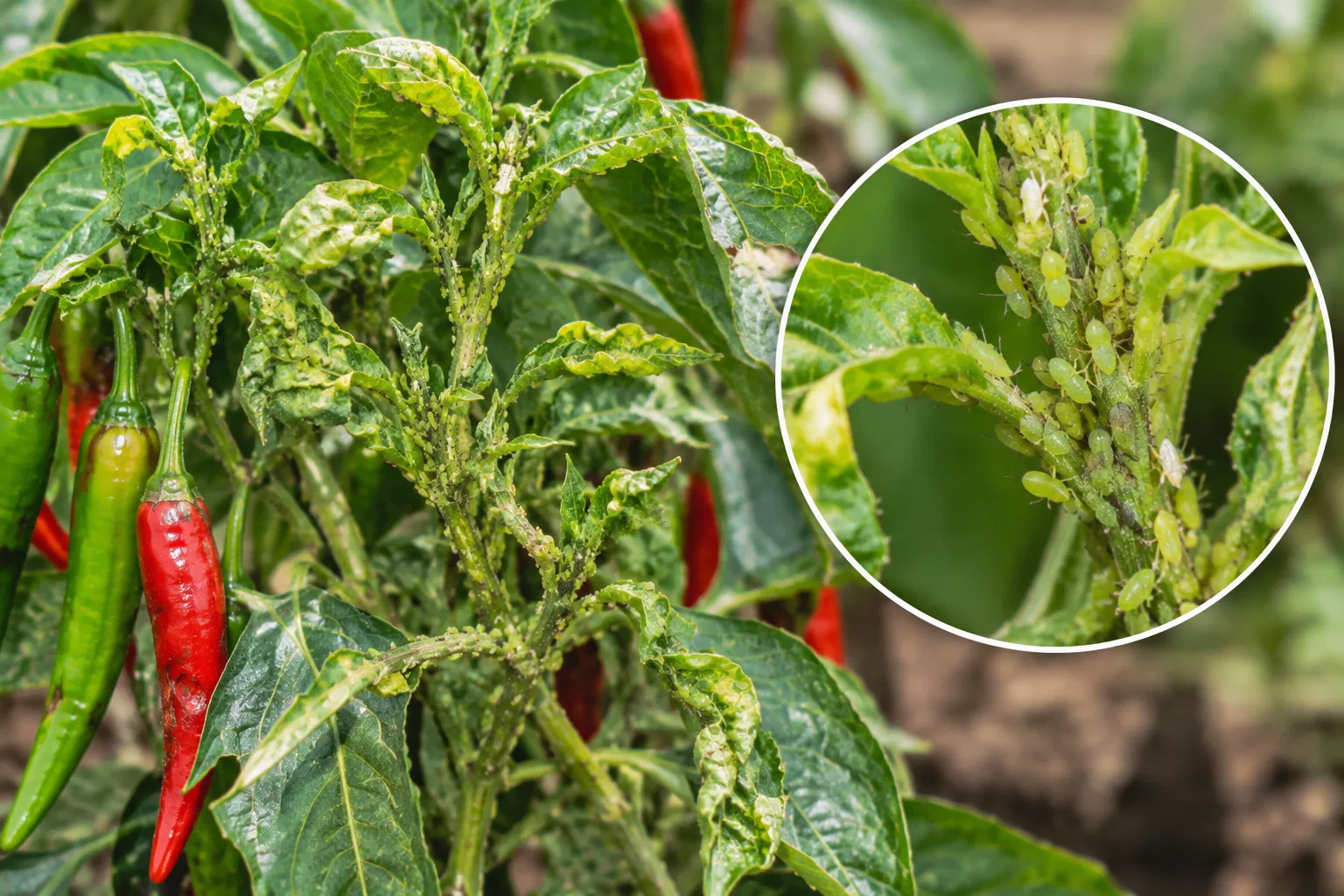
Aphids are easy to underrate in chilli because the direct damage looks mild at first. A few colonies on the underside of some leaves does not seem urgent, and the plant keeps growing. The problem is what happens next. Aphids reproduce without mating and give birth to live young that mature in about a week, so numbers climb faster than almost any other pest in the crop. More seriously, they carry the viruses that cause mosaic and vein banding in chilli, and a single aphid can pass on an infection in the few seconds it spends probing a leaf before it even settles to feed. That makes early detection worth far more than a heavy spray later.
Symptoms
- Dense colonies of small, soft-bodied, slow-moving insects packed on the underside of leaves, on tender shoots and around flower buds
- Downward curling and cupping of leaves with crinkled margins, and shoots that stay short and stunted
- Yellowing, reduced leaf size and a general loss of vigour as sap is drained from the plant
- Sticky honeydew coating the leaf surface, followed by black sooty mould that blocks light and blackens both leaves and fruit
- Ants moving up and down the stems, a reliable secondary sign that colonies are established
- Mosaic mottling, vein banding and leaf distortion where aphids have transmitted viral infections
- Flower and young fruit drop where infestation is heavy during the reproductive stage
Causes
- Aphis gossypii, the cotton aphid, which is the species most often found on chilli, alongside Myzus persicae, the green peach aphid and the more efficient virus carrier of the two
- Parthenogenetic reproduction, where females produce live nymphs without mating and those nymphs mature within about a week, so a few colonisers become a full infestation inside a fortnight
- Warm, dry weather, which suits aphid multiplication; populations build through dry spells and collapse under heavy rain
- Excess nitrogen, which produces the soft, sap-rich foliage that raises aphid survival and breeding rate
- Nearby cotton, brinjal, cucurbit or older chilli crops reaching maturity and releasing waves of winged aphids into the new field
- Broad-spectrum sprays that eliminate ladybird beetles, syrphid larvae, green lacewings and parasitic wasps, removing the natural check on the population
- Weed hosts and volunteer plants on bunds and field borders serving as a reservoir between seasons
- Dense planting and water stress, which create the sheltered canopy aphids favour and weaken the crop's ability to compensate
How to Identify
Aphids are one to two millimetres long, pear-shaped and slow-moving, and they cluster rather than scatter. The confirming feature is a pair of short tube-like cornicles projecting from the rear of the abdomen, which no other small insect in chilli has. Cotton aphids vary from yellowish-green to dark green or almost black, while green peach aphids are shiny pale green and sometimes pink. Start on the underside of the older leaves and the growing points, since colonies establish there before spreading.
Watch for winged individuals mixed into a colony. Their presence means the population is about to disperse to neighbouring plants, and that is the point at which to act rather than after the spread has happened. Put up yellow sticky traps to catch winged migrants and give early warning of an incoming flight, and scout 10 plants at 5 random spots per acre twice a week from transplanting onward.
Two lookalikes are worth ruling out. Thrips also curl leaves but are slender, fast-moving and leave silvery feeding scars along the veins, with no honeydew. Mite damage bronzes the leaf underside and curls it downward, but tapping a leaf produces no visible insects. If the leaves are curling and you can see clustered insects with cornicles plus sticky honeydew, it is aphids.
Control Methods
Chemical Control
1. Flonicamid 50% WG
Flonicamid is a selective feeding blocker developed specifically for sucking pests. It acts on the chordotonal sensory organs of the insect, so aphids lose coordination and stop inserting their stylets within minutes of exposure, then die of starvation. Because feeding stops almost immediately, sap loss and further virus transmission stop with it. It is systemic and translaminar, reaching aphids inside curled leaves, and it is notably safe for bees and natural enemies, which makes it one of the better choices for keeping biological control intact.
Product Recommendation
2. Dimpropyridaz 120 g/l SL
Dimpropyridaz is the newest chemistry available for sucking pests and belongs to a class of its own, with no cross-resistance to anything used before it. It interferes with the TRPV channels that control the insect's sense of coordination, working at a different site from other feeding blockers. Exposed aphids become disoriented, stop feeding within a few hours and cannot fly, which also limits their movement to neighbouring plants. It is registered for aphids in chilli and can be applied from the vegetative stage through flowering and fruit development.
Product Recommendation
3. Spirotetramat 15.31% OD
Spirotetramat inhibits lipid biosynthesis, which starves the insect of the fats it needs to develop, so nymphs fail to mature and adult females produce far fewer viable young. Its distinguishing feature is two-way systemic movement: it travels both upward to new shoots and downward to the roots, reaching aphids on parts of the plant a spray never touched. That makes it valuable for suppressing a population over time rather than for knocking down a colony today, so apply it at the start of a build-up rather than at the peak.
Product Recommendation
4. Tolfenpyrad 15% EC
Tolfenpyrad belongs to the pyrazole group and blocks mitochondrial electron transport, cutting off the insect's energy supply. Its strong anti-feeding action stops damage almost immediately on contact, before the insect dies, and it acts across nymphs and adults alike. It also suppresses egg laying and reduces survival of the young, which slows the rebuilding of the colony between sprays.
Product Recommendation
5. Imidacloprid 30.5% SC
Imidacloprid is a systemic neonicotinoid that binds to nicotinic acetylcholine receptors in the insect nervous system and disrupts normal signal transmission. It is absorbed and moved through the plant, so it reaches aphids sheltering inside curled leaves where a contact spray cannot land, and it remains one of the most economical systemic options available.
Product Recommendation
6. Beta-cyfluthrin 8.49% + Imidacloprid 19.81% w/w OD
This combination pairs a pyrethroid giving rapid contact knockdown with a systemic neonicotinoid absorbed into the plant. It suits situations where jassids, whitefly and thrips are present alongside aphids and a single broad-spectrum spray is wanted, and the oil dispersion formulation improves retention and rainfastness on waxy chilli foliage.
Product Recommendation
Cultural Control
- Raise seedlings under insect-proof net so transplants enter the field clean and do not carry an infestation or an infection in from the nursery
- Avoid planting beside an older cotton, brinjal, cucurbit or chilli crop that is about to be harvested, since maturing crops push waves of winged aphids into the new field
- Clear weed hosts, volunteer plants and crop residue from the field and bunds, where aphids survive between crops
- Keep nitrogen at the recommended dose and apply it in splits, because excess nitrogen directly raises aphid breeding rates
- Rogue out the first few colonised plants or heavily infested leaves rather than waiting for a field-wide spray
- Remove and destroy plants showing clear mosaic or vein banding symptoms, since they act as a virus source for the rest of the field
- Sow two or three border rows of maize or sorghum as a barrier crop, which intercepts winged aphids flying in from neighbouring fields
- Maintain proper spacing and adequate irrigation, since crowded canopies and water-stressed plants both favour rapid colony build-up
- Protect natural enemies by avoiding calendar sprays; ladybird beetles, syrphid larvae, green lacewings and parasitic wasps account for heavy aphid mortality when left undisturbed
Mechanical Control
Install yellow sticky traps at 8 to 10 per acre just above the canopy, raising them as the crop grows. They catch winged aphids, and more usefully they signal when a fresh migration has begun so the first spray can be timed correctly instead of applied on a calendar. Strip off and destroy heavily colonised lower leaves during routine scouting, and on small holdings a strong jet of water directed at the leaf undersides dislodges colonies with no chemical input at all. Silver reflective mulch laid in the nursery and around young plants disorients winged aphids and measurably reduces the number that settle, which is one of the few measures that genuinely cuts virus spread.
Conclusion
Aphids in chilli are manageable, but the goal is not simply killing the ones you can see. Because they multiply within a week and transmit virus in seconds, the work that pays is everything that keeps the population low from the start: a netted nursery, distance from older host crops, clean borders, balanced nitrogen and yellow sticky traps that tell you when a flight has arrived. Scout twice a week, act on the first colonies rather than the first curled leaf, and leave the ladybirds and syrphids alone to do the share of the work they are already doing.
Disclaimer: Always confirm current label registration, approved dosage, water volume, and pre-harvest interval (PHI) for your state before using any product, since labels are periodically revised by regulatory authorities.
This guide is a general advisory. Do your own research and verification before using any product. Always confirm suitability for your crop stage, region, and field conditions before making any purchase, spray, or crop-management decision.