Anthracnose is the disease that decides what a chilli crop is finally worth. It attacks the fruit directly, and a crop that looks healthy in the field can lose a large share of its marketable value between fruit set and drying. The same fungus also causes dieback, killing branches from the tip downward and cutting yield before the fruits even form. What makes anthracnose especially difficult is latent infection: fruits picked green and apparently clean can carry the fungus inside and break down during drying or storage, which is why the disease often shows up only when the crop reaches the market.
Symptoms
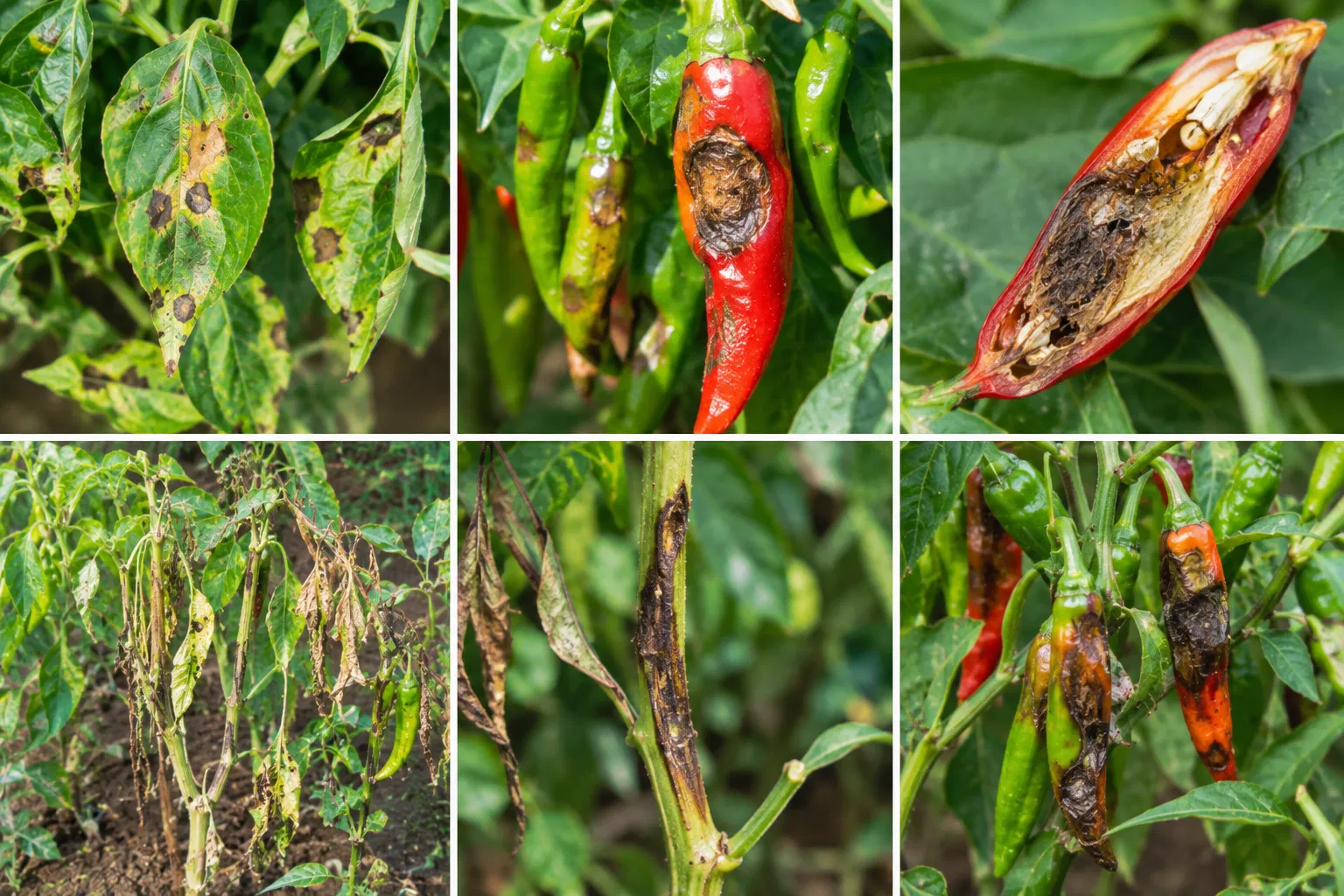
- Sunken, circular to oval lesions on green and ripening fruits, with dark margins and a water-soaked appearance around the edge
- Concentric rings of tiny black dots inside the lesion, which are the fungal fruiting bodies, often bearing pink or salmon-coloured spore masses in humid weather
- Infected fruits turning straw-coloured or whitish and drying on the plant, with the seeds inside blackened and shrivelled
- Dieback beginning as blackening of the growing tip and progressing downward along the twig, killing branches from the top
- Heavy shedding of flowers and buds along with defoliation, leaving the plant looking scorched at the top
- Lesions appearing on apparently sound fruit during drying or storage, from infections that were latent at harvest
Causes
- Several species of Colletotrichum, chiefly Colletotrichum capsici, Colletotrichum gloeosporioides and Colletotrichum acutatum, which survive in infected crop debris, on seed and on alternate hosts
- Infected seed, which is one of the main ways the disease enters a clean field and the reason seed treatment matters so much
- Warm, humid weather between roughly 25 and 30 degrees Celsius combined with long periods of leaf and fruit wetness
- Rainfall during fruit maturity, which splashes spores from infected fruits and debris onto healthy fruit and is the single highest-risk window in the season
- Dense planting and overhead irrigation, both of which keep the canopy wet and slow drying after rain
- Excess nitrogen along with low potassium and calcium, which produces soft fruit skin that the fungus penetrates more easily
- Wounds from thrips, mites, fruit borers and sunscald, which open entry points on the fruit surface
- Continuous chilli cultivation in the same field and infected debris left after harvest, which build up inoculum season after season
How to Identify
The reliable field marker is the lesion structure. Anthracnose produces a depressed, sunken spot on the fruit with concentric rings of black fruiting bodies inside it, and in humid conditions those rings ooze pink or orange spore masses. That separates it from bacterial spot, which leaves raised, scabby, non-sunken spots, and from Phytophthora fruit rot, which shows soft decay with white cottony growth rather than black rings. Cut an affected fruit open and the seeds will be discoloured and shrivelled, which confirms the diagnosis.
For the dieback phase, note the direction of the damage. Anthracnose dieback starts at the growing tip and moves downward, while wilt diseases start at the base and move up, and nutrient problems discolour the leaves without blackening the stem. Scout twice a week from flowering onward, checking the lower canopy and any fruits touching the soil first, and inspect after every rain spell because that is when new infections establish. Remember also that green fruit can carry latent infection with no visible lesion, so a clean-looking crop at harvest is not proof the disease is absent.
Control Methods
Chemical Control
1. Azoxystrobin 18.2% + Difenoconazole 11.4% w/w SC
This combination pairs a strobilurin with a triazole. Azoxystrobin blocks fungal respiration and stops spore germination, while difenoconazole interferes with ergosterol biosynthesis and halts fungal growth already inside the tissue. Together they give preventive and curative action with translaminar and acropetal movement, so the spray reaches parts of the fruit and canopy it did not directly land on. It is the standard choice at the onset of fruit infection.
Product Recommendation
2. Tebuconazole 50% + Trifloxystrobin 25% WG
Another strobilurin and triazole pairing, with trifloxystrobin providing surface and vapour redistribution over the fruit and tebuconazole moving systemically to stop established infection. It gives long residual protection and is particularly suited to the fruit development stage, where repeated coverage of a rapidly expanding fruit surface is difficult to achieve with contact products alone.
Product Recommendation
3. Azoxystrobin 11% + Tebuconazole 18.3% w/w SC
A systemic combination that works on two fronts, with azoxystrobin disrupting energy production in the fungus and tebuconazole blocking cell membrane formation. It offers protective, curative and eradicative action and serves as a useful alternative when the first two combinations have already been used earlier in the season.
Product Recommendation
4. Azoxystrobin 23% SC
Azoxystrobin on its own is a broad-spectrum systemic strobilurin that interferes with fungal respiration, stopping spore germination and early infection. It is most effective applied preventively around flowering and early fruit set, before lesions appear, and gives long residual cover across the canopy.
Product Recommendation
5. Carbendazim 12% + Mancozeb 63% WP
This is the long-standing workhorse for chilli fruit rot and dieback. Carbendazim acts systemically inside the plant to stop the fungus multiplying, while mancozeb forms a protective contact barrier on the surface that prevents new spores from establishing. The combination of internal and external action at an economical price keeps it in most spray programmes.
Product Recommendation
6. Propineb 70% WP
Propineb is a zinc-containing dithiocarbamate that acts on several points in fungal metabolism at once, including respiration and protein synthesis. That multisite action means resistance develops very slowly, which makes it valuable as a rotation partner between systemic sprays. The zinc it releases also supports leaf colour and fruit quality.
Product Recommendation
7. Chlorothalonil 75% WP
Chlorothalonil is a non-systemic contact fungicide that inhibits several metabolic processes in the fungus and is toxic to the fungal cell membrane, stopping spores from germinating on the fruit surface. Because it does not move inside the plant, uniform coverage decides the result, and it must be reapplied as new fruit expands. It carries a very low resistance risk and is a dependable protective partner during the rainy fruit-development window.
Product Recommendation
8. Copper Oxychloride 50% WP
Copper oxychloride releases copper ions on the plant surface that disrupt enzyme systems in both fungal and bacterial pathogens. It is purely protective and needs to go on before infection, but it is inexpensive, works well in humid and rainy conditions, and its bactericidal action is a bonus where bacterial spot is present alongside anthracnose.
Product Recommendation
9. Mancozeb 75% WP
Mancozeb is a multisite contact protectant that attacks several fungal enzyme systems simultaneously, which is why repeated use over many years has not produced resistance. It forms a protective film on the fruit and leaf surface and is the standard base spray to alternate with systemic products. It also supplies trace manganese and zinc to the crop.
Product Recommendation
Building a Rotation
Anthracnose is one of the diseases where the spray schedule matters more than the individual product. Strobilurins such as azoxystrobin and trifloxystrobin, and triazoles such as difenoconazole and tebuconazole, are both prone to resistance when used repeatedly, and Colletotrichum populations in heavy chilli belts have already shown reduced sensitivity in places. Keep sprays containing a strobilurin to no more than two or three in a season, never back to back, and alternate every systemic spray with a multisite protectant such as mancozeb, propineb, chlorothalonil or copper. Begin preventive cover at flowering rather than waiting for the first lesion, since a fungicide applied after fruit lesions appear protects the fruits that are still clean but cannot repair the ones already infected.
Cultural Control
- Use certified disease-free seed and treat it before sowing, since infected seed is one of the main ways the disease enters a clean field
- Collect and destroy infected fruits and blighted twigs during every picking rather than dropping them in the field, where they continue releasing spores
- Plough deeply after harvest and remove crop residue, and rotate with a non-solanaceous crop for at least two seasons where the disease has been severe
- Keep spacing wide enough for air movement and stake the plants so fruits do not rest on wet soil
- Irrigate through drip rather than overhead sprinklers, and water in the morning so the canopy dries before nightfall
- Keep nitrogen moderate and ensure adequate potassium and calcium, which produce firmer fruit skin that resists penetration
- Pick fruits promptly as they ripen instead of letting them over-ripen on the plant, because mature fruit is far more susceptible
- Manage thrips, mites and fruit borers, since the wounds they leave are direct entry points for the fungus
Physical and Post-Harvest Control
Much of the loss from anthracnose happens after picking, so handling matters as much as spraying. Grade out damaged and lesioned fruit before drying rather than letting it sit with the healthy lot, since a single infected fruit spreads spores through a drying heap. Dry on raised platforms, cement floors or clean tarpaulin instead of bare ground, spread the layer thin, and dry as quickly as conditions allow so moisture comes down fast and latent infections have no opportunity to develop. Store only thoroughly dried produce in clean, dry bags, and keep the store itself dry, because re-absorbed moisture during storage is enough to trigger fresh lesions on fruit that looked sound at the time of packing.
Conclusion
Anthracnose cannot be sprayed away once lesions cover the fruit, so the entire approach has to be preventive. Start with clean, treated seed, build a spray programme that begins at flowering and alternates systemic combinations with multisite protectants, and never lean on the same chemistry twice in a row. Around that, keep the canopy open and dry, remove infected fruit at every picking, harvest on time, and dry the crop fast on a clean surface. Managed this way, the fruit that reaches the market is the fruit the season was supposed to produce.
Disclaimer: Always confirm current label registration, approved dosage, water volume, and pre-harvest interval (PHI) for your state before using any product, since labels are periodically revised by regulatory authorities.
This guide is a general advisory. Do your own research and verification before using any product. Always confirm suitability for your crop stage, region, and field conditions before making any purchase, spray, or crop-management decision.