For farmers, weather is more than just a forecast—it influences planting, irrigation, pest management, fertilization, harvesting, and ultimately farm profitability. A missed rainfall event or an unexpected frost can significantly affect crop performance. This is why AI in weather forecasting for agriculture is becoming one of the most valuable technologies in modern farming.
Artificial intelligence (AI) is transforming how weather information is collected, analyzed, and applied on farms. Instead of relying solely on traditional weather forecasts, growers can now access highly localized predictions powered by machine learning, satellite imagery, weather stations, sensors, and historical climate data. These insights enable smarter planning, lower production risks, and more resilient farming operations.
Why Weather Forecasting Matters in Agriculture
Agricultural operations depend on accurate timing. Poor weather decisions can lead to wasted irrigation, ineffective spraying, delayed harvesting, and reduced yields. While traditional forecasting provides valuable regional information, agriculture often requires field-level weather intelligence.
Even neighboring farms may experience different rainfall, wind, humidity, or temperature conditions. AI helps bridge this gap by generating localized forecasts that support day-to-day farm management.
How AI Improves Weather Forecasting for Farmers
AI analyzes vast quantities of environmental and historical data to identify complex weather patterns faster than conventional methods. As more information becomes available, machine learning models continuously improve forecast accuracy.
1. Integrating Multiple Data Sources
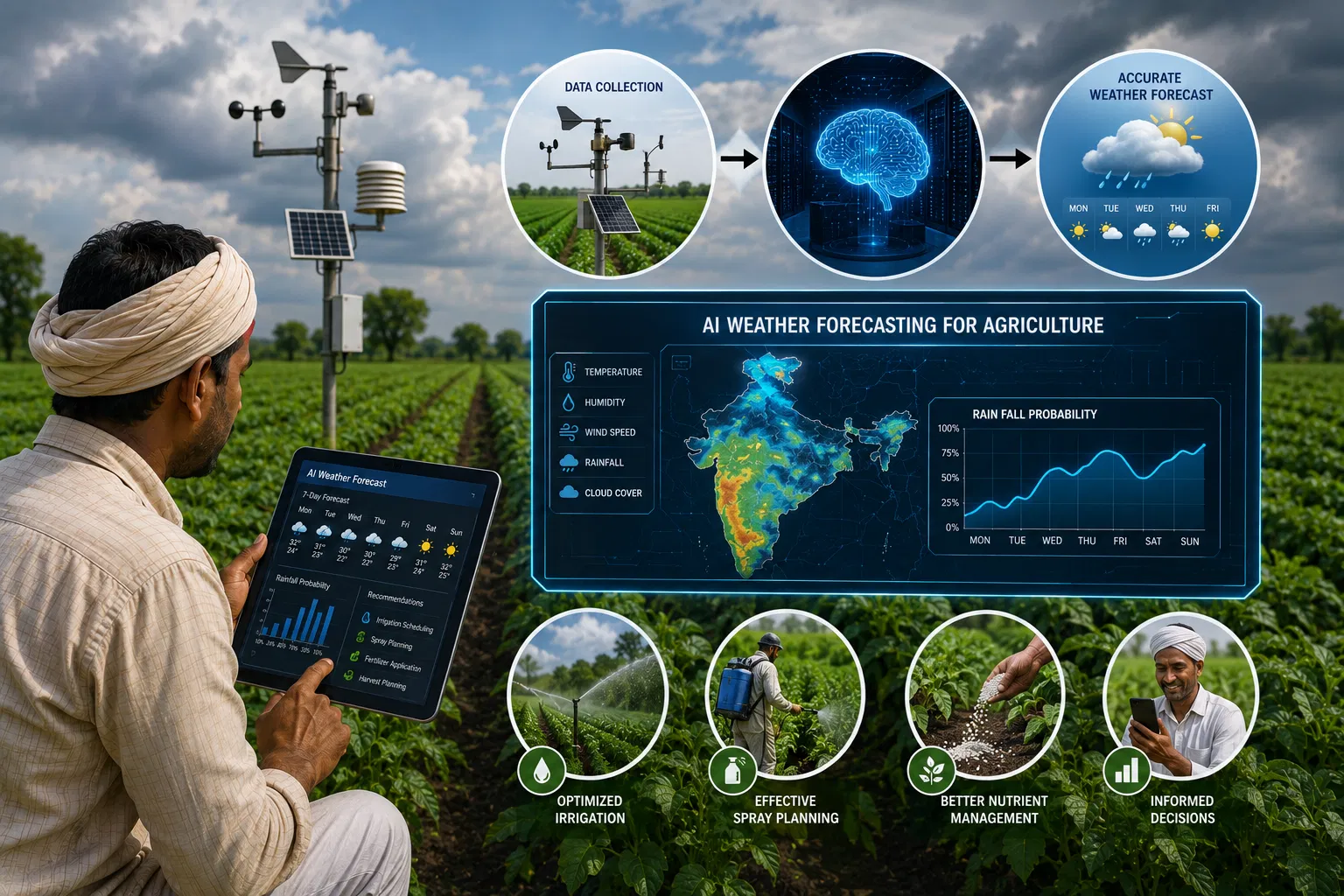
AI combines information from numerous sources, including:
- Weather stations
- Satellite imagery
- Radar observations
- Soil moisture sensors
- Historical weather records
- Crop and field data
- Temperature, humidity, and wind measurements
By integrating these datasets, AI produces more comprehensive and accurate agricultural weather forecasts.
2. Hyperlocal Weather Forecasting
One of AI's greatest advantages is its ability to generate hyperlocal forecasts for individual farms or fields rather than broad regional predictions.
This enables farmers to make more precise decisions regarding irrigation, spraying, planting, and harvesting based on local conditions instead of generalized forecasts.
3. Early Detection of Weather Risks
AI systems can identify changing weather patterns before they become severe. Farmers receive earlier warnings about heavy rainfall, frost, drought, hail, high temperatures, or strong winds, allowing sufficient time to protect crops and equipment.
4. Continuous Learning
Machine learning algorithms improve over time by comparing predictions with actual weather outcomes. As local climate data accumulates, forecast accuracy continues to increase.
Practical Benefits of AI Weather Forecasting in Agriculture
Improved Planting Decisions
AI forecasts help identify suitable planting windows by evaluating soil temperature, rainfall probability, and frost risk, improving seed germination and crop establishment.
Smarter Irrigation Management
AI combines weather forecasts with soil moisture information to support better irrigation scheduling, reducing unnecessary water use while maintaining adequate crop moisture.
Reduced Crop Losses
Early warnings for frost, storms, and extreme temperatures allow growers to take preventive measures before significant damage occurs.
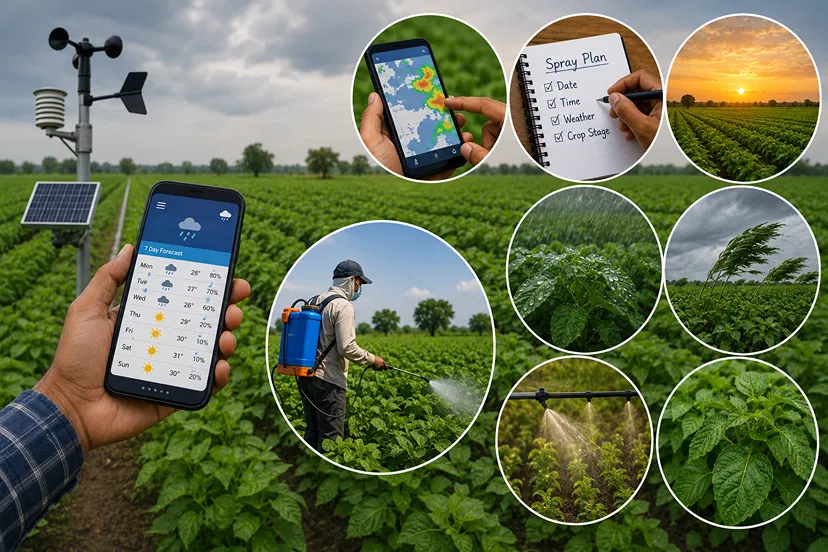
Better Spray Timing
Wind, rainfall, humidity, and temperature strongly influence spray effectiveness. AI helps farmers identify suitable application windows for insecticides, fungicides, and other crop inputs, reducing drift, wash-off, and wasted applications.
Efficient Harvest Planning
Accurate weather forecasts help schedule harvesting during favorable conditions, reducing losses caused by unexpected rainfall or adverse weather.
Better weather forecasts do more than predict the weather—they improve farming decisions, protect yields, and reduce production costs.
Key Technologies Behind AI Weather Forecasting
Machine Learning
Machine learning identifies relationships within large weather datasets and continuously improves forecasting accuracy by learning from historical outcomes.
Remote Sensing
Satellite imagery and aerial observations provide information on cloud movement, vegetation health, moisture conditions, and storm development that AI models analyze in real time.
Internet of Things (IoT) Sensors
Field sensors continuously monitor temperature, humidity, rainfall, wind speed, and soil moisture, allowing AI systems to generate highly localized predictions.
Predictive Analytics
Predictive models estimate future conditions such as drought risk, irrigation requirements, disease pressure, and weather-related crop stress.
Applications of AI Weather Forecasting
AI forecasting supports many areas of modern agriculture, including:
- Precision farming
- Greenhouse climate management
- Disease forecasting and preventive crop protection
- Drought monitoring
- Livestock weather management
- Irrigation optimization
Challenges and Limitations
Although AI significantly improves forecasting, several challenges remain.
- Forecast quality depends on accurate data collection.
- Microclimates can still be difficult to predict perfectly.
- Some farms may have limited access to sensors and digital infrastructure.
- Weather forecasting always contains a degree of uncertainty.
AI should therefore be viewed as a decision-support tool rather than an absolute guarantee.
The Future of AI Weather Forecasting in Agriculture
AI weather forecasting will continue becoming more accurate, localized, and integrated with other precision agriculture technologies.
Future developments may include:
- Field-specific weather dashboards.
- Automated frost, heat, and storm alerts.
- Integration with irrigation systems and farm machinery.
- Crop-specific forecasting models.
- Improved long-term climate adaptation planning.
These innovations will help farmers respond more effectively to increasingly variable weather conditions.
Conclusion
AI is transforming agricultural weather forecasting by providing more accurate, timely, and field-specific predictions. Farmers can use these forecasts to improve planting, irrigation, spraying, harvesting, and overall farm management.
Although AI cannot eliminate weather uncertainty, it helps reduce risk through better planning and faster decision-making. As digital agriculture continues to evolve, AI-powered forecasting will become an increasingly valuable tool for improving productivity and sustainable crop protection practices.