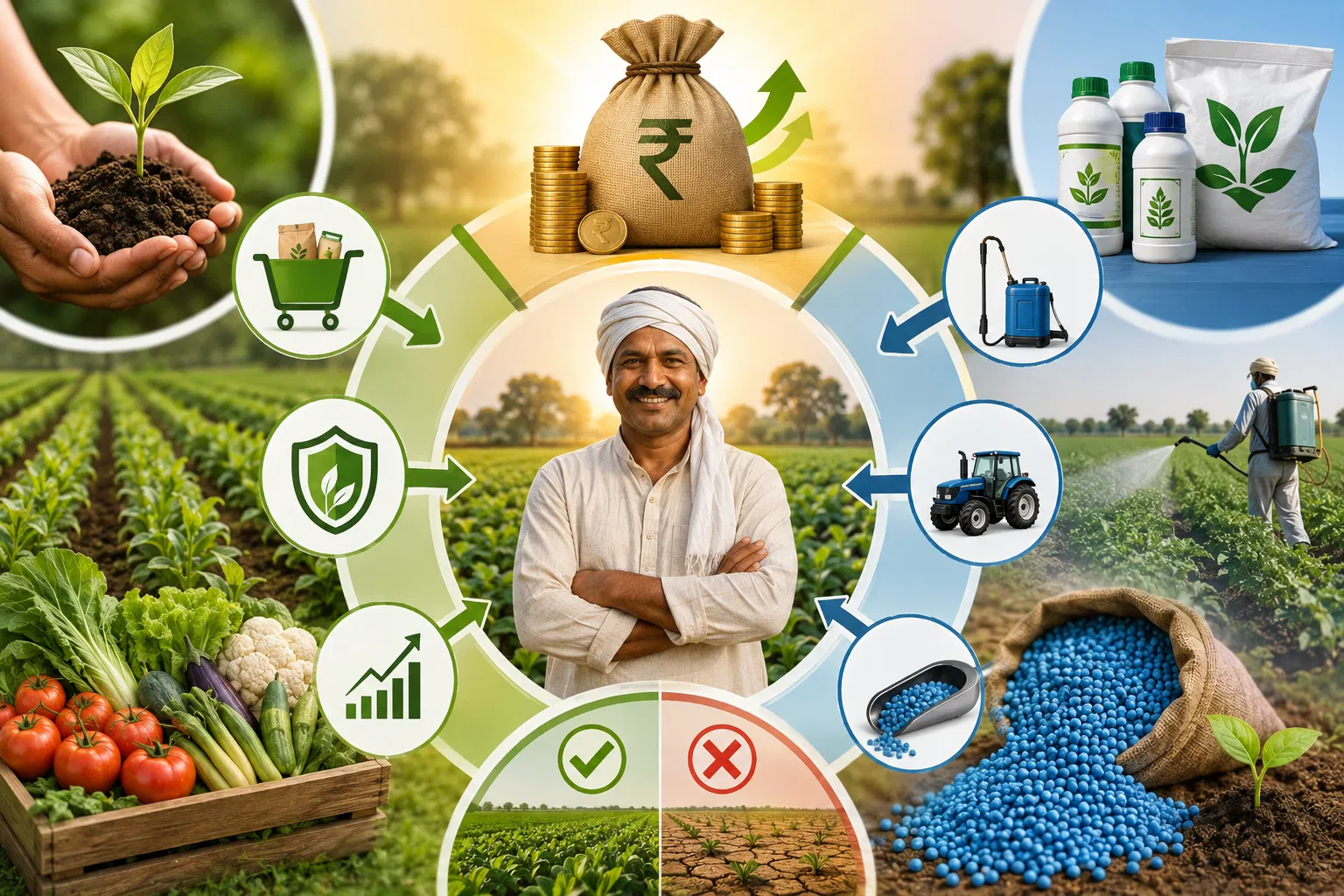
Finance Minister Nirmala Sitharaman's Union Budget 2026-27, presented on 1 February 2026, earmarked ₹1.71 lakh crore for the Department of Fertilizers — one of the single largest components of agriculture-linked government spending, even though it sits outside the Ministry of Agriculture's own budget. This allocation exists because urea, DAP, and other fertilisers cost far more to produce or import than what the government allows companies to charge farmers at the shop counter; the difference is paid out as subsidy. Pesticide support, by contrast, works very differently — it isn't funded through one central subsidy budget the way fertiliser is, but through a mix of state-run subsidised depots and central Integrated Pest Management (IPM) programmes. Understanding both helps farmers know exactly where the government's input support actually reaches them.
Budget 2026-27 Fertilizer & Pesticide Support Overview
- Budget Presented – 1 February 2026, by Finance Minister Nirmala Sitharaman
- Department of Fertilizers Allocation – ₹1.71 lakh crore for 2026-27 (later reports indicate the final allocation was revised upward to around ₹1,91,836.29 crore, and the Fertiliser Ministry has since sought to nearly double this due to rising global costs linked to the West Asia conflict)
- Kharif 2026 P&K Subsidy – ₹41,533.81 crore approved by the Union Cabinet for Phosphatic and Potassic fertilisers (April–September 2026), around ₹4,317 crore more than Kharif 2025
- Pesticide Support Type – No single central pesticide subsidy scheme; support comes through state-run subsidised pesticide depots and central Integrated Pest Management (IPM) programmes
- Type – Central Government (Department of Fertilizers for fertiliser subsidy; Directorate of Plant Protection, Quarantine & Storage, plus State Agriculture Departments, for pesticide/IPM support)
- Helpline No – Kisan Call Centre, 1800-180-1551; farmers can also contact their nearest Krishi Vigyan Kendra (KVK) for IPM demonstration plots or their state agriculture department for subsidised pesticide depot locations
- States Covered – All-India for fertiliser subsidy (uniform statutory pricing); pesticide subsidy access and rates vary by state
Objectives of the Budget's Input Subsidy Support
- Shield farmers from volatile global fertiliser prices and supply disruptions by maintaining statutorily controlled retail prices
- Ensure timely, adequate availability of fertilisers through a mix of domestic production and imports
- Encourage balanced and sustainable nutrient use, alongside continued support for organic fertiliser promotion
- Reduce indiscriminate chemical pesticide use through Integrated Pest Management, protecting soil, water, and human health
- Support domestic fertiliser production capacity to reduce long-term import dependence
Fertilizer Subsidy Structure in Budget 2026-27
| Fertilizer Type | Subsidy Mechanism | Farmer-Facing Price |
|---|---|---|
| Urea | Fully price-controlled; government pays the difference between actual delivered cost and the statutory MRP directly to manufacturers/importers; urea subsidy alone typically accounts for roughly ₹70,000-80,000 crore annually | MRP unchanged since 1 March 2018 — around ₹242-276 per 45 kg bag (varies slightly by source/period), plus applicable neem-coating charges and taxes |
| DAP, MOP, NPK & other P&K fertilisers | Nutrient Based Subsidy (NBS) scheme — a fixed per-kg subsidy rate on Nitrogen, Phosphate, Potash, and Sulphur content, revised each Kharif and Rabi season | DAP around ₹1,350 per 50 kg bag; MOP around ₹1,670 per bag; NPK around ₹1,470 per bag, though exact prices can vary by grade and season |
| Organic Fertilizers | Support through the Policy on Promotion of Organic Fertilizers, including Market Development Assistance and R&D funding | Varies by product and state-level implementation |
Key Features of Fertilizer Subsidy Delivery
- Urea is supplied to farmers at a statutorily notified Maximum Retail Price, with the subsidy covering the gap between this price and the actual cost of production or import
- Under NBS (in effect since 1 April 2010), the P&K sector is decontrolled — companies can set their own MRP within reasonable, monitored levels, while the government pays a fixed nutrient-based subsidy per kg
- For Kharif 2026, per-kg NBS rates were set at approximately ₹47.32 for Nitrogen, ₹52.76 for Phosphate, ₹2.38 for Potash, and ₹3.16 for Sulphur — rates raised from Rabi 2025 to absorb global price pressure without passing the increase on to farmers
- Fertiliser movement is monitored nationwide through the Integrated Fertilizer Monitoring System (iFMS), with states issued monthly supply plans based on projected requirement
- The Department of Fertilizers coordinates weekly with State Agriculture Officials to identify and correct any supply gaps
- Domestic production is supplemented by imports whenever domestic output falls short of seasonal demand, with global tenders processed well in advance
How Pesticide Support Works (Different from Fertilizer Subsidy)
- Unlike fertiliser, there is no single national pesticide subsidy scheme covering all chemical crop-protection products
- The central government's main pesticide-related support comes through Integrated Pest Management (IPM), adopted as the cardinal principle of India's plant protection policy since 1985
- IPM demonstration plots, run through Krishi Vigyan Kendras (KVKs), give farmers free training and subsidised IPM inputs — pheromone traps, sticky traps, neem-based bio-pesticides, and bio-control agents
- Most state agriculture departments separately run subsidised pesticide depots, selling registered crop-protection chemicals at roughly 25-40% below market rate to registered small and marginal farmers
- In emergency pest outbreaks (such as desert locust invasions), the central government has activated emergency subsidy releases, providing free pesticide and aerial spray support to affected farmers
- Some state seed subsidy schemes now bundle basic pest-management kits (like pheromone and sticky traps) alongside seed distribution, encouraging farmers to combine subsidised inputs with lower chemical dependence
Benefits to Farmers
- Fertiliser prices remain stable and predictable at the farm-gate level, insulated from sharp swings in global fertiliser markets
- Comfortable buffer stocks (over 51% of Kharif 2026 seasonal demand reported in inventory) reduce the risk of local shortages during peak sowing periods
- Free or subsidised IPM training and inputs through KVKs help farmers cut pesticide costs while reducing chemical residue on their produce
- State-run subsidised pesticide depots give registered small and marginal farmers access to crop-protection chemicals well below open-market prices
- Emergency pest-outbreak response ensures farmers aren't left to bear the full cost of sudden, large-scale infestations on their own
- Continued organic fertiliser promotion funding supports farmers looking to gradually reduce chemical fertiliser dependence
Limitations and Points of Concern
- The Fertiliser Ministry has sought to nearly double the ₹1.71 lakh crore Budget Estimate due to a sharp rise in import costs linked to the West Asia conflict, indicating real pressure on the subsidy bill exceeding what was originally budgeted
- Because pesticide subsidy is largely state-driven rather than centrally standardised, the discount rate, access, and product range can vary significantly from state to state
- IPM benefits are concentrated around KVK demonstration plots, so farmers without a nearby, active KVK programme may have more limited direct access
- Subsidised pesticide depots are generally reserved for registered small and marginal farmers, so eligibility can be a barrier for unregistered or larger landholding farmers
- Global fertiliser price volatility (driven by supply chain disruptions) continues to create uncertainty around whether the budgeted subsidy figure will hold through the full financial year
Documents Required
- Aadhaar Card
- Land ownership or cultivation proof
- Farmer registration with the state agriculture department (for subsidised pesticide depot access)
- Bank account passbook, where DBT-linked components apply
- Category proof (small/marginal farmer status), where required by state-specific pesticide subsidy rules
How Farmers Can Access These Benefits
- Fertiliser at the subsidised MRP is available directly through any authorised fertiliser retailer or cooperative dealer — no separate application is needed, since the subsidy is built into the retail price itself.
- To access subsidised pesticides, register with your state agriculture department as a small or marginal farmer and locate your nearest state-run subsidised pesticide depot (run by departments like UP's Krishi Vibhag, MP's Agriculture Department, or Bihar's ATMA programme).
- Contact your local Krishi Vigyan Kendra (KVK) to enrol in Integrated Pest Management demonstration programmes for free training and subsidised bio-pesticide inputs.
- During notified pest emergencies, watch for announcements from your district agriculture office regarding free emergency pesticide or aerial spray support.
- Check the iFMS-linked monthly supply plan or your local cooperative society for fertiliser stock availability ahead of the sowing season to plan purchases early.
- Where available, combine subsidised seed kits that include pest-management tools (like pheromone traps) with your regular input purchases to reduce overall chemical dependence.
Conclusion
Fertiliser and pesticide support in Budget 2026-27 work through fundamentally different mechanisms — a large, centrally administered price-control and nutrient-subsidy system for fertilisers, and a more fragmented, state-led combination of subsidised depots and IPM training for pesticides. With fertiliser subsidy demand already running ahead of the original ₹1.71 lakh crore estimate due to global price pressures, farmers can expect continued government focus on keeping urea and DAP prices stable at the farm gate, while pesticide cost relief remains something farmers generally need to actively seek out through their state agriculture department or local KVK.
Disclaimer: This article is for informational purposes only. Scheme details, interest rates, and subvention amounts are subject to periodic revision by the Government of India, RBI, and NABARD. Farmers are advised to verify the latest terms and eligibility criteria with their bank, NABARD, or official government sources before applying.