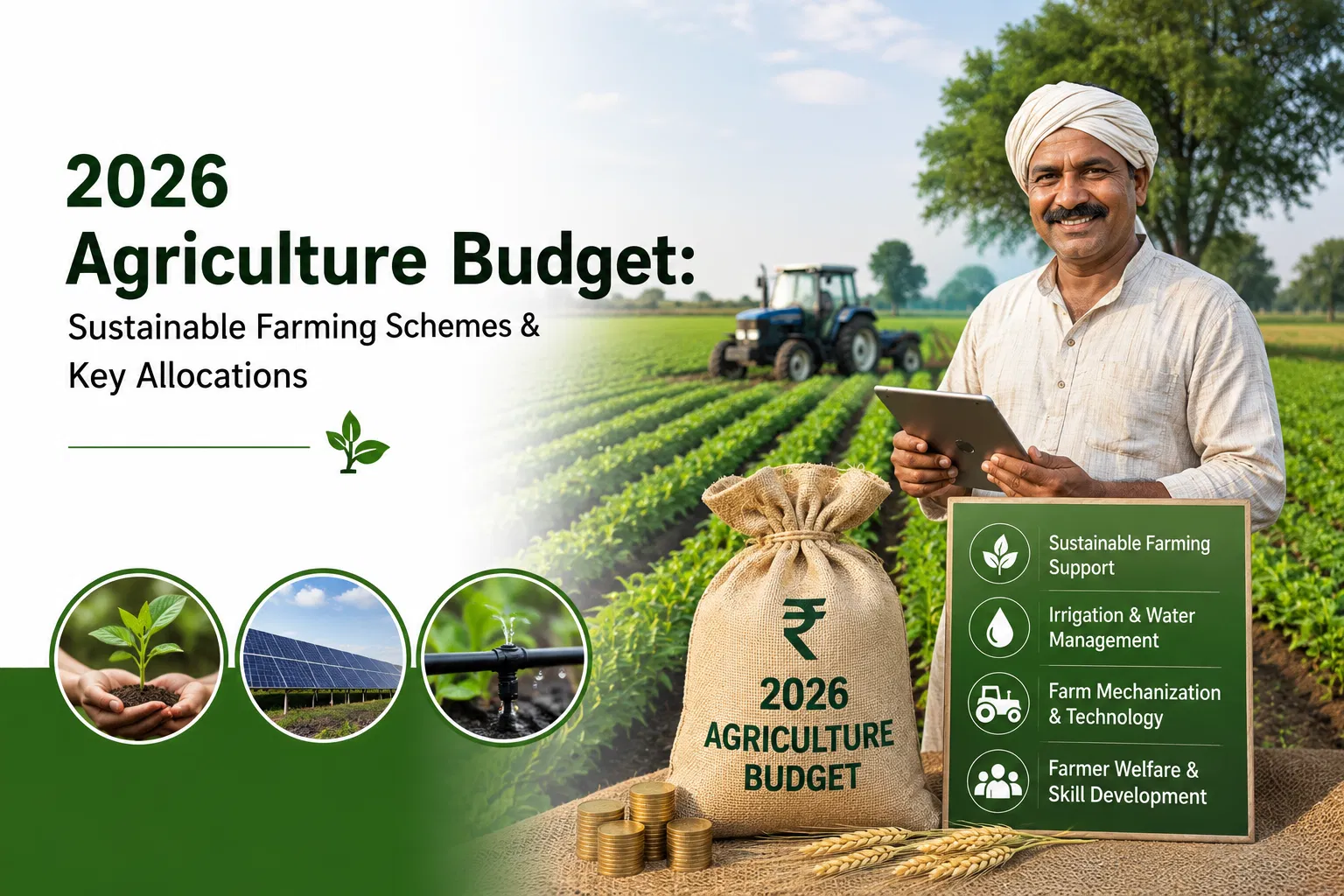
Finance Minister Nirmala Sitharaman presented the Union Budget 2026-27 on 1 February 2026, setting out the government's spending plan for agriculture, rural development, and allied sectors for the coming financial year. The Ministry of Agriculture and Farmers' Welfare received an allocation of around ₹1,32,561 crore, alongside a separate ₹1,70,944 crore fertiliser subsidy under the Department of Fertilizers. Rather than a single dramatic overhaul, this budget continued the direction set in recent years steady growth in core farm spending, a sharper push toward allied sectors like dairy and fisheries, and continued investment in sustainability-linked programmes such as natural farming, soil health, and micro-irrigation.
Budget 2026-27 Agriculture Overview
- Budget Presented – 1 February 2026, by Finance Minister Nirmala Sitharaman
- Total Agriculture & Allied Sector Allocation – ₹1.62 lakh crore, around 7% higher than the Revised Estimates of ₹1.51 lakh crore for 2025-26
- Ministry of Agriculture and Farmers' Welfare Allocation – Approximately ₹1,32,561 crore (figures cited across sources range from ₹1.30 lakh crore to ₹1.40 lakh crore depending on which sub-components are included)
- Department of Fertilizers Allocation – ₹1,70,944 crore, a growth of nearly 9% over the previous year
- Type – Central Government Union Budget, covering Centrally Sponsored Schemes and Central Sector Schemes administered by the Ministry of Agriculture and Farmers Welfare
- Helpline No – Kisan Call Centre, 1800-180-1551, for queries on any individual scheme mentioned in the budget
- States Covered – All-India, with state-specific implementation through respective Agriculture Departments
Objectives of the Budget's Agriculture Push
- Improve farmer incomes through diversification into high-value crops and stronger value-chain integration
- Expand digital agriculture infrastructure and AI-based advisory tools for farmers
- Promote sustainable, climate-resilient, and chemical-free farming practices
- Strengthen allied sectors — dairy, fisheries, and animal husbandry — as additional income sources
- Continue investment-led growth in infrastructure, mechanisation, and farm productivity rather than only consumption-oriented spending
Key Sustainable Farming Allocations
| Scheme / Component | Budget 2026-27 Allocation | Focus Area |
|---|---|---|
| PM Rashtriya Krishi Vikas Yojana (PM-RKVY) | ₹57,074.72 crore (under the broader ₹1,01,321.61 crore package approved for related schemes) | "Cafeteria" scheme letting states choose components: soil health management, Rainfed Area Development, Agroforestry, organic farming (Paramparagat Krishi Vikas Yojana), mechanisation/crop residue management, Per Drop More Crop, crop diversification, and RKVY-DPR |
| Krishionnati Yojana | Hiked by ₹4,400 crore over the previous year — one of the largest increases in this budget | Umbrella scheme for productivity, extension, and market-linked improvements across crops |
| Modified Interest Subvention Scheme (MISS) | ₹22,600 crore (unchanged from 2025-26), around 16% of the total ministry budget | Subsidised KCC crop loan interest, indirectly supporting timely, well-financed cultivation |
| Pradhan Mantri Fasal Bima Yojana (PMFBY) & RWBCIS | ₹12,200 crore, largely similar to 2025-26 Revised Estimates (crop insurance funding was reduced slightly from the prior year's Budget Estimate) | Crop insurance against natural risks from pre-sowing to post-harvest stages |
| Mission for Vegetables and Fruits | ₹700 crore | Boosting horticulture productivity and diversification |
| High-Value Crop Promotion | ₹350 crore | Coconut, sandalwood, cocoa, cashew, agarwood, walnuts, almonds, and pine nuts |
| Bharat-VISTAAR (AI advisory platform) | ₹150 crore | Multilingual AI tool integrating AgriStack and ICAR's farming-practice packages for farmer advisory |
| Mission for Atmanirbharta in Pulses | State-wise allocations continued (for example, ₹104.17 crore to Assam) | Boosting domestic pulses production and reducing import dependence |
Focus on Natural and Organic Farming
- Chemical-free natural farming continues to be promoted nationwide as part of the government's sustainability push, building on the goal set in earlier budgets to bring one crore farmers into natural farming practices
- Budget documentation for 2026-27 describes efforts to "scientifically strengthen agricultural practices towards sustainability, climate resilience and safe food," with institutional capacity-building for natural farming documentation, farmer-led demonstration, training, and continuous hand-holding support
- Paramparagat Krishi Vikas Yojana (organic farming) continues as a selectable component under the PM-RKVY cafeteria structure, giving states flexibility to prioritise organic conversion support locally
- Soil Health Management remains another selectable PM-RKVY component, encouraging regular testing and nutrient management to reduce over-dependence on chemical fertilisers
What This Means for Farmers
- Direct income support through PM-KISAN and subsidised credit through MISS continue largely unchanged, giving farmers predictable, familiar support structures
- States have more flexibility than before to direct PM-RKVY funds toward the sustainability components most relevant to local conditions — be it agroforestry, micro-irrigation, or organic farming
- Farmers cultivating high-value crops (coconut, cashew, sandalwood, and similar) have a newly dedicated funding stream to tap into, alongside the broader horticulture push
- Access to AI-based advisory through Bharat-VISTAAR is expected to expand, giving farmers more localised, multilingual guidance drawing on AgriStack and ICAR research
- Crop insurance coverage under PMFBY remains largely flat in funding terms even as extreme weather events increase, which some agricultural groups have flagged as a concern for farmers facing rising climate risk
Limitations and Points of Concern
- Several schemes saw allocations remain flat or only marginally increased compared to the previous year, rather than substantial new funding
- PMFBY's crop insurance allocation was reduced slightly from the prior Budget Estimate, a concern flagged given rising instances of floods, heatwaves, and erratic rainfall affecting farmers
- Certain "missions" announced with visibility in earlier budgets reportedly received zero funds in both the 2025-26 Revised Estimates and the 2026-27 allocation, raising questions from agricultural policy groups about their actual implementation
- Because PM-RKVY operates as a flexible "cafeteria" scheme, the specific sustainability benefit a farmer receives depends heavily on which components their state chooses to prioritise, leading to uneven benefits across states
- Budget figures for the Ministry of Agriculture and Farmers' Welfare vary slightly across sources (₹1.30 lakh crore to ₹1.40 lakh crore) depending on which sub-components and departments are included in the count
How Farmers Can Access These Budget-Linked Benefits
- Check with your State Agriculture Department on which PM-RKVY components — natural farming, soil health, agroforestry, micro-irrigation, or mechanisation — your state has prioritised for the year.
- If you already hold a Kisan Credit Card, continue availing the MISS-subsidised interest rate on crop loans, since this scheme continues largely unchanged.
- Ensure your PMFBY crop insurance enrolment is active and up to date ahead of the sowing season to remain covered.
- If you cultivate high-value crops like coconut, cashew, or sandalwood, ask your local horticulture office about newly available support under the dedicated high-value crop promotion allocation.
- Explore Bharat-VISTAAR or other AgriStack-linked advisory tools as they roll out in your region for localised, AI-supported farming guidance.
- Watch for state-level Annual Action Plans under PM-RKVY, since these determine exactly which sustainable-farming subsidy or support becomes available locally each year.
Conclusion
The Union Budget 2026-27 largely continues the government's existing agricultural direction rather than introducing sweeping new schemes — steady growth in core allocations, continued flexibility for states through PM-RKVY's cafeteria approach, and a clear thread of sustainability running through natural farming, soil health, and micro-irrigation support. For farmers, the practical takeaway is less about a single new benefit and more about staying engaged with their state's specific implementation choices, since much of this year's sustainability funding flows through flexible, state-directed channels rather than one uniform national scheme.
Disclaimer: This article is for informational purposes only. Scheme details, interest rates, and subvention amounts are subject to periodic revision by the Government of India, RBI, and NABARD. Farmers are advised to verify the latest terms and eligibility criteria with their bank, NABARD, or official government sources before applying.