Whitefly damages chilli twice over, and the second injury is the expensive one. The feeding itself drains sap and coats the leaves in honeydew, which is manageable. What is not manageable is the virus: whitefly is the only carrier of chilli leaf curl, and an infected plant never recovers, never yields properly and cannot be treated. The other difficulty is biological. Adults fly off the moment a sprayer approaches, while the eggs and nymphs that make up most of the population sit fixed and hidden on the underside of the leaf. Spraying at the adults alone leaves the next generation untouched, which is why a field can look clean for three days and be covered again in a week.
Symptoms
- Clouds of tiny white-winged insects rising from the canopy when the plants are disturbed, settling again within seconds
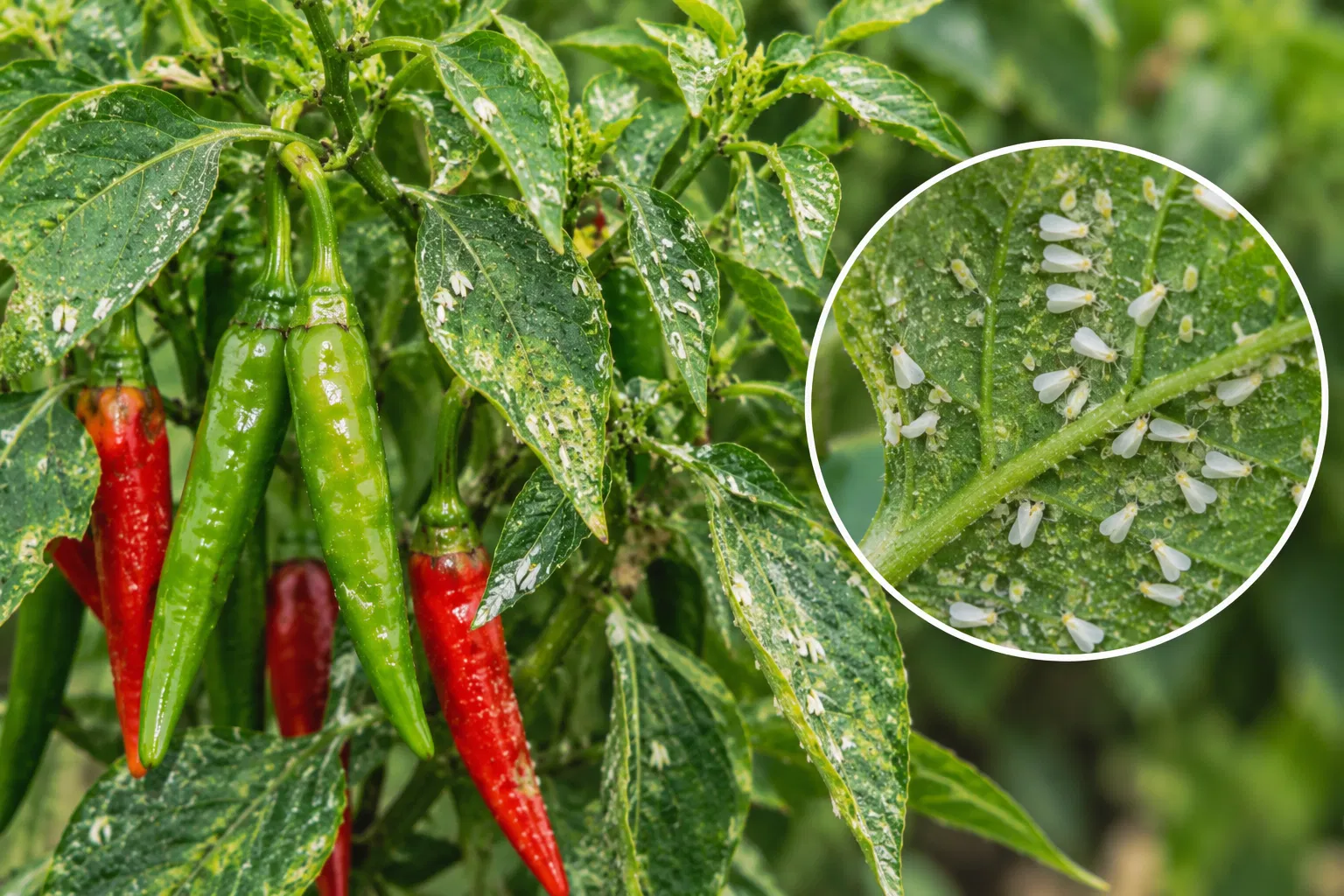
- Flat, oval, scale-like nymphs and pale yellow eggs packed on the underside of young and middle leaves, easily mistaken for dirt or scale
- Yellowing, mottling and downward curling of leaves, with reduced leaf size and a stunted, bushy plant
- Sticky honeydew on the leaf surface followed by black sooty mould, which blocks light and blackens leaves and fruit alike
- Upward curling and puckering of leaves with shortened internodes and a bunched top, the signature of chilli leaf curl virus rather than of feeding alone
- Heavy flower and bud drop, with infected plants setting few fruits and those small and misshapen
- Ants working the plant, drawn by the honeydew
Causes
- Bemisia tabaci, the whitefly responsible, which carries chilli leaf curl virus and completes a generation in roughly three weeks in warm weather
- Hot, dry weather with temperatures above 30 degrees Celsius, which speeds up breeding; heavy rain washes nymphs off the leaves and suppresses the population
- Eggs and immobile nymphs concentrated on the leaf underside, where a spray directed downward over the canopy never reaches them
- Repeated use of the same insecticide groups, which has produced heavy resistance in Indian whitefly populations, especially to the neonicotinoids and pyrethroids relied on for years
- Broad-spectrum sprays that eliminate Encarsia formosa and other parasitoids, along with predatory mites, anthocorid bugs and lacewings that would otherwise hold numbers down
- A very wide host range covering cotton, tomato, brinjal, okra, cucurbits, pulses and many weeds, which keeps a reservoir alive next to the field
- Nearby cotton or older chilli and tomato crops reaching maturity, which release waves of adults into a young crop
- Excess nitrogen, which produces soft, lush foliage that supports faster breeding
- Dense planting and a closed canopy, which shelters the pest and blocks spray from reaching the lower leaf surfaces
How to Identify
Adults are about one millimetre long with pale yellow bodies and white wings dusted with a waxy powder. They gather on the underside of the youngest leaves near the growing tip, so lift a top leaf and look beneath it rather than shaking the plant, which only scatters them. The give-away is the flight response: brush the canopy and a small white cloud lifts and resettles almost at once.
Counting adults badly understates the problem, because they are the smallest part of the population. Turn over middle-aged leaves and look for the immature stages: eggs are minute, pale yellow and stalked, laid in loose groups, and the nymphs after the first stage are flat, oval, translucent and completely stationary, looking more like scale insects or specks of grime than anything alive. A leaf that carries these is a leaf producing next week's adults, and that is the stage a spray has to reach.
Separate feeding damage from virus damage, because the response differs. Feeding produces yellowing, honeydew and sooty mould and eases once the pest is controlled. Leaf curl virus produces upward curling and puckering, severely shortened internodes and a stunted bunched plant, and no spray reverses it. Put up yellow sticky traps, which attract whitefly strongly, and scout twice a week from transplanting, checking the youngest leaves for adults and the middle leaves for eggs and nymphs.
Control Methods
Chemical Control
1. Dimpropyridaz 120 g/l SL
Dimpropyridaz is the newest chemistry available for sucking pests and sits in a class of its own, with no cross-resistance to anything used before it. It interferes with the TRPV channels that govern the insect's coordination, a different target from every other feeding blocker. Exposed whitefly become disoriented, stop feeding within a few hours and are unable to fly, which limits their movement to neighbouring plants as well as their damage. It is registered for whitefly in chilli and can be used from the vegetative stage through flowering and fruit development.
Product Recommendation
2. Pyriproxyfen 10% EC
Pyriproxyfen is an insect growth regulator that mimics juvenile hormone, so treated eggs fail to hatch and nymphs cannot moult into adults. It also sterilises the females it contacts, cutting the next generation before it is laid. This is the group that addresses the real problem with whitefly, because it works on the eggs and fixed nymphs that make up the bulk of the population rather than on the mobile adults. It gives no visible knockdown, so judge it by the fall in nymph counts a week later rather than by dead adults on the day.
Product Recommendation
3. Pyriproxyfen 5% + Fenpropathrin 15% EC
This combination covers both halves of the population in a single spray. Pyriproxyfen halts eggs and nymphs as above, while fenpropathrin, a synthetic pyrethroid, knocks down the adults on contact. It suits the situation most growers actually face, where adults are visible on the top leaves and nymphs are building underneath, and it saves the second pass a standalone growth regulator would need.
Product Recommendation
4. Cyantraniliprole 7.3% + Diafenthiuron 36.4% w/w SC
A dual-action systemic combination. Cyantraniliprole binds to ryanodine receptors and drains calcium from the muscle cells, stopping feeding within hours, while diafenthiuron is converted on the leaf into an active form that blocks energy production in the insect and also has vapour action, reaching pests on surfaces the spray missed. The systemic movement carries it into curled leaves where whitefly shelters, which contact products cannot do.
Product Recommendation
5. Flonicamid 50% WG
Flonicamid is a selective feeding blocker built for sucking pests. It acts on the chordotonal sensory organs, so whitefly lose coordination and stop feeding within minutes, then die of starvation. Because feeding stops almost at once, sap loss and honeydew production stop with it. It is systemic and translaminar, and notably safe for bees and natural enemies, which makes it a good choice where parasitoids are still active in the field.
Product Recommendation
6. Fenpropathrin 30% EC
Fenpropathrin is a synthetic pyrethroid that acts on sodium channels in the insect nervous system, giving fast contact knockdown of adults along with useful activity against mites. It is the option to reach for when adult numbers are high and immediate suppression is needed, but it does nothing to the eggs and nymphs underneath, so pair it with or follow it by a growth regulator rather than relying on it alone.
Product Recommendation
7. Beta-cyfluthrin 8.49% + Imidacloprid 19.81% w/w OD
This pairs a pyrethroid giving rapid contact knockdown with a systemic neonicotinoid taken up into the plant. It suits fields carrying aphids, jassids and thrips alongside whitefly, where one broad-spectrum spray is wanted, and the oil dispersion formulation improves retention and rainfastness on waxy chilli foliage.
Product Recommendation
8. Acephate 50% + Imidacloprid 1.80% SP
An organophosphate and neonicotinoid combination with contact, stomach and systemic action. Acephate gives broad knockdown across sucking and chewing pests while imidacloprid moves through the plant, and the soluble powder formulation is economical for large areas under mixed pest pressure.
Product Recommendation
Getting the Spray to Where the Pest Is
With whitefly the technique matters as much as the product. Eggs and nymphs sit on the underside of the leaf, so a spray aimed down over the canopy simply does not touch them. Use a hollow cone nozzle, direct the lance upward into the canopy from below, keep the water volume full rather than cutting it to save time, and spray in the early morning or late evening when adults are sluggish and less likely to fly off ahead of the boom. A well-aimed spray of an ordinary product beats a poorly aimed spray of an expensive one.
One note on the last two solutions above: both contain imidacloprid, and Indian whitefly populations carry well-documented resistance to the neonicotinoid group. They remain useful for mixed sucking-pest pressure, but if two well-timed applications produce no visible drop in numbers, the answer is a different group rather than a higher dose or a shorter interval.
Cultural Control
- Raise seedlings under 40 to 50 mesh insect-proof net so transplants enter the field free of both the pest and the virus it carries
- Avoid planting next to cotton, tomato, brinjal or an older chilli crop nearing harvest, since maturing crops release waves of adults into a young field
- Remove and destroy plants showing clear leaf curl symptoms as soon as they appear, because they serve as a virus source for the rest of the field and will not recover
- Clear weed hosts, volunteer plants and crop residue from the field and bunds, where whitefly survives between crops
- Sow two or three border rows of maize or sorghum as a barrier crop to intercept adults flying in
- Keep nitrogen at the recommended dose and split it, since lush growth directly supports faster breeding
- Maintain wider spacing so the canopy stays open, both to slow the pest and to let spray reach the lower leaf surfaces
- Strip off and destroy heavily infested lower leaves during routine scouting rather than leaving them to seed the canopy
- Protect natural enemies by avoiding calendar sprays; Encarsia formosa and other parasitoids account for substantial whitefly mortality when left undisturbed
Mechanical Control
Yellow sticky traps at 15 to 20 per acre, set just above the canopy and raised as the crop grows, are unusually effective against whitefly because the adults are strongly drawn to yellow. They catch adults, and more importantly they show when a fresh flight has arrived so the first spray can be timed to the pest rather than to the calendar. Silver reflective mulch laid around young plants disorients incoming adults and measurably reduces the number that settle, which is one of the few measures that genuinely cuts virus spread. Where the crop is grown under cover, insect-proof netting on all openings keeps the pest out altogether.
Conclusion
Whitefly management in chilli rests on two things that have nothing to do with buying a stronger insecticide. The first is aiming: eggs and nymphs live on the underside of the leaf, so the spray has to go upward into the canopy at full water volume, and a growth regulator has to be part of the programme or the next generation simply replaces the one you killed. The second is accepting that leaf curl virus cannot be sprayed away, which moves the real work to the netted nursery, host-crop distance, reflective mulch, clean borders and pulling out the first infected plants. Scout twice a week, count nymphs rather than adults, and act while the population is still small.
Disclaimer: Always confirm current label registration, approved dosage, water volume, and pre-harvest interval (PHI) for your state before using any product, since labels are periodically revised by regulatory authorities.
This guide is a general advisory. Do your own research and verification before using any product. Always confirm suitability for your crop stage, region, and field conditions before making any purchase, spray, or crop-management decision.