Some of the most effective pest controllers in nature are not insects, predators, or traps—they are fungi. Among them, Verticillium and other entomopathogenic fungi stand out as powerful biological agents that infect and kill insects naturally. These fungi play a major role in ecological balance and are increasingly important in sustainable agriculture, where growers want effective pest management without relying entirely on chemical pesticides.
If you've ever wondered how fungi can act like natural insect killers, or why scientists and farmers are paying close attention to them, this guide breaks it down clearly. From how these fungi infect pests to their real-world use in biological control, here's everything you need to know about Verticillium and other entomopathogenic fungi.
What Are Entomopathogenic Fungi?
Entomopathogenic fungi are fungi that infect and kill insects. The term comes from entomo meaning insect, pathogenic meaning disease-causing, and fungi meaning, well, fungi. Unlike many fungal species that decompose dead plant matter, these organisms target living insects as part of their life cycle.
They are found in soil, plant surfaces, and natural habitats around the world. When environmental conditions are right, they attach to an insect's body, penetrate the outer cuticle, multiply inside, and eventually kill the host. Afterward, they may produce spores that spread to other insects.
These fungi are especially valuable because they can target specific pests while reducing harm to beneficial insects, humans, and the environment.
What Is Verticillium?
Verticillium is a genus of fungi with several species that have been studied for their ability to infect insects. In biological control discussions, the name often appears in connection with insect-pathogenic strains historically used against pests. While some species in the broader Verticillium group are known for plant diseases, certain entomopathogenic types have attracted attention for pest suppression.
In practical terms, Verticillium-related fungi are part of the larger family of biological control fungi that scientists explore for managing insects in crops, gardens, and forests. Their importance lies in their natural ability to act as microbial insecticides under the right conditions.
Key idea: Entomopathogenic fungi don't poison insects in the same way synthetic pesticides do. Instead, they infect the insect body and grow within it, making them a biological, not chemical, control option.
How Do Entomopathogenic Fungi Kill Insects?
The infection process is fascinating and highly efficient. Most entomopathogenic fungi follow a similar sequence:
- Spore attachment: Fungal spores land on an insect's outer body.
- Germination: Under suitable humidity and temperature, the spores germinate.
- Penetration: The fungus breaks through the insect cuticle using enzymes and mechanical pressure.
- Internal growth: The fungus spreads inside the insect's body, consuming nutrients and releasing toxins in some cases.
- Death of the host: The insect becomes weak, stops feeding, and eventually dies.
- Spore production: In humid conditions, the fungus may grow out of the dead insect and release new spores.
This method is highly effective, but it depends on environmental factors. Moisture is especially important, since fungal spores need humidity to germinate and infect successfully.
Common Entomopathogenic Fungi Used in Pest Control
Verticillium is only one part of a broader group of insect-killing fungi. Several other genera are widely studied and used in biological control programs.
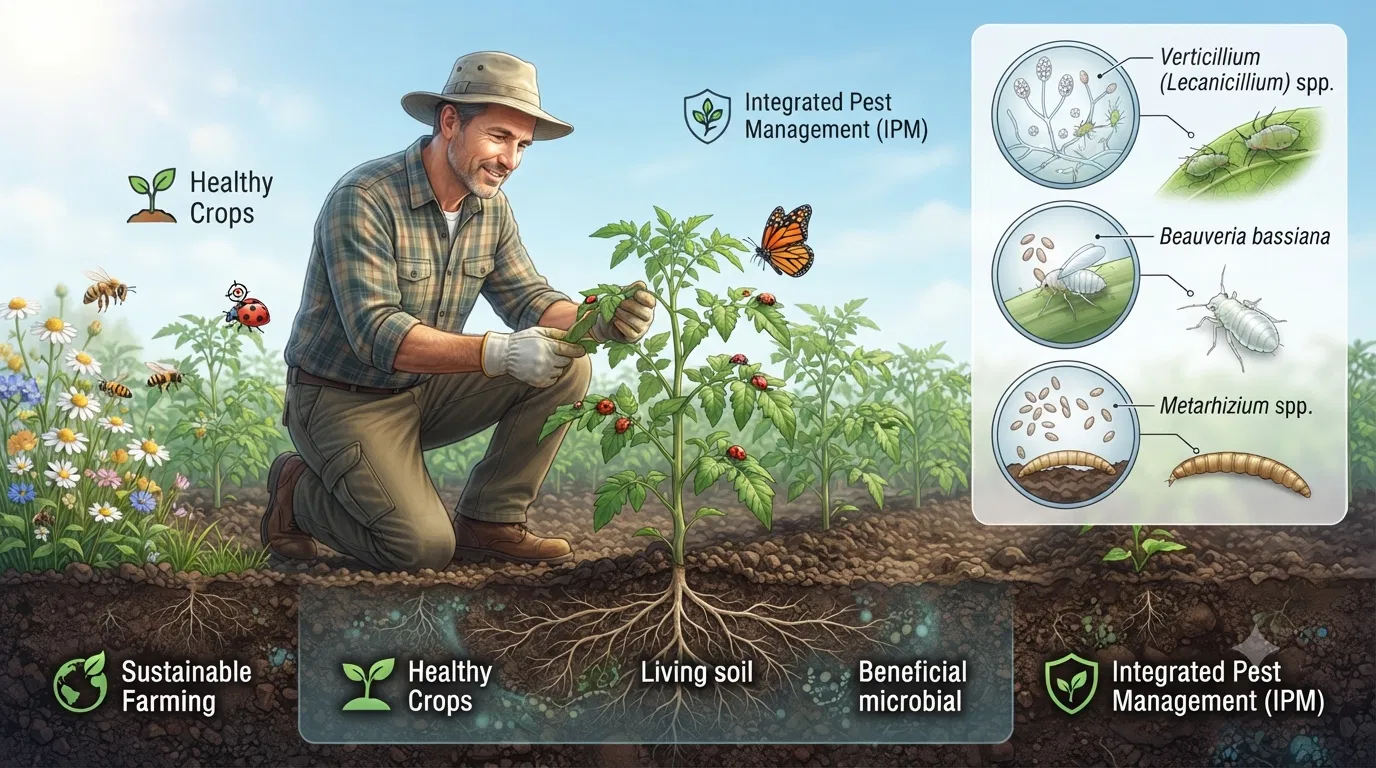
Beauveria bassiana
Beauveria bassiana is one of the best-known entomopathogenic fungi. It infects a wide range of pests, including aphids, whiteflies, beetles, thrips, and some caterpillars. It is often used in greenhouse and field applications as a biopesticide.
Metarhizium anisopliae
Metarhizium species are another major group of insect pathogens. They are commonly used against soil-dwelling insects such as grubs, termites, and some root-feeding pests. Their strength lies in their ability to persist in soil and infect hosts that come into contact with treated surfaces.
Isaria fumosorosea
Isaria fumosorosea is especially useful against soft-bodied insects like whiteflies, aphids, and mites. It is popular in integrated pest management because it can complement other control methods.
Lecanicillium species
Lecanicillium fungi are often used against sap-sucking pests. They are considered promising biological control agents because they can help reduce pest populations without creating the resistance problems often seen with chemical insecticides.
Why These Fungi Matter in Agriculture
Modern agriculture faces a difficult challenge: how to protect crops while reducing environmental impact. Entomopathogenic fungi offer a practical solution because they support integrated pest management, or IPM.
Here's why they matter:
- Lower chemical use: Farmers can reduce reliance on synthetic pesticides.
- Targeted action: Many fungal strains attack specific pests.
- Resistance management: Fungi use a different mode of action than conventional insecticides.
- Environmental safety: They generally leave fewer harmful residues.
- Compatibility: They can be combined with other control tactics in IPM programs.
For growers dealing with repeated pest outbreaks, these fungi can become a valuable tool in a long-term management strategy.
Challenges in Using Entomopathogenic Fungi
Even though they are powerful, these fungi are not perfect. Their success depends on the right conditions, and that creates some limitations in the field.
- Humidity dependence: Dry conditions can reduce infection rates.
- Temperature sensitivity: Extreme heat or cold may limit performance.
- Slower action: They usually work more slowly than chemical insecticides.
- Sunlight exposure: UV light can damage fungal spores.
- Application timing: They must be applied when pests are present and environmental conditions are favorable.
Because of these factors, success often depends on careful planning, proper formulation, and realistic expectations. They are best viewed as part of a larger pest management system rather than a one-step solution.
How Verticillium and Other Fungi Fit Into Sustainable Pest Management
The growing interest in biological control has made entomopathogenic fungi more relevant than ever. As pesticide resistance rises and consumers demand safer food production practices, sustainable alternatives are becoming essential.
Verticillium and related fungi contribute by helping farmers and gardeners manage pests in a way that supports long-term ecological health. They can be used in greenhouses, organic systems, orchards, turf management, and certain field crops, depending on the pest and environment.
They also fit well with other eco-friendly practices, such as:
- crop rotation
- resistant plant varieties
- beneficial insect conservation
- spot treatments instead of blanket spraying
- monitoring pest populations before treatment
When used correctly, they help create a more balanced and resilient pest control strategy.
Best Practices for Using Entomopathogenic Fungi
To get the best results, it helps to follow a few practical guidelines.
- Apply at the right time: Treat when pest populations are active and conditions favor fungal growth.
- Focus on humidity: Early morning or evening applications may improve performance.
- Avoid harsh sunlight: UV exposure can reduce spore viability.
- Check compatibility: Some fungicides and pesticides may interfere with fungal activity.
- Monitor results: Biological control often requires observation and patience.
These fungi are living organisms, so their success depends on how well they are matched to the environment and target pest.
Conclusion
Verticillium and other entomopathogenic fungi are more than scientific curiosities—they are important natural allies in pest control. By infecting insects from the outside in, they offer a biologically based alternative to chemical pesticides and support more sustainable agriculture.
As pest pressures increase and environmental concerns grow, these fungi will continue to play a bigger role in biological control and integrated pest management. Whether you are a grower, gardener, or simply curious about nature's hidden systems, understanding these insect-killing fungi reveals just how powerful and elegant biological pest control can be.
If sustainable pest management matters to you, entomopathogenic fungi are worth watching closely.