
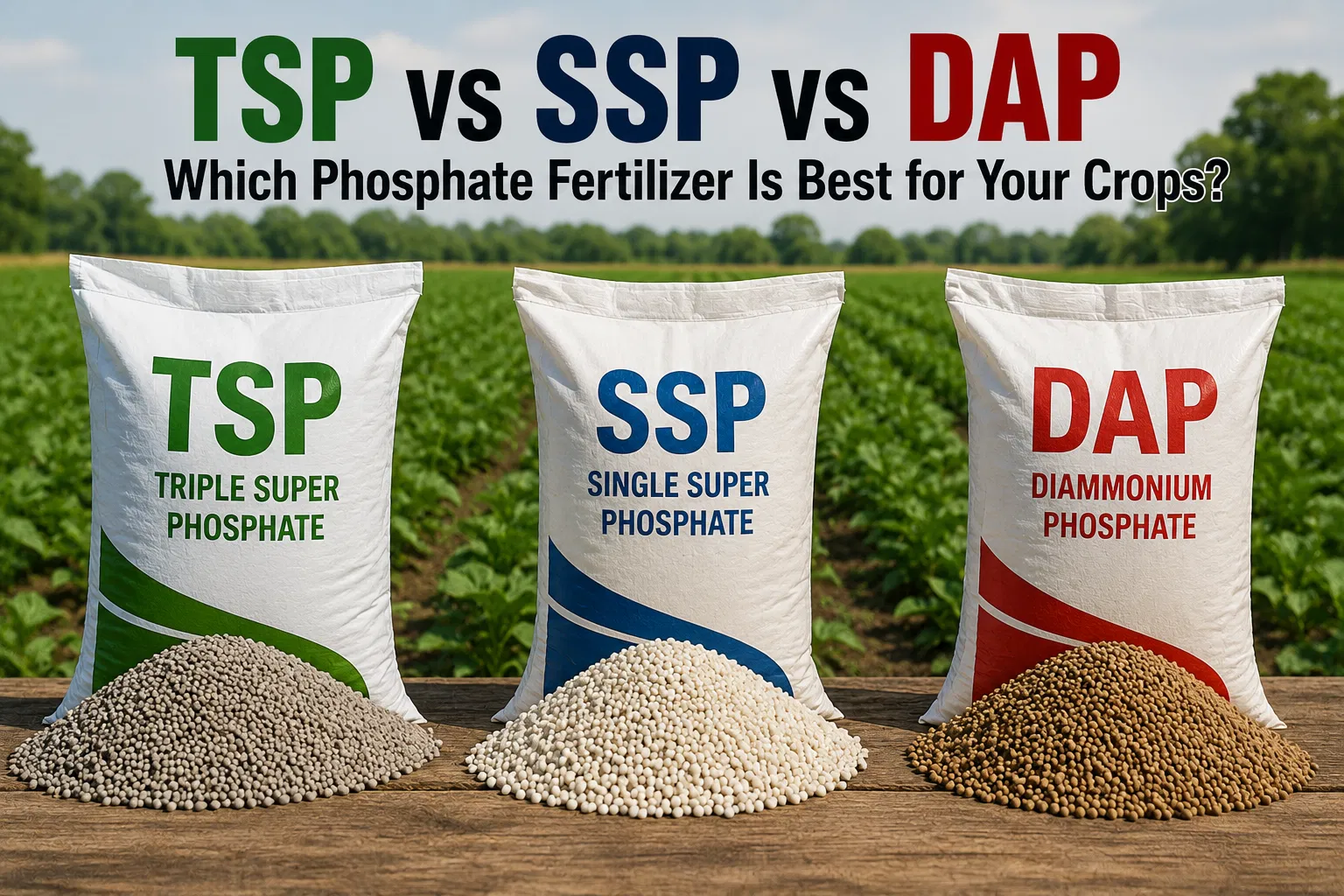
Choosing the right phosphate fertilizer can make a noticeable difference in crop performance, soil health, and overall fertilizer efficiency. When farmers compare TSP vs SSP vs DAP, the best choice often depends on soil conditions, crop needs, nutrient balance, and cost. These three fertilizers are widely used because they supply phosphorus, one of the most important nutrients for root development, flowering, and early plant growth.
If you are trying to decide between Triple Superphosphate (TSP), Single Superphosphate (SSP), and Diammonium Phosphate (DAP), this guide breaks down the differences clearly so you can make a smarter fertilizer decision.
What Are TSP, SSP, and DAP?
All three are phosphate fertilizers, but they are not the same. Each one has a different nutrient profile, soil effect, and practical use in agriculture.
Triple Superphosphate (TSP)
TSP is a concentrated phosphorus fertilizer made to provide a high level of available phosphate. It contains a high percentage of phosphorus and very little else, which makes it ideal when a crop needs phosphorus without extra nutrients.
Single Superphosphate (SSP)
SSP is an older, lower-analysis phosphate fertilizer that also supplies sulfur and calcium. Because of this, it is often preferred in soils that are low in sulfur or calcium, especially when a farmer wants a more balanced nutrient source.
Diammonium Phosphate (DAP)
DAP is a popular compound fertilizer that provides both phosphorus and nitrogen. It is widely used as a starter fertilizer because it supports early root development and plant vigor while also giving a nitrogen boost.
Nutrient Composition: TSP vs SSP vs DAP
The biggest difference between these fertilizers is their nutrient content. Understanding the formula helps explain why each product is used in different farming situations.
- TSP: High phosphorus content, usually around 46% P2O5
- SSP: Lower phosphorus content, typically around 16%–20% P2O5, plus sulfur and calcium
- DAP: About 46% P2O5 and 18% nitrogen
From a nutrient concentration standpoint, TSP and DAP deliver more phosphorus per unit weight than SSP. However, SSP offers the advantage of additional sulfur, which can be valuable in nutrient-deficient soils.
Key Differences Between TSP, SSP, and DAP
To compare phosphate fertilizers effectively, it helps to look at how they perform in the field.
1. Phosphorus Strength
TSP and DAP both offer high phosphorus concentration, making them efficient choices when a farmer wants to apply less material while still meeting crop phosphorus requirements. SSP contains less phosphorus, so more product is needed to supply the same amount.
2. Additional Nutrients
DAP includes nitrogen, which can be useful during early crop establishment. SSP provides sulfur and calcium, which can improve nutrient balance in certain soils. TSP is mainly a phosphorus source and is best when phosphorus is the primary need.
3. Soil Reaction
Soil pH matters when selecting phosphate fertilizers. DAP can temporarily create an alkaline reaction near the fertilizer band, which may affect seed placement if used incorrectly. SSP is often considered gentler in some soil applications, while TSP is generally neutral to slightly acidic in behavior depending on soil conditions.
4. Cost Efficiency
SSP is usually cheaper per ton, but because it has less phosphorus, the cost per unit of phosphorus may not always be the lowest. TSP and DAP often provide better nutrient concentration, which can improve transport and application efficiency. The true value depends on local prices and nutrient requirements.
5. Best Use Cases
Each fertilizer fits a different purpose:
- TSP: Best for crops needing concentrated phosphorus without added nitrogen or sulfur
- SSP: Best for sulfur-deficient soils or where calcium and sulfur are needed along with phosphorus
- DAP: Best as a starter fertilizer or where both nitrogen and phosphorus are needed
When to Choose TSP
TSP is a strong choice when soil tests show adequate nitrogen and sulfur but low phosphorus. Since it is highly concentrated, it is efficient for crops with a clear phosphorus requirement. It is commonly used in row crops, vegetables, and high-value crops where precise nutrient management matters.
Best for: Farmers who want a concentrated phosphorus source without extra nutrients that may not be needed.
TSP is especially useful when fertilizer blending is part of the nutrition plan. It can be combined with other inputs to create a custom fertilizer mix tailored to soil and crop demands.
When to Choose SSP
SSP remains an important fertilizer in many farming systems because it delivers more than phosphorus. The sulfur content is particularly valuable in crops like canola, legumes, onions, and brassicas, which can respond strongly to sulfur availability.
SSP is often chosen when:
- The soil is low in sulfur
- Calcium supplementation is helpful
- Cost is a major factor
- The farmer prefers a lower-analysis but multi-nutrient phosphate source
Although SSP has a lower phosphorus concentration, it can still be a smart agronomic choice where sulfur deficiency limits crop productivity.
When to Choose DAP
DAP is one of the most widely used phosphate fertilizers because it combines two major nutrients in one product. It is especially effective at planting time, when crops need a strong start. The nitrogen in DAP helps stimulate early growth, while phosphorus promotes root establishment and energy transfer in the plant.
DAP is commonly selected for:
- Starter fertilizer applications
- Early season crop establishment
- Fields needing both nitrogen and phosphorus
- Large-scale farming where efficient nutrient delivery matters
However, DAP should be applied carefully near seeds to reduce the risk of ammonia-related injury in sensitive conditions. Placement and rate management are important for best results.
Which Is Better: TSP, SSP, or DAP?
There is no single winner in the TSP vs SSP vs DAP comparison. The best phosphate fertilizer depends on what your soil and crop actually need.
If you want the highest phosphorus concentration without extra nutrients, TSP is often the best fit. If your soil also needs sulfur, SSP can provide a practical and economical solution. If you need phosphorus and nitrogen together, especially at planting, DAP is often the most efficient option.
A soil test is the best starting point. It helps determine whether phosphorus is the only deficiency or whether sulfur and nitrogen should also be considered. That decision can have a major impact on yield and fertilizer return on investment.
Application Tips for Better Results
Using phosphate fertilizers correctly is just as important as choosing the right product. Good placement and timing help plants absorb nutrients more efficiently.
- Test the soil first: Know what nutrients are missing before applying fertilizer. A soil testing kit makes this simple.
- Match fertilizer to crop stage: Use starter fertilizer for early growth when appropriate.
- Apply near the root zone: Phosphorus moves slowly in soil, so placement matters.
- Avoid overapplication: Extra phosphorus does not always mean better yields.
- Consider blending: Custom fertilizer blends can improve nutrient balance.
Environmental and Agronomic Considerations
Efficient phosphate use is important for both farm profitability and environmental stewardship. Excess phosphorus can contribute to nutrient runoff and water quality issues. Choosing the right fertilizer and applying it at the right rate helps reduce waste while supporting better crop performance.
In many cases, the most effective fertilizer strategy is not simply buying the highest analysis product. It is about selecting the right source, placing it properly, and aligning it with the crop’s actual nutrient demand.
Final Takeaway on TSP vs SSP vs DAP
When comparing TSP vs SSP vs DAP, each fertilizer has a clear purpose. TSP offers concentrated phosphorus, SSP adds sulfur and calcium, and DAP delivers both phosphorus and nitrogen for strong early growth. The best choice depends on soil test results, crop requirements, budget, and application goals.
If you want the most effective phosphate fertilizer strategy, start with the soil, then match the product to the nutrient gap. That simple approach can improve yields, reduce waste, and give your crops a stronger start.
Choose wisely, apply accurately, and let your fertilizer work as hard as your crop does.


