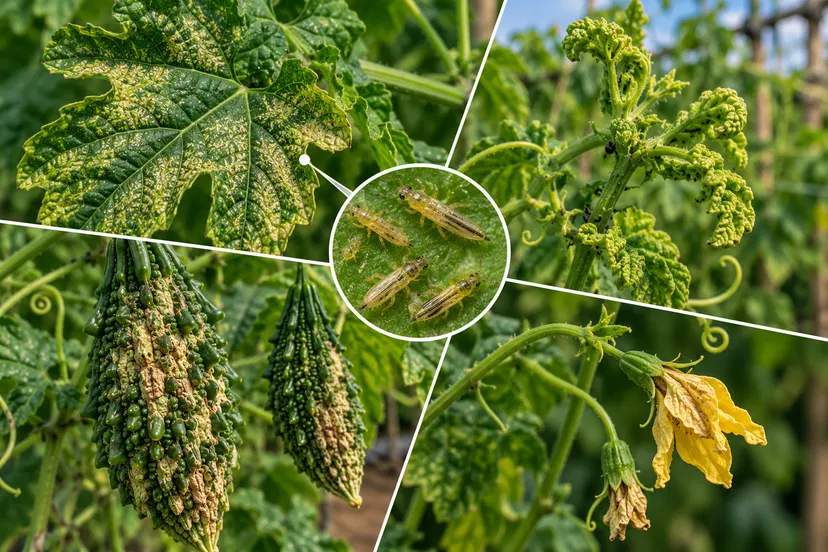
Bitter Gourd: Planting and Package of Practices
Bitter gourd pays well when it is grown properly and disappoints badly when it is not, and the gap between the two usually comes down to three things: whether the vines are lifted onto a support, whether the fruit fly is trapped before it finds the first young fruit, and whether picking is frequent enough to keep the plant setting. A crop left to sprawl on the ground and sprayed only after the fruit starts rotting will give a fraction of what the same seed could have produced. This guide covers the full package of practices in the order the work actually happens, from the first ploughing to the last picking, with every stage set out in a table you can check at a glance.
Quick answer: Bitter gourd, Momordica charantia, is a warm season cucurbit grown in summer and the rainy season across India. It generally does best at 24 to 27 degrees Celsius on a well drained sandy loam at pH 6.0 to 7.5. Seed is soaked for about 24 hours before sowing because of its hard coat, vines are trained on a bower or pandal, and the first picking usually comes 50 to 60 days after sowing. Picking continues every two to three days, and yields commonly run from about 15 to 25 tonnes per hectare, with hybrids going higher.
Bitter Gourd Crop at a Glance
Item
Recommendation
Botanical name
Momordica charantia, family Cucurbitaceae
Common names
Karela, pavakkai, hagalkayi, bitter melon
Temperature
Optimum 24 to 27 degrees Celsius; seed germinates best above 18 degrees; frost damages the crop
Altitude
Grown from the plains up to about 1,000 metres
Soil
Well drained sandy loam, medium black soil, or riverbed alluvium rich in organic matter
Soil pH
6.0 to 7.5
Sowing seasons
Summer: January to March. Rainy: May to July
Seed rate
About 4 to 5 kg per hectare for open pollinated types; hybrids roughly 1.5 to 2.2 kg per hectare
Farmyard manure
15 to 25 tonnes per hectare
Support
Bower about 3 metres, or pandal about 1.5 metres
First harvest
50 to 60 days after sowing for most released varieties
Picking interval
Every 2 to 3 days
Yield
About 15 to 25 tonnes per hectare, with hybrids recorded at 40 tonnes and above
Recommended Varieties and Hybrids
Starting with a released variety matched to your season and region is the cheapest yield decision available. The following are releases from government research institutes and state agricultural universities.
Releasing institute
Varieties and hybrids
ICAR Indian Institute of Vegetable Research, Varanasi
Kashi Pratishtha, Kashi Mayuri
Pusa series, released through ICAR
Pusa Do Mausami, Pusa Hybrid 1, Pusa Hybrid 4, Pusa Aushadhi, Pusa Purvi, Pusa Rasdar, Pusa Vishesh
ICAR Indian Institute of Horticultural Research, Bengaluru
Arka Harit
Punjab Agricultural University, Ludhiana
Punjab Karela-15, Punjab Jhaar Karela-1, Punjab Kareli-1, Punjab-14
Kerala Agricultural University
Priya, Preethi, Priyanka
Mahatma Phule Krishi Vidyapeeth, Rahuri
Hirkani, Phule Green Gold, Phule Ujwala, Phule Priyanka (hybrid)
Other state releases
CO 1, MDU 1, Konkan Tara, Kalyanpur Baramasi, Coimbatore Long, Pride of Gujarat
A few choices worth knowing. Kashi Mayuri sets fruit even above 35 degrees Celsius and carries tolerance to anthracnose, downy mildew and mosaic, which makes it useful where summers are harsh. Kashi Pratishtha gives long slender fruits with a smoother skin that travels better to distant markets. Punjab Karela-15 is moderately resistant to yellow mosaic, and Punjab Jhaar Karela-1 is resistant to root knot nematode and virus diseases. Preethi is described as relatively less susceptible to fruit fly, which is worth weighing in a season when fruit fly pressure is usually heavy. For hybrid seed, a wide choice of bitter gourd seed varieties is available, including Nunhems US 1315 and VNR Akash F1.
Climate and Soil Requirements
This is a warm season crop suited to subtropical and hot regions, and it generally grows best between 24 and 27 degrees Celsius. Seed germinates best above about 18 degrees, which is why sowing too early in a cold spell wastes seed. The crop is damaged by frost, and it can be grown from the plains up to roughly 1,000 metres. One caution on the other side: high humidity during vegetative growth encourages fungal disease, so airflow through the crop matters as much as warmth.
For soil, a well drained sandy loam or medium black soil rich in organic matter suits it best, and alluvial land along river beds is also commonly used. Soil pH recommendations fall between about 6.0 and 7.5 across states, with the crop reported to tolerate up to around pH 8.0. What it will not tolerate is standing water, so drainage is the first thing to fix on a heavy field. If you are unsure where your field sits, this guide to soil pH and how to correct it explains the testing and correction options.
Sowing Season
Season
Sowing months
Notes
Summer crop
January to March
January to February in the plains; February to March in north India once frost risk passes
Rainy season crop
May to July
May in the plains; June to July in Punjab and north India
Southern states
January to March, and September to December
A rainfed crop may also be sown after the first showers in May to June
Protected cultivation
February to June, July to November, and November to March
Season depends on the structure and the variety used
The summer crop falls in the zaid window, and if you are planning the year around irrigation availability, this guide to zaid or summer season crops is worth reading alongside.
Land Preparation
Give the field one or two crosswise ploughings to bring it to a fine tilth, then level it and clear out old crop material. Apply the farmyard manure about 10 to 15 days before sowing so it has time to settle into the soil. The crop is then established either in furrows or in pits, and the spacing of that layout is set by the support system you intend to use, so decide on the bower or trellis before you mark the field.
Open furrows 1.5 to 2.5 metres apart, the wider spacing being for a full bower system.
For the pit system, dig pits about 60 cm across and 30 to 45 cm deep. Some recommendations use smaller pits of about 30 cm each way with closer spacing.
Mix well rotted farmyard manure and the basal fertiliser into the topsoil and fill the pits with that mixture.
Irrigate the pits or ridges three to four days before sowing so the soil is moist at sowing but not waterlogged.
Where a bower is planned, leave irrigation channels every five to six metres so the crop can be watered once the canopy covers the frame.
On raised beds under drip, beds of about 120 cm with the lateral along the centre work well.
Seed Rate and Spacing by System
Published figures differ because the systems differ, not because the sources disagree. Pick the row that matches how you are growing.
System
Spacing
Seed rate
Seeds per spot
Row sowing, closer layout
1.5 m between rows, 60 cm between plants
4 to 5 kg per hectare
2 to 3 seeds, thin to 1
Furrow sowing with a bower
Furrows 2.5 m apart, plants 1 m apart along the furrow
4 to 5 kg per hectare
2 to 3 seeds, thin to 1
Pit system
Pits at 2 by 1.5 m up to 2 by 2 m
4 to 5 kg per hectare
4 to 5 seeds, thin to 2 or 3
Bed system
Beds about 1.5 m wide, plants 45 cm apart on both sides
About 2 kg per acre
2 to 3 seeds, thin to 1
Hybrid seed, any system
As above
Roughly 1.5 to 2.2 kg per hectare
Follow the packet rate
Seed Treatment and Sowing
Bitter gourd seed has a hard coat, and this is where many crops lose a week. The officially recommended fix is soaking, not cutting: soak the seed in water for about 24 hours before sowing. Note that none of the official packages recommend clipping, nicking or sanding the seed coat, even though that advice circulates widely, so soaking is the safer practice.
Treatment against soil borne fungi is also standard, and the order in which treatments are applied matters, which this guide to seed treatment practices before sowing sets out in full.
Step
What to do
Soaking
Soak seed in water for about 24 hours before sowing to soften the hard coat
Chemical treatment
Thiram at about 3 g per kg of seed against soil borne fungi
Biological option
Trichoderma viride at about 4 g per kg, or Pseudomonas fluorescens at about 10 g per kg
Sowing depth
1 to 2 cm
Germination
Generally 4 to 5 days in warm, moist soil
Thinning
After about 2 weeks, keep the strongest 2 or 3 plants per pit
Nursery option
Raise in poly bags and transplant at 15 to 20 days, or at 10 to 15 cm height
Manures and Fertilisers
Organic matter comes first. Farmyard manure at 15 to 25 tonnes per hectare, applied 10 to 15 days before sowing or filled into the pits, is the base across state recommendations.
On chemical fertiliser the published doses vary a good deal with state and with whether the crop is an open pollinated variety or a hybrid under fertigation, so treat the figures below as a bracket and let a soil test fix the dose for your field. Combining organic and chemical sources rather than relying on either alone is the approach set out in this guide to integrated nutrient management.
Input
Quantity
When and how to apply
Farmyard manure
15 to 25 tonnes per hectare
10 to 15 days before sowing, or mixed into the pits
Nitrogen
50 to 100 kg per hectare across recommendations
Half as a basal dose, the rest at flowering
Phosphorus
40 to 60 kg per hectare
Full dose as a basal application
Potash
30 to 60 kg per hectare
Full dose as a basal application
Top dressing method
Not applicable
Place in a ring about 6 to 7 cm away from the stem base, not against it
Cut off point
Not applicable
Try to complete fertiliser application before fruit set begins
Irrigation Schedule
Keeping the upper 50 cm of soil moist encourages the taproot to develop properly, and the crop needs noticeably more water once it starts setting fruit. Where drip is available it gives much better control than flooding, and this crop wise guide to drip irrigation for vegetables covers the system planning side.
Crop stage
Irrigation
Before sowing
Irrigate the pits or ridges 1 to 2 days ahead so soil is moist at sowing
After sowing
A light irrigation 4 to 5 days after sowing
Vegetative growth
Weekly, or every 3 to 4 days on light soil
Flowering and fruiting
Step up to alternate days; this is where water stress costs fruit directly
Summer crop
Every 6 to 7 days on heavier land; 8 to 9 irrigations over the season is typical
Rainy season crop
Usually none needed; the job becomes drainage instead
Training the Vines on a Bower or Pandal
If you do only one thing from this guide, do this one. Vines grown on a support keep producing for roughly six to seven months, while the same vines left trailing on the ground generally finish in three to four months. Ground grown fruit also touches wet soil, which means blemishes, rot and a lower grade. The general method of taking a main stem up and then spreading the laterals is covered in this guide to training vines on a trellis.
Support type
Height
How it is built
Bower
About 3 metres
Poles pitched about 5 m apart at alternate furrow ends, joined with wire, cross wires at about 45 cm
Pandal
About 1.5 metres
Bamboo, stakes or pipe with wire and coir or plastic rope tied criss cross; cheaper to build
Lean to trellis
1.8 to 2.0 metres
Stakes 1.2 to 1.8 m apart with wire strung between them
Erect the support once the vines begin to trail rather than waiting until they are long and tangled. Vines usually take around one and a half to two months to reach the top of a bower. Pruning helps as well: remove the lateral branches until the main runner reaches the top, then keep four to six laterals and cut the tip of the main runner. Removing the laterals from the first ten nodes is reported to improve total yield.
Flowering, Pollination and Fruit Set
Bitter gourd carries separate male and female flowers, and male flowers outnumber females by a wide margin, commonly around twenty five to one. Fruit set therefore depends entirely on insects carrying pollen, and bees do most of that work. Avoid spraying during peak bee activity, and where pollination is poor, placing a bee colony near the field is far more practical than hand pollination.
Several officially recommended sprays can shift the balance toward female flowers. Gibberellic acid at 25 to 100 ppm sprayed after the plant has six to eight true leaves is one, and ethrel at about 100 ppm sprayed from around 15 days after sowing at weekly intervals is another. Boron also appears in official recommendations for improving fruit set, and its role in pollen tube growth is explained in this note on micronutrients in flowering and fruit set. A boron based product such as Janatha Seabor is recommended for use on this crop.
Weed Management
Plan on two to three weedings, with the first at about 30 days after planting and the rest at roughly monthly intervals, finishing before the vines spread so far that walking through the crop damages them. Earth up around the plants during the rainy season to improve drainage at the collar. Mulching with organic material or plastic on raised beds cuts the weeding work considerably and holds moisture in the summer crop.
Pest Management
Fruit fly, the pest that defines this crop
Melon fruit fly, Bactrocera cucurbitae, is the single biggest threat to bitter gourd. The female lays eggs under the skin of young fruit, the maggots feed inside, and the fruit rots and drops. Because the damage happens inside the fruit, a cover spray reaches very little of it, which is why trapping and sanitation do most of the work here. This article on managing fruit flies in melons and cucurbits goes deeper into the trapping and bait options.
Step
What to do and when
Set traps early
At the start of flowering, not after damage appears. Recommendations range from about 10 traps per hectare up to 16 per acre
Spring crop timing
Traps out in the third or fourth week of March
Rainy crop timing
Traps out in the fourth week of June
Field sanitation
Collect and bury every fallen and infested fruit; each one left behind breeds the next generation
Bait
Jaggery solution bait splashes placed in spots around the field, renewed fortnightly
Variety choice
Preethi is described as relatively less susceptible
For trapping, options recommended for this crop include the Tapas Fruit Fly Trap and Lure IPM Combo and the Gaiagen Bacu Lure melon fly combo.
Other insect pests
Pest
Scientific name
What you see
What generally helps
Red pumpkin beetle
Aulacophora foveicollis
Adults scrape holes in leaves; grubs bore into roots
Early scouting, neem cake in soil, hand collection
Aphids
Aphis gossypii
Colonies on tender shoots, curled leaves, sticky deposits
Biological options, soap sprays, vector control for virus
Whitefly
Bemisia tabaci
Tiny white flies rising when the canopy is disturbed
Yellow sticky traps and early action, since it spreads virus
Thrips
Thrips palmi
Silvered, puckered young leaves
Scouting on the growing point, timely sprays
Leaf miner
Liriomyza trifolii
Winding pale tunnels inside the leaf
Remove heavily mined leaves, avoid repeat sprays that flare it
Pumpkin caterpillar
Diaphania indica
Rolled leaves, chewed foliage, webbing
Hand collection at low numbers, targeted sprays
Epilachna beetle
Not given
Leaves scraped to a skeleton by adults and grubs
Remove egg masses, grubs and adults by hand
Several of these overlap across the whole family, and this guide to common cucurbit pests and how to identify them is useful for telling them apart in the field. For caterpillars and fruit borers on bitter gourd, Dhanuka Cover is recommended, and for the sucking pest complex together with pumpkin caterpillar and leaf miner, FMC Benevia carries a bitter gourd recommendation. On the biological side, Katyayani Beauveria Bassiana is recommended for sucking pests on gourds, and Beauveria bassiana also appears in official fruit fly practice as a soil application during fruiting.
Disease Management
Disease
Pathogen
What you see
What generally helps
Powdery mildew
Sphaerotheca fuliginea
White powdery patches that rub off, starting on older leaves
Open canopy, early sprays, repeat at about 14 day intervals
Downy mildew
Pseudoperonospora cubensis
Angular yellow patches on top, greyish growth underneath
Protect before wet spells; remove affected leaves
Mosaic
Virus, spread by aphids and whitefly
Yellow mottling, vein clearing, narrow shoe string leaves
Pull out affected plants; control the vectors; cannot be cured
Gummy stem blight
Didymella bryoniae
Dark lesions on stems with a gummy ooze
Clean seed, field sanitation, biological soil treatment
Anthracnose and Alternaria blight
Fungal
Sunken dark spots on fruit, or ringed brown leaf spots
Rotation, debris removal, protective cover in damp weather
Collar rot
Soil borne fungal
Rot at the stem base, plant collapse
Drainage, raised beds, biological soil treatment
For a closer look at the three that cost the most on this crop, see this article on bitter gourd diseases and how to manage them, and this one on downy mildew in cucurbits. For downy mildew, BASF Cabrio Top carries a bitter gourd recommendation.
One warning specific to this crop: copper and sulphur dusts can damage bitter gourd foliage, so they are generally avoided here even though they are routine on other crops. Always observe the waiting period before harvest, which matters on a crop picked every two to three days.
Harvesting and Post-Harvest Handling
First picking generally comes 50 to 60 days after sowing for most released varieties. After that, pick every two to three days. Frequent picking is not just about marketable fruit, it keeps the plant setting new fruit instead of putting its energy into seed.
Stage
Practice
First harvest
50 to 60 days after sowing for most released varieties
Picking interval
Every 2 to 3 days
Maturity sign
Fruit still tender and green, flesh thick and juicy, seeds inside soft and white
Too late
Fruit turns yellow or orange and splits, and loses its value completely
Time of day
Harvest in the morning hours and move the fruit into shade at once
How to cut
Cut with scissors or a sharp knife; do not pull the fruit off the vine
Market grade
Green fruit about 20 to 25 cm with a short neck and well formed tubercles
Packing
Bamboo baskets or boxes lined at the base with neem leaves or newspaper, covered with gunny
Cool storage
About 12 to 13 degrees Celsius at 85 to 90 percent humidity, which can add 2 to 3 weeks
Storage limits
Below 10 degrees causes chilling damage; above 13 degrees the fruit yellows and splits
Keep apart from
Banana, pineapple and apple, which release ethylene and hasten yellowing
Yield
About 15 to 25 tonnes per hectare, roughly 6 to 10 tonnes per acre; hybrids recorded higher
Official Resources for Farmers
Recommendations differ between states and are revised from time to time, so confirm varieties, doses and spray choices with your own state department before acting.
Indian Council of Agricultural Research
ICAR Indian Institute of Vegetable Research, bitter gourd varieties
ICAR Indian Institute of Horticultural Research, Bengaluru
National Horticulture Board, bitter gourd sowing and bower system
National Horticulture Board, manures and fertilisers
National Horticulture Board, harvesting and yield
Vikaspedia, bitter gourd package of practices
Farmers Portal, state wise best practices
Kisan Call Centre, toll free 1800 180 1551
National Seeds Corporation
eNAM national agriculture market
State
Official portal
Uttar Pradesh
Department of Horticulture and Food Processing
Bihar
Department of Agriculture
Punjab
Department of Agriculture and Farmer Welfare
Haryana
Department of Horticulture
Rajasthan
Raj Kisan Sathi
Maharashtra
Mahadbt farmer schemes portal
Andhra Pradesh
Department of Agriculture
Telangana
Department of Agriculture
Tamil Nadu
Department of Horticulture and Plantation Crops
Kerala
State Horticulture Mission
Odisha
Directorate of Agriculture and Food Production
Himachal Pradesh
Department of Agriculture
Uttarakhand
Department of Agriculture
Frequently Asked Questions
What is the seed rate of bitter gourd per acre?
Open pollinated varieties generally need about 1.6 to 2 kg per acre, from the recommended 4 to 5 kg per hectare. Hybrids are sown thinner, so follow the packet rate.
Why should bitter gourd seed be soaked before sowing?
The seed has a hard coat, and soaking in water for about 24 hours helps it take up moisture and germinate evenly. Cutting or nicking the seed is not an officially recommended practice.
How many days does bitter gourd take to give the first harvest?
Most released varieties give the first picking 50 to 60 days after sowing. Picking then continues every two to three days.
What is the yield of bitter gourd per acre?
Well managed crops commonly give about 15 to 25 tonnes per hectare, which is roughly 6 to 10 tonnes per acre. Hybrids have been recorded higher.
Does bitter gourd need a trellis?
It benefits greatly from one. Vines on a support generally keep producing for six to seven months against three to four months on the ground, and the fruit stays cleaner.
How do I control fruit fly in bitter gourd?
Set pheromone traps at the start of flowering and bury every fallen fruit, since the maggots develop inside the fruit where sprays cannot reach them.
Which month is best for sowing bitter gourd?
January to March for the summer crop and May to July for the rainy season crop. Southern states also sow from September to December.
Disclaimer: Variety, fertiliser and spray recommendations for bitter gourd differ between states and are revised periodically, so confirm current advice with your state agriculture or horticulture department before acting. Have the soil tested before fixing a fertiliser dose, and observe the waiting period before harvest on a crop picked this frequently. Do your own verification before any purchase or field decision.