Pomegranate: Planting and Package of Practices
Pomegranate (Punica granatum) is one of the most profitable fruit crops for dryland farmers in India. It tolerates drought well, and a well managed orchard can bear for many years. India grows it on about 2.7 lakh hectares, with Maharashtra producing the largest share, followed by Karnataka, Gujarat, Andhra Pradesh and Telangana.
Good returns in pomegranate generally come from healthy planting material, the right bahar, balanced nutrition through drip and strict control of bacterial blight. This guide covers the full package of practices from planting to harvest.
Pomegranate at a Glance
Particular
Details
Botanical name
Punica granatum
Family
Lythraceae
Climate
Semi-arid; grows well at about 25 to 35°C with 500 to 800 mm rainfall
Soil
Well drained sandy loam to medium deep loam, pH about 6.5 to 7.5
Propagation
Hardwood cuttings, air layering and tissue culture plants
Planting season
February to March, or June to August at the start of the monsoon
Pit size
60 x 60 x 60 cm (1 m cube in hard or shallow soils)
Common spacing
4.5 x 3 m (about 740 plants per ha)
Cropping starts
From the third year
Fruit maturity
About 130 to 180 days after flowering, depending on variety
Yield
About 20 to 25 t per ha (8 to 10 t per acre) in well managed bearing orchards
Climate and Soil for Pomegranate
Pomegranate prefers a semi-arid climate with mild winters and hot, dry summers. Hot, dry weather during fruit development generally gives better colour and sweetness, while humid weather at fruit set can spoil fruit quality and favour bacterial blight and pests. Long cold spells below about 11°C can harm the plants.
The crop grows best on well drained, medium deep sandy loam to loam soils, and light soils often give better fruit colour. Heavy, waterlogged soils can lead to wilt and root problems. A pH of about 6.5 to 7.5 is ideal, though the crop can be managed up to about 8.5 and tolerates moderate salinity.
Recommended Pomegranate Varieties
Most commercial orchards in India grow Bhagwa because of its bright saffron rind, soft seeds and good export demand. Other varieties suit specific regions, markets or processing.
Varieties From MPKV, Rahuri
Variety
Key traits
Maturity after flowering
Approx. yield
Bhagwa
Large fruit, glossy saffron rind, red soft seeded arils; export quality
170 to 180 days
About 22 t per ha
Phule Bhagwa Super
Dark saffron rind, improved Bhagwa type
About 177 days
About 22 t per ha
Phule Arakta
Bold, deep blood red arils
130 to 140 days
About 22 t per ha
Mridula
Deep blood red, soft arils
130 to 140 days
About 10 t per ha
Ganesh
Older variety with light pink arils; drought tolerant
145 to 155 days
About 10 t per ha
Varieties From ICAR-NRC on Pomegranate, Solapur
Variety
Key traits
Maturity after flowering
Approx. yield
Solapur Lal
Deep red arils and rind, richer in iron, zinc and vitamin C than Bhagwa; seeds harder than Bhagwa; good for table and juice
160 to 165 days (15 to 20 days earlier than Bhagwa)
About 26 to 27 t per ha from the 6th year
Solapur Anardana
High acid, high antioxidant variety for anardana
Not specified
Not specified
Other Varieties
Variety
Released by
Key traits
Ruby
ICAR-IIHR, Bengaluru
Red, bold arils; about 16 to 18 t per ha
Jalore Seedless
ICAR-CAZRI, Jodhpur
Light pink arils, spreading habit; suits arid areas; 140 to 150 days
Amlidana, Goma Khatta, Phule Anardana
Various institutes
Acidic varieties grown mainly for anardana (dried seeds)
Solapur Lal is new to many regions, so it is a good idea to try it on a small area first and buy plants only from licensed nurseries.
Propagation and Planting Material
Hardwood cuttings: Take pencil thick cuttings of about 20 to 25 cm from 6 to 12 month old wood, avoiding flowering shoots. Dipping the base in IBA 2500 ppm for about 5 minutes can improve rooting.
Air layering: Common in South India and done during the rains or in November to December. This guide on air layering fruit plants explains the method.
Tissue culture plants: Increasingly used for uniform, disease free planting material.
Plant healthy saplings about 5 to 6 months old from a licensed nursery. Planting material can carry bacterial blight, wilt or nematodes without showing it, so always check the source before buying.
Land Preparation and Planting
Plough and level the field. Where possible, solarise the land by covering moist soil with thin transparent polythene for about 6 weeks in the hottest months to reduce soil borne pests and diseases.
In areas with poor drainage, plant on raised beds about 45 cm high.
Dig pits of 60 x 60 x 60 cm, or 1 m cube in hard or shallow soils, and expose them to the sun for 2 to 3 weeks.
Fill each pit with topsoil mixed with about 20 kg well rotted farmyard manure, 1 kg neem cake and 500 g single super phosphate, along with Trichoderma and other recommended bio-agents.
Plant at the start of the monsoon or in February to March, and water right after planting.
Spacing
Plants per hectare
Suitable for
4.5 x 3 m
About 740
Common spacing for most orchards
4 x 3 m
About 833
Bhagwa in well managed orchards
5 x 4 m
About 500
Medium vigour varieties and wilt prone areas
5 x 5 m
About 400
Spreading varieties such as Ganesh and Jalore Seedless
Very high density planting is generally avoided where wilt is a problem, as crowded roots can help the disease spread.
Training and Pruning
Pomegranate is generally trained as a multi stem bush, which suffers less from stem borer and shot hole borer than a single stem tree.
Start training about 3 to 6 months after planting and keep 3 to 4 healthy stems per plant.
Remove all shoots and suckers up to about 30 to 40 cm from the ground throughout the life of the orchard.
After harvest, prune branches back to pencil thickness, and remove crossed, broken, weak and diseased branches and water shoots.
At bahar treatment, lightly cut back about 10 to 15 cm of the shoot tips and thin out crowded shoots.
Cut branches infected with bacterial blight 2 to 4 inches below the canker, paste the cut ends with 10% Bordeaux paste and spray 1% Bordeaux mixture the same day.
Do not prune in rain, and disinfect pruning tools between plants.
Bahar Treatment (Crop Regulation)
Pomegranate can flower in three seasons, called bahars. Farmers choose one bahar a year so the plant flowers and fruits at the most suitable time for their region and market.
Bahar
Flowering
Harvest
Points to note
Ambe (Ambia)
January to February
June to August
Needs assured irrigation in summer; good fruit colour
Mrig
June to July
December to February
Rainy season crop with high blight risk; generally avoided in blight prone areas, though preferred in hot, arid areas such as parts of Rajasthan
Hasta
September to October
March to May
Lower blight risk and good prices, but stressing plants during the rains can be difficult
How Bahar Treatment Is Done
Take only one crop a year, and give the plants a rest of about 2 to 3 months after harvest.
Stop irrigation to stress the plants for about 1 to 2 months. For Hasta bahar, water is generally withheld for 20 to 25 days after the rains end, and for Ambe bahar until most leaves have dropped.
If leaves do not drop well, spray ethephon 39% SL to defoliate. The recommended label dose is 2 to 2.5 ml per litre of water, and DAP or 0:52:34 at about 5 g per litre is commonly added. Bayer Ethrel lists pomegranate defoliation for all three bahars.
Spray 1% Bordeaux mixture just before defoliation, then do light pruning.
Apply manures and fertilisers and restart irrigation to bring on new growth and flowering.
Read more in this guide on bahar treatment in pomegranate.
Manures and Fertilisers
The table below shows a commonly recommended yearly schedule per plant. Soil and leaf tests every year or two can help fine tune the dose.
Age of plant
Farmyard manure (kg)
N (g)
P (g)
K (g)
1 year
10
250
125
125
2 years
20
250
125
125
3 years
30
500
125
125
4 years
40
500
125
250
5 years and above
40
625
250
250
Young plants: Apply the yearly dose in three splits, around January, June and September.
Bearing plants: Apply all the manure with half of the nitrogen and all of the phosphorus and potash at bahar treatment, and give the remaining nitrogen in monthly splits or through drip.
Organic options: Part of the farmyard manure can be replaced with vermicompost, neem cake or poultry manure.
Bio-inputs: About 20 to 30 days after chemical fertilisers, add bio-agents such as Trichoderma and mycorrhiza mixed with farmyard manure.
Fertigation Schedule for Bearing Orchards
Crop stage
Fertiliser per application
Number of applications
Flowering to fruit set
0:52:34 at about 11 kg + 0:0:50 at about 11 kg per ha (about 4.5 kg each per acre)
About 7, at weekly intervals
After fruit set
Urea at about 14 to 23 kg per ha (about 5.5 to 9 kg per acre)
About 8, at weekly intervals
Fruit enlargement to maturity
Urea at about 41 to 70 kg + 0:52:34 at about 22 kg + 0:0:50 at about 22 kg per ha
About 8, at weekly intervals
At flowering, gypsum at about 1.1 kg and magnesium sulphate at about 300 g per tree can also be given. Stop fertigation about 15 days before harvest.
Water soluble fertilisers that list pomegranate include:
Mahadhan MKP 0:52:34
Mahadhan KNO3 13:00:45
Micronutrients
Zinc, manganese and boron shortages are common in pomegranate soils. Sprays of zinc sulphate at about 3 g per litre, manganese sulphate at about 6 g per litre and boric acid at about 2.5 g per litre, given separately, or a micronutrient mixture at 1.5 to 2 g per litre, can be applied at new growth and before flowering.
Micronutrient and bio-fertiliser options that list pomegranate include:
Multiplex Prokissan
Amruth Pomegranate Grow
Irrigation
Drip irrigation is generally the best method for pomegranate, as it saves water, supports fertigation and keeps soil moisture steady. Use about 2 drippers per plant for the first 3 years and 4 drippers from the fourth year.
Plant stage
Approx. water per plant per day
Young, non bearing plants
About 5 to 25 litres, increasing with age
Bearing plants
About 20 to 65 litres, depending on season and canopy
Rest period
About 15 to 20 litres, once or twice a week
Flowering, fruit set and fruit development are the most critical stages, as moisture stress then can cause flower drop and fruit cracking.
Avoid sudden changes from dry to very wet soil, which is a common cause of cracking.
Excess water and waterlogging can increase wilt and nematode problems, so skip irrigation for a few days after good rain.
Weed Management and Intercropping
Keep the orchard free of weeds, as they can shelter blight bacteria, nematodes and insects.
Mulch the basin with 15 to 20 cm of organic material, keeping it a little away from the trunk.
In the first 2 to 3 years, pulses, green manure crops or short vegetables can be grown between rows.
Avoid intercrops that host thrips and other pests, such as chilli, tomato and brinjal. Marigold can help reduce nematodes.
Avoid using a rotavator in orchards affected by wilt, as it can spread the disease.
Flowering, Fruit Set and Fruit Care
A spray of NAA at about 10 ppm at bud initiation and flowering can help improve fruit set.
Remove flowers that open well before or after the main flush, so the crop matures evenly.
Limit the fruit load to about 50 to 70 fruits per plant at 2 to 4 years, and about 80 to 100 fruits from the fifth year. Remove bunched, damaged and badly shaped fruits early.
Bag fruits at about lemon size to protect them from fruit borer, sunburn and birds, after a protective spray.
Flower and fruit drop can also come from nutrient gaps, water stress and thrips. This guide on pomegranate flower drop covers the common causes and fixes.
Pest and Disease Management in Pomegranate
Bacterial blight, wilt, fruit borer and thrips are the biggest threats to pomegranate. Yellow and blue sticky traps at about 25 to 30 per acre can help monitor sucking pests, and regular orchard sanitation can lower disease pressure. For a full plan, see this IPM guide for pomegranate.
Major Pests of Pomegranate
Pest
Damage signs
Key management
Fruit borer or anar butterfly (Deudorix isocrates)
Larvae bore into fruits, which rot and drop; holes with frass near the crown
Remove and bury bored fruits, bag fruits, neem oil sprays at egg stage and recommended insecticides
Thrips (Scirtothrips dorsalis)
Brown, scabby scars on the rind; curled young leaves
Sticky traps, neem based sprays early, and recommended insecticides before and after flowering
Aphids and whitefly
Colonies on tender shoots and leaves; sticky honeydew and sooty mould
Yellow sticky traps, neem oil and natural enemies such as lacewings
Mealybugs
White, cottony masses on fruits, stems and the crown
Neem and pongamia oil sprays early; recommended insecticides when needed
Mites
Bronzing and drying of leaves in hot, dry weather
Neem oil early; recommended acaricides when numbers rise
Shot hole and pinhole borer
Tiny holes on the stem with powdery frass; branches dry and die
Stem paste on the lower trunk, drenching as advised and pheromone traps
Nematodes
Galls on roots, yellowing and slow growth
Clean planting material, bio-agents twice a year and marigold
For shot hole and pinhole borer, the Pomo Trap with Pomo Lure is made for pomegranate and is placed beside infested trees. Thrips need close watching at flowering, as explained in this guide on thrips control in pomegranate.
Major Diseases of Pomegranate
Disease
Signs to look for
Key management
Bacterial blight or oily spot (Xanthomonas axonopodis pv. punicae)
Water soaked, oily spots on leaves and fruits that turn dark; cracked spots on fruits; cankers on stems
One crop a year, avoid Mrig bahar in blight areas, prune and destroy infected parts, Bordeaux mixture and recommended copper sprays every 7 to 10 days in the crop season
Wilt (Ceratocystis fimbriata and other soil fungi)
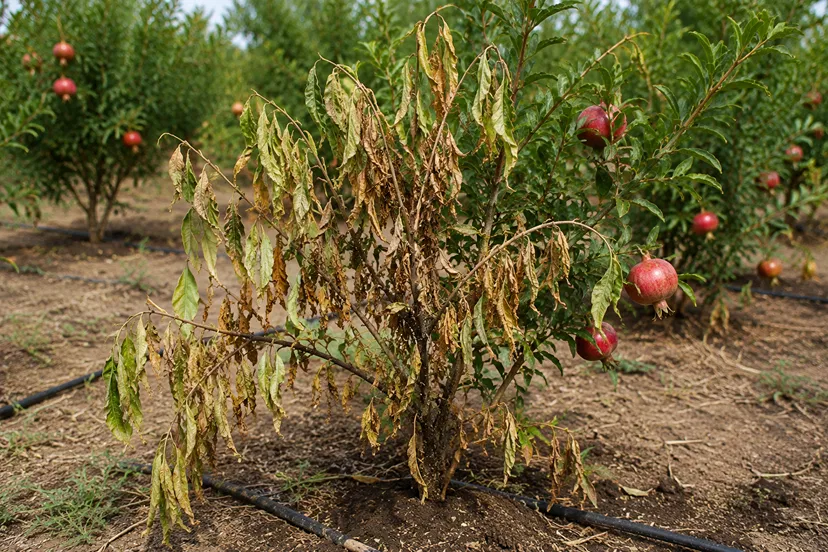
Leaves yellow and droop on one branch first, then the whole plant dries; brown streaks inside the stem
Healthy planting material, good drainage, soil drenches and bio-agents as advised; uproot and burn badly affected plants
Anthracnose, Cercospora and Alternaria spots
Dark spots on leaves and fruits; fruit rot
Remove infected fruits and 2 to 3 recommended fungicide sprays from flowering, 10 to 14 days apart
Streptocycline (streptomycin + tetracycline), seen in many older blight schedules, does not carry a recommendation for pomegranate and is being phased out of crop use, so Bordeaux mixture and recommended copper based products are generally relied on instead. This post on managing bacterial blight in pomegranate gives more detail, and wilt control is covered in this guide on pomegranate wilt and soil treatment.
Recommended Products for Pomegranate Pests and Diseases
Pest or Disease
Active Ingredient
Product
Dose
Waiting Period
Thrips and fruit borer (anar butterfly); whitefly and aphids
Cyantraniliprole 10.26% OD
FMC Benevia
Thrips and fruit borer: 0.75 ml per litre (about 300 ml in 400 L water per acre); whitefly and aphids: 0.9 ml per litre
5 days
Thrips and fruit borer
Broflanilide 20% SC
PI Brofreya
0.25 ml per litre (about 50 ml in 200 L water per acre)
1 day
Bacterial blight, leaf spot, fruit rot and anthracnose
Kasugamycin 5% + Copper oxychloride 45% WP
Dhanuka Conika
1 g per litre
10 days
Bacterial blight, Alternaria and Cercospora leaf spot
Copper sulphate 47.15% + Mancozeb 30% WDG
UPL Cuprofix Disperss
5 g per litre (about 1 kg in 200 L water per acre)
44 days
Cercospora and Alternaria leaf spot, anthracnose
Azoxystrobin 8.3% + Mancozeb 66.7% WG
UPL Avancer Glow
3 g per litre (about 600 g in 200 L water per acre)
25 days
Fruit rot
Difenoconazole 25% EC
Syngenta Score
1 ml per litre
7 days
Leaf and fruit spots
Propineb 70% WP
Bayer Antracol
3 g per litre
10 days
Rotate products from different groups and use any one product only 2 to 3 times a season. Spray in the evening, cover the whole canopy and fruit, and check the waiting period before harvest. A battery sprayer such as the Tapas Pahalwaan 202 double motor sprayer can make it easier to cover tall bushes. Wear gloves, a mask and full clothing while spraying.
Physiological Disorders
Disorder
Likely cause
What can help
Fruit cracking
Uneven irrigation, hot dry winds, low boron and calcium
Steady drip irrigation, boron and calcium sprays at fruit enlargement and mulching
Sunburn
Strong sun on exposed fruits in hot months
Kaolin sprays, shade nets and fruit bagging
Flower and fruit drop
Water stress, nutrient shortage, heavy thrips attack
Regular irrigation, balanced feeding and timely pest control
Aril browning
Delayed harvest and high heat near maturity
Harvest at the right maturity
Learn more about the causes of splitting in this guide on fruit cracking in pomegranate.
Harvesting and Yield
Pomegranate fruits are generally ready about 130 to 180 days after flowering, depending on the variety.
Ripe fruits show their typical rind colour with a slight shine, and the crown turns inward and dries.
A ripe fruit gives a metallic sound when tapped.
Harvest with secateurs, leaving a short stalk, and avoid dropping or bruising the fruits.
Harvest on time, as early picking can lower quality and late picking can lead to cracking and aril browning.
Cropping is generally allowed from the third year. A well managed bearing orchard can give about 20 to 25 tonnes per hectare (about 8 to 10 tonnes per acre), and good Bhagwa orchards under drip can give 30 to 40 kg of fruit per plant.
Frequently Asked Questions
What is the best spacing for pomegranate?
A spacing of 4.5 x 3 m, with about 740 plants per hectare, is commonly followed. Spreading varieties may need wider spacing such as 5 x 5 m.
Which is the best bahar for pomegranate?
It depends on the region. In areas where bacterial blight is common, the rainy season Mrig bahar is generally avoided and Hasta or Ambe bahar is preferred.
How many years does pomegranate take to bear fruit?
Plants can flower from the second year, but cropping is generally allowed from the third year so the plant builds a strong frame first.
How much fertiliser does a bearing pomegranate tree need?
A tree aged 5 years or more commonly needs about 625 g N, 250 g P and 250 g K per year, with 20 to 40 kg of farmyard manure.
How can bacterial blight be controlled in pomegranate?
Take one crop a year, avoid the rainy season crop in blight areas, prune and destroy infected parts, and spray Bordeaux mixture or recommended copper products at regular intervals.
Why do pomegranate fruits crack?
Cracking is mostly caused by uneven irrigation, hot dry winds and low boron or calcium. Regular watering and timely boron and calcium sprays can help reduce it.
What is the yield of pomegranate per acre?
A well managed bearing orchard can give about 8 to 10 tonnes per acre, depending on variety, spacing and care.
Disclaimer: This pomegranate guide gives general cultivation advice, and varieties, bahar, fertiliser doses and spray needs can differ by region, soil and season. Get your soil and leaves tested, follow the current product label for dose and waiting period, and consult your local horticulture officer before spraying.