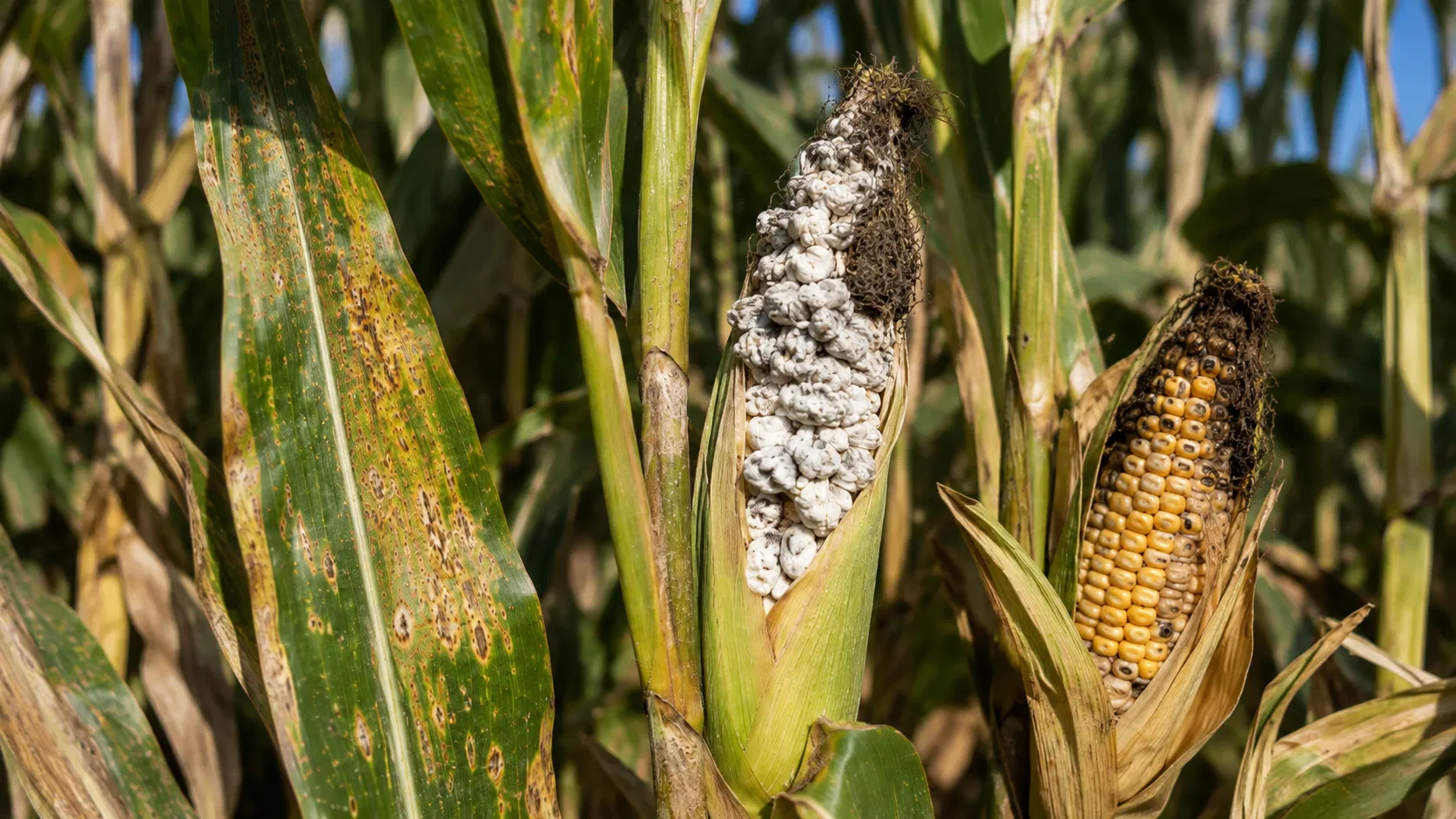
Maize (Zea mays) is grown across nearly every state in India, feeding the poultry, dairy, starch, and food-grain industries alongside its role as a staple crop. Its dense canopy, long growing season, and back-to-back cropping in the same fields make it a magnet for foliar fungal diseases that can quietly erode yield well before harvest.
The trouble is that maize disease symptoms often look similar from a distance — a streaked or spotted leaf can mean several different things, and treating the wrong one wastes both money and time.
This guide covers the 3 maize diseases with the most consistent field impact in Indian growing conditions, how to tell them apart, and which solutions genuinely help with each one.
1. Leaf Blight (Exserohilum turcicum)
Also known as Turcicum leaf blight, this disease strips the plant of green leaf area during grain fill, when the crop needs it most — a heavy outbreak can visibly thin the canopy and cut cob size and weight.
How to Spot It
Long, elliptical, greyish-green to tan lesions running parallel to the leaf veins, often starting on the lower, older leaves and spreading upward as the lesions enlarge and merge.
Solutions to Manage It
| Product | Active Ingredient |
|---|---|
| BACF Carman Fungicide | Carbendazim 12% + Mancozeb 62% WP |
| Syngenta Amistar Top Fungicide | Azoxystrobin 18.2% + Difenoconazole 11.4% SC |
| Dhanuka M-45 Fungicide | Mancozeb 75% WP |
2. Rust (Puccinia sorghi)
Common rust builds up fast in humid, moderate-temperature weather, covering leaves in pustules that rupture and release spores — heavy infections reduce the leaf's ability to photosynthesize and can weaken stalks late in the season.
How to Spot It
Small, raised, reddish-brown pustules scattered on both leaf surfaces that turn powdery and rupture, releasing a rust-coloured spore dust that rubs off on your fingers.
Solutions to Manage It
| Product | Active Ingredient |
|---|---|
| Tata Ergon Fungicide | Kresoxim-methyl 44.3% SC |
| Syngenta Amistar Top Fungicide | Azoxystrobin 18.2% + Difenoconazole 11.4% SC |
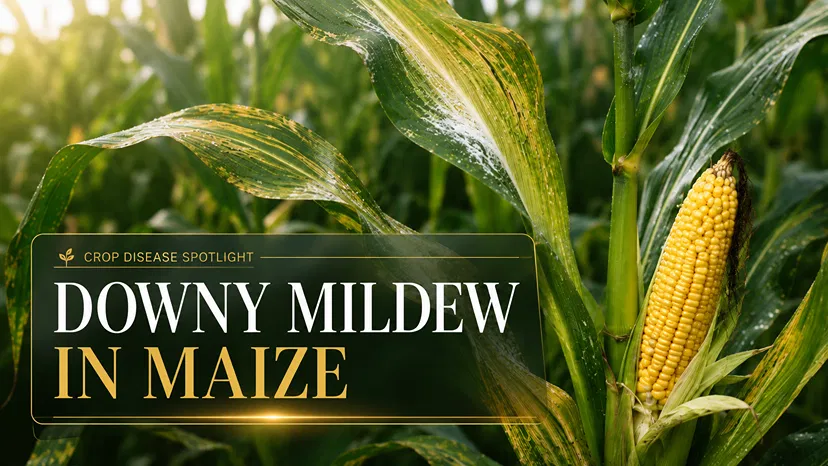
3. Downy Mildew (Peronosclerospora spp.)
A systemic, seed- and soil-borne disease that can distort the whole plant from early growth onward — badly infected plants are stunted, produce little to no grain, and act as a source of infection for the rest of the field.
How to Spot It
Pale yellow to white streaking running parallel to the leaf veins, a downy white-to-grey fungal growth on the underside of young leaves in humid mornings, and stunted, bushy, or malformed plants that fail to develop normal cobs.
Solutions to Manage It
| Product | Active Ingredient |
|---|---|
| Nichino Mask Fungicide | Metalaxyl 35% WS |
| BACF Carman Fungicide | Carbendazim 12% + Mancozeb 62% WP |
| Syngenta Amistar Top Fungicide | Azoxystrobin 18.2% + Difenoconazole 11.4% SC |
Frequently Asked Questions
1. What is the most common disease of maize in India?
Turcicum leaf blight (Exserohilum turcicum) is one of the most widespread and yield-limiting maize diseases in India, especially in humid, high-rainfall growing regions.
2. Can maize downy mildew be treated once symptoms appear?
Not fully — downy mildew is systemic once it's established, so infected plants rarely recover. The real control point is before sowing, through seed treatment and resistant hybrids; foliar sprays mainly protect healthy plants nearby.
3. How is maize rust different from leaf blight?
Rust shows up as small, raised, rust-coloured pustules that leave powder on your fingers, while leaf blight forms long, greyish-tan streaks running along the leaf — the lesion shape and texture are the fastest way to tell them apart in the field.
4. When should fungicide sprays start for maize leaf diseases?
Starting at the first sign of lesions or pustules on the lower leaves, with a follow-up spray at label-recommended intervals, generally protects yield far better than waiting for the disease to reach the upper canopy.
Disclaimer
- Always confirm current label registration, approved dosage, water volume, and pre-harvest interval (PHI) for your state before using any product - labels are periodically revised by regulatory authorities.
- This guide is a general advisory. Do your own research and verification before using any product. Always confirm suitability for your crop stage, region, and field conditions before making any purchase, spray, or crop-management decision.