Soybean (Glycine max) is India's leading kharif oilseed, grown on close to 12 million hectares across Madhya Pradesh, Maharashtra, Rajasthan and Karnataka. Insect pests take a heavy and largely preventable share of that crop every season, by some estimates a quarter or more of the potential yield in an unprotected field.
What makes soybean pests difficult is that the worst of them work out of sight. The girdle beetle and stem fly both feed inside the stem, so the plant looks normal from the road while its internal plumbing is being cut. By the time a grower notices drooping shoots or plants dying off in patches, the larvae have already completed most of their damage and are beyond the reach of a spray.
The defoliators are the opposite problem: highly visible, but easy to underestimate. A soybean plant can lose a surprising amount of leaf area early on and still recover, but the same loss during pod filling translates directly into lighter seed. This guide covers the 8 pests that cost Indian soybean growers the most, the damage signs that identify each one, and the solutions registered against it.
1. Girdle Beetle (Obereopsis brevis)
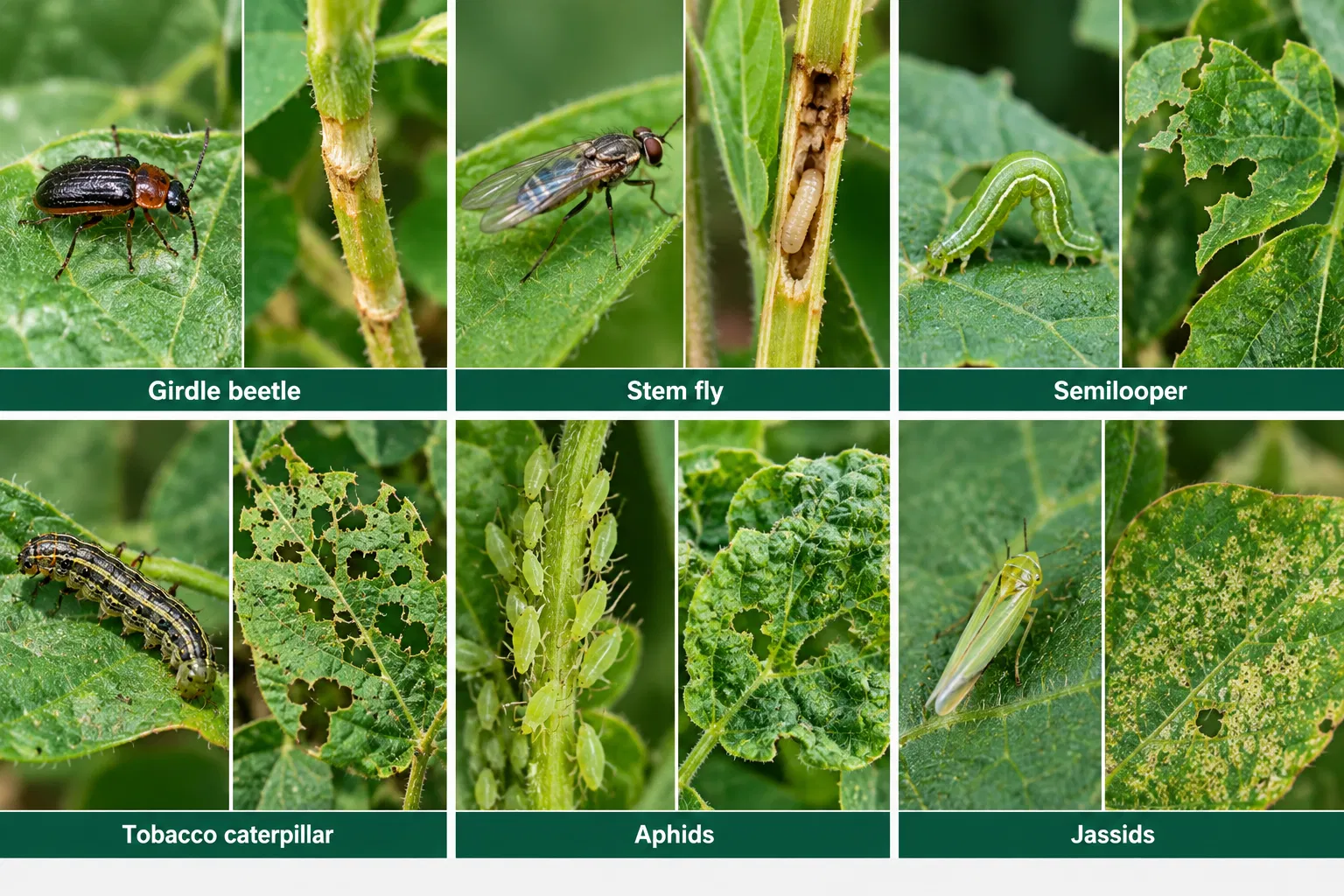
The girdle beetle is the most destructive insect pest of soybean in central India, and the one whose damage is most unmistakable once you know what to look for. The female cuts two parallel rings around the stem or branch and lays an egg between them. The girdled portion above the rings dies, and the grub then tunnels downward inside the stem, hollowing it out. Every affected branch is a total loss.
How to Spot It
Two neat parallel girdles cut around the stem or petiole, roughly a centimetre apart the signature of this pest and unlike anything else in soybean; the shoot, leaf or branch above the girdle wilting, drying and hanging down while the rest of the plant stays green; stems that are hollow and packed with sawdust-like frass when split open; drying branches scattered through the field, most numerous where the crop is dense.
Solutions to Control It
| Product | Active Ingredient |
|---|---|
| FMC Coragen Insecticide | Chlorantraniliprole 18.5% SC |
| Bayer Solomon Insecticide | Beta-cyfluthrin 8.49% + Imidacloprid 19.81% w/w OD |
| Syngenta Simodis Insecticide | Isocycloseram 9.2% w/w DC |
| Syngenta Alika Insecticide | Thiamethoxam 12.6% + Lambda-cyhalothrin 9.5% ZC |
| Syngenta Ampligo Insecticide | Chlorantraniliprole 9.3% + Lambda Cyhalothrin 4.6% ZC |
| Bayer Vayego Insecticide | Tetraniliprole 18.18% SC |
2. Stem Fly (Melanagromyza sojae)
Stem fly is the quietest yield thief in soybean. The maggot mines downward through the petiole into the main stem and tunnels along it, destroying the tissue that carries water and nutrients. Young plants attacked soon after germination may die outright; older plants survive but produce fewer pods and lighter seed, and the grower rarely connects the two.
How to Spot It
Young seedlings wilting and dying in patches within the first few weeks; reddish-brown tunnels running lengthwise through the pith when the stem is split open, the definitive check for this pest; drooping or yellowing of individual leaves whose petiole has been mined; plants that look intact but stay stunted, flower poorly and set fewer pods than neighbours.
Solutions to Control It
| Product | Active Ingredient |
|---|---|
| Syngenta Alika Insecticide | Thiamethoxam 12.6% + Lambda-cyhalothrin 9.5% ZC |
| Syngenta Ampligo Insecticide | Chlorantraniliprole 9.3% + Lambda Cyhalothrin 4.6% ZC |
| Syngenta Simodis Insecticide | Isocycloseram 9.2% w/w DC |
3. Semilooper (Chrysodeixis acuta, Thysanoplusia orichalcea)
The semilooper, also called the green semilooper, is the most abundant defoliator of Indian soybean and often the first pest a grower notices. The pale green caterpillars feed voraciously on leaves from the flowering stage onward, and because their numbers can build quickly in a humid canopy, a light infestation at flowering can become severe defoliation by pod fill.
How to Spot It
Pale green caterpillars with fine white lines along the body that arch the middle of the back into a loop as they crawl, only two pairs of prolegs, unlike a full looper; irregular holes eaten through the leaf blade, leaving the veins as a skeleton in heavy feeding; caterpillars resting on the underside of leaves during the day; green pellets of excreta on lower leaves and soil.
Solutions to Control It
| Product | Active Ingredient |
|---|---|
| FMC Coragen Insecticide | Chlorantraniliprole 18.5% SC |
| Bayer Solomon Insecticide | Beta-cyfluthrin 8.49% + Imidacloprid 19.81% w/w OD |
| BASF Exponus Insecticide | Broflanilide 300 g/l SC |
| Syngenta Simodis Insecticide | Isocycloseram 9.2% w/w DC |
| Bayer Vayego Insecticide | Tetraniliprole 18.18% SC |
| Plethora Insecticide | Novaluron 5.25% + Indoxacarb 4.50% SC |
4. Tobacco Caterpillar and Leaf Worm (Spodoptera litura)
The same insect appears on labels under several names, tobacco caterpillar, leaf worm and common cutworm are all Spodoptera litura. It is the most damaging defoliator of soybean when it arrives in numbers, because the older larvae eat enormous quantities of leaf and feed at night, when they are hardest to catch. Young larvae feed together in a group on the leaf where they hatched, then disperse across the field.
How to Spot It
Clusters of dozens of tiny caterpillars scraping the surface off a single leaf, leaving it papery and translucent, the earliest and best moment to act; larger larvae, dark green to brown with a pair of dark crescent marks on each segment, hiding in leaf litter or soil cracks by day; large irregular holes and stripped shoots appearing overnight; heaps of dark excreta pellets under damaged plants.
Solutions to Control It
| Product | Active Ingredient |
|---|---|
| FMC Coragen Insecticide | Chlorantraniliprole 18.5% SC |
| Corteva Delegate Insecticide | Spinetoram 11.70% SC |
| BASF Exponus Insecticide | Broflanilide 300 g/l SC |
| Plethora Insecticide | Novaluron 5.25% + Indoxacarb 4.50% SC |
| Bayer Vayego Insecticide | Tetraniliprole 18.18% SC |
| Syngenta Simodis Insecticide | Isocycloseram 9.2% w/w DC |
| Syngenta Ampligo Insecticide | Chlorantraniliprole 9.3% + Lambda Cyhalothrin 4.6% ZC |
5. Whitefly (Bemisia tabaci)
Whitefly does modest damage by feeding, but it matters out of all proportion because it transmits yellow mosaic virus, the most serious viral disease of Indian soybean. There is no cure for an infected plant, so controlling the whitefly before it spreads the virus is the only real defence. Populations climb fastest in warm, dry weather and on crops sown late.
How to Spot It
Clouds of tiny white winged insects rising when the canopy is disturbed, settling again on leaf undersides; flat, oval, pale scale-like nymphs fixed to the underside of leaves; sticky honeydew on lower leaves, often blackened by sooty mould; bright yellow mottling or complete yellowing of young leaves, which signals yellow mosaic virus rather than the feeding itself.
Solutions to Control It
| Product | Active Ingredient |
|---|---|
| UPL Ulala Insecticide | Flonicamid 50% WG |
6. Jassids (Empoasca kerri)
Jassids, also called leafhoppers, suck sap from the underside of leaves and inject a toxic saliva as they feed. The result is a scorched, curled appearance known as hopperburn, which cuts the leaf's ability to photosynthesise long before the leaf actually dies. Young plants are hit hardest, which is why seed treatment is worth considering in fields with a history of the pest.
How to Spot It
Small wedge-shaped green insects that run sideways or hop away when a leaf is turned over; leaf margins yellowing, then browning and curling downward in a scorched cup shape, the hopperburn pattern; stunted plants with a bronzed or reddish cast to the foliage; damage concentrated on younger, upper leaves.
Solutions to Control It
| Product | Active Ingredient |
|---|---|
| UPL Ulala Insecticide | Flonicamid 50% WG |
| Bayer Gaucho Insecticide | Imidacloprid 48% FS |
7. Aphids (Aphis glycines)
Aphids cluster on the tenderest parts of the plant — growing tips, young leaves and flower buds, and drain sap in large colonies. Beyond the direct feeding loss, the honeydew they excrete supports a sooty mould that blackens leaves and blocks light, and they act as vectors for several plant viruses. Colonies build up explosively in cool, humid conditions.
How to Spot It
Dense colonies of small soft-bodied pale green to yellow insects packed along growing tips, young shoots and the underside of tender leaves; curled, crinkled and stunted new growth; sticky honeydew coating the leaves below the colony, later turning black with sooty mould; ants moving up and down the stems, a reliable indirect sign of an aphid colony above.
Solutions to Control It
| Product | Active Ingredient |
|---|---|
| UPL Ulala Insecticide | Flonicamid 50% WG |
8. Leaf Weevil (Myllocerus spp.)
The grey leaf weevil is a two-stage pest, and the half that does the real damage is the half nobody sees. Adults notch the leaf margins, which looks alarming but is usually tolerable. The grubs live in the soil and feed on the roots and nodules, cutting the plant's nitrogen-fixing capacity and its ability to draw water. Damage is worst in light, sandy soils.
How to Spot It
Neat semicircular notches bitten out along the leaf edges, giving the margin a scalloped outline; small greyish-white weevils with a short snout sitting on leaves, which drop to the ground and play dead when disturbed; plants that yellow and wilt without any visible above-ground cause; white legless grubs and chewed root nodules when the root zone is dug up.
Solutions to Control It
| Product | Active Ingredient |
|---|---|
| Syngenta Ekalux Insecticide | Quinalphos 25% EC |
Disclaimer: Always confirm current label registration, approved dosage, water volume, and pre-harvest interval (PHI) for your state before using any product, labels are periodically revised by regulatory authorities.
This guide is a general advisory. Do your own research and verification before using any product. Always confirm suitability for your crop stage, region, and field conditions before making any purchase, spray, or crop-management decision.