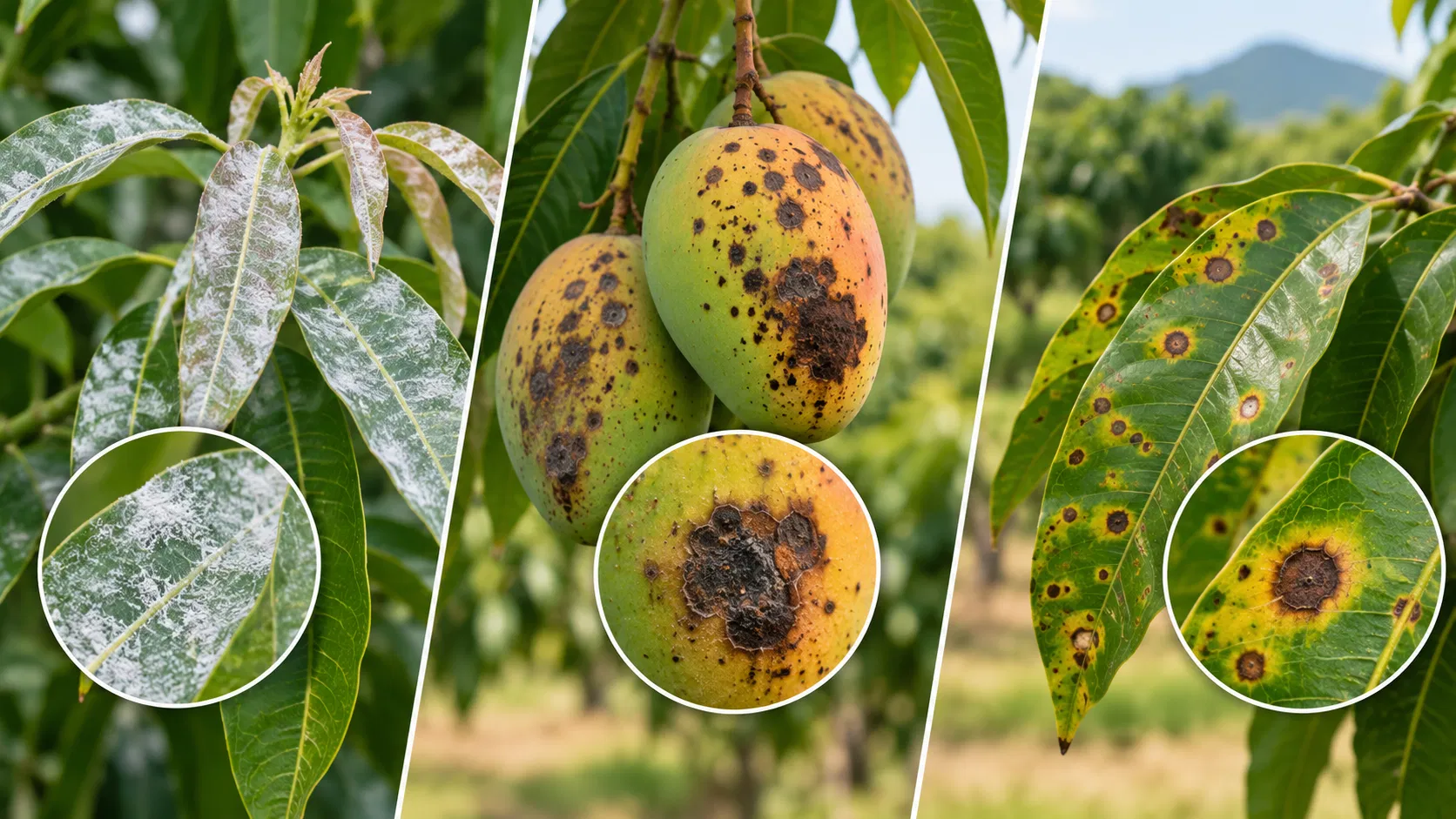
Mango is one of India's most widely grown fruit crops, valued both for domestic consumption and export. But orchards are constantly under pressure from fungal diseases that spread quickly in humid, rainy, or overcast weather, and can affect leaves, flowers, and fruit at every stage of the crop cycle. Left unmanaged, these diseases lower yield, spoil fruit quality, and cause losses in storage and transit.
This guide covers the three fungal diseases that most commonly affect mango, how to identify each one in the field, and the fungicide solutions available to control them.
1. Powdery Mildew (Oidium mangiferae)
Powdery mildew attacks young leaves, panicles, and developing fruit, most severely during cool, cloudy, and humid weather around the flowering stage. It can cause heavy flower and fruitlet drop, sharply reducing fruit set for the season.
How to Spot It
Look for a white to greyish powdery coating on leaves, flower panicles, and young fruit. Infected flowers shrivel and drop before setting fruit. Young fruits that do survive often show corky, russeted patches on the skin and may drop prematurely. In severe cases, affected leaves curl and appear distorted.
Solutions to Manage/Control It
| Product | Active Ingredient |
|---|---|
| Tata Rallis Contaf Plus Fungicide | Hexaconazole 5% SC |
| Syngenta Amistar Fungicide | Azoxystrobin 23% SC |
| Syngenta Thionutri Fungicide | Sulphur 80% WG |
2. Anthracnose (Colletotrichum gloeosporioides)
Anthracnose affects leaves, twigs, flower panicles, and fruit, and is one of the most damaging mango diseases both in the orchard and after harvest. It causes blossom blight that reduces fruit set, and fruit infected in the field can develop sunken black rot spots that expand rapidly once the fruit begins to ripen.
How to Spot It
Watch for small, irregular dark brown to black spots on leaves that enlarge and merge together. On flower panicles, look for blackened, blighted patches that cause flowers to drop. On fruit, the disease shows up as sunken, dark, circular lesions that expand quickly during ripening and storage.
Solutions to Manage/Control It
| Product | Active Ingredient |
|---|---|
| Syngenta Amistar Fungicide | Azoxystrobin 23% SC |
| Tata Rallis Blitox Fungicide | Copper Oxychloride 50% WP |
| Bayer Buonos Fungicide | Tebuconazole 38.39% w/w SC |
3. Leaf Spot
Leaf spot diseases show up as scattered lesions across the leaf surface, reducing the leaf area available for photosynthesis. In heavy infections, affected leaves drop early, which weakens tree vigour, particularly in young orchards and nursery plants.
How to Spot It
Look for small, roughly circular brown to greyish-tan spots on the leaf surface, often with a darker margin or a faint yellow halo around each spot. In heavier infections, the spots merge to give the leaf a blighted appearance, and badly affected leaves fall off the tree well before their time.
Solutions to Manage/Control It
| Product | Active Ingredient |
|---|---|
| Bayer Buonos Fungicide | Tebuconazole 38.39% w/w SC |
Frequently Asked Questions
What is the most common disease affecting mango trees in India?
Powdery mildew and anthracnose are the two most widespread and damaging mango diseases in India, especially during humid weather at flowering and fruiting stages.
Can one fungicide control more than one mango disease at the same time?
Yes. Some broad-spectrum fungicides, such as those based on Azoxystrobin or Tebuconazole, are registered for both anthracnose and powdery mildew, so a single spray schedule can cover multiple diseases.
When should I start spraying mango trees for these diseases?
Spraying is most effective when started preventively at the flowering stage, since powdery mildew and anthracnose both attack panicles and young fruit early in the season.
Can these diseases still be treated after fruit has already set?
Yes, but control becomes harder once fruit is infected. Continuing a spray schedule through fruit development helps limit further spread and reduces losses at harvest and in storage.
- Always confirm the current label registration, approved dosage, and pre-harvest interval (PHI) for your state before using any product, as labels are periodically revised by regulatory authorities.
- This is general advisory content. Please do your own research and verify with a local agronomist or dealer before making any purchase, spray, or crop-management decision.