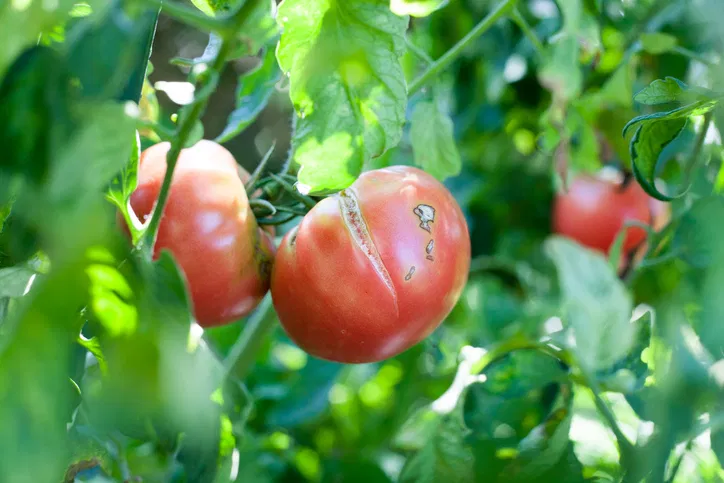
Tomato (Solanum lycopersicum) is grown in every state of India and in almost every season, from open fields in Karnataka, Andhra Pradesh and Maharashtra to polyhouses supplying premium urban markets. It is also one of the most disease-prone vegetables in cultivation. The crop stands in the field for months, is harvested in repeated pickings, and carries a dense leafy canopy that holds moisture, a combination that suits fungal and bacterial pathogens almost perfectly.
What makes tomato diseases so expensive is that the fruit itself is the product. A leaf spot that would be tolerable on a grain crop here translates into sunscalded, undersized fruit, while a rot on the fruit surface means produce no trader will accept at any price. Price volatility sharpens the loss further: an outbreak during a high-price window costs far more than the same outbreak a month later.
Most of these diseases are also far cheaper to prevent than to cure. By the time lesions are visible on fruit, the pathogen has usually been in the canopy for a week or more. This guide covers the 10 diseases that cost Indian tomato growers the most, the field symptoms that separate them, and the solutions registered against each.
1. Early Blight (Alternaria solani)
Early blight is the single most widespread disease of Indian tomato and the one with the longest list of registered solutions. It works upward from the oldest leaves, stripping the lower canopy and leaving the fruit exposed to direct sun. It also attacks stems and fruit, and it is most aggressive in warm, humid weather with alternating wet and dry spells.
How to Spot It
Dark brown spots on the older, lower leaves marked with concentric rings in a target-board pattern, each ringed by a yellow halo; spots that enlarge, merge and brown off whole leaflets, defoliating the plant from the bottom up; dark sunken lesions with the same ringed pattern at the stem end of the fruit; dark elongated collar lesions at the base of the stem on young plants.
Solutions to Manage It
| Product | Active Ingredient |
|---|---|
| Syngenta Amistar Top Fungicide | Azoxystrobin 18.2% + Difenoconazole 11.4% w/w SC |
| Bayer Nativo Fungicide | Tebuconazole 50% + Trifloxystrobin 25% WG |
| Adama Custodia Fungicide | Azoxystrobin 11% + Tebuconazole 18.3% w/w SC |
| Syngenta Miravis Duo Fungicide | Pydiflumetofen 6.89% + Difenoconazole 11.49% w/w SC |
| Syngenta Kavach Flo Fungicide | Chlorothalonil 40.0% + Difenoconazole 4.0% w/w SC |
| Dhanuka Kasu-B Fungicide | Kasugamycin 3% SL |
2. Late Blight (Phytophthora infestans)
Late blight is the fastest-moving disease a tomato grower will ever face. Under cool, cloudy, wet weather it can take a healthy field to collapse within a week, and once it is established in a humid canopy no spray will fully halt it. This is a disease that has to be anticipated from the weather rather than treated from the symptoms.
How to Spot It
Large pale green to brown water-soaked patches on leaves, usually starting at the leaf tip or margin and spreading inward with no defined edge; a fine white downy fungal growth on the underside of the lesion in humid morning conditions the confirming sign; dark brown-black lesions girdling the stem and petioles; firm greasy brown blotches on green fruit that spread fast and turn the fruit foul.
Solutions to Manage It
| Product | Active Ingredient |
|---|---|
| Syngenta Folio Gold Fungicide | Metalaxyl M 3.3% + Chlorothalonil 33.1% SC |
| Syngenta Kavach Flo Fungicide | Chlorothalonil 40.0% + Difenoconazole 4.0% w/w SC |
| Syngenta Amistar Top Fungicide | Azoxystrobin 18.2% + Difenoconazole 11.4% w/w SC |
| Dhanuka Godiwa Super Fungicide | Azoxystrobin 18.2% + Difenoconazole 11.4% w/w SC |
| UPL Avancer Glow Fungicide | Azoxystrobin 8.3% + Mancozeb 66.7% WG |
| Tata Rallis Blitox Fungicide | Copper oxychloride 50% WP |
3. Frog Eye Leaf Spot
Frog eye leaf spot is the name growers and labels use for the ringed leaf spotting that develops alongside, and is often mistaken for, early blight. Several leaf-spotting fungi contribute to the complex, and in practice it is treated as one problem. It thins the canopy during fruit development, which both cuts yield and leaves ripening fruit exposed to sunscald.
How to Spot It
Small roughly circular spots with pale grey or tan centres and distinctly darker brown margins, giving each lesion a ringed eye-like look; spots scattered fairly evenly across the leaf blade rather than confined to the oldest leaves; centres that dry out, turn papery and sometimes fall through to leave small holes; heavy spotting that runs together and yellows the whole leaflet.
Solutions to Manage It
| Product | Active Ingredient |
|---|---|
| Tata Rallis Blitox Fungicide | Copper oxychloride 50% WP |
4. Septoria Leaf Spot (Septoria lycopersici)
Septoria leaf spot is a prolific defoliator that is often lumped in with early blight but behaves differently and needs identifying on its own. Its lesions are smaller and far more numerous, and it spreads upward quickly through a wet canopy by rain splash. A severe outbreak can leave a plant almost bare of leaves while the fruit is still filling.
How to Spot It
Many small circular spots, far smaller than early blight lesions, with grey or tan centres and dark brown borders, lacking the concentric rings of early blight; tiny black pinhead specks visible in the spot centres with a hand lens, the definitive check; spotting that starts on the lowest leaves and climbs rapidly; heavy early defoliation with the fruit itself usually left unmarked.
Solutions to Manage It
| Product | Active Ingredient |
|---|---|
| BASF Merivon Fungicide | Fluxapyroxad 250 g/l + Pyraclostrobin 250 g/l SC |
5. Powdery Mildew (Leveillula taurica)
Powdery mildew is the characteristic tomato disease of warm days with cool, humid nights, and it has become far more common in polyhouse production. Unlike most mildews it colonises the leaf from inside, which is why the yellow blotching appears on top while the powdery growth sits underneath. It saps vigour steadily and drives early leaf fall.
How to Spot It
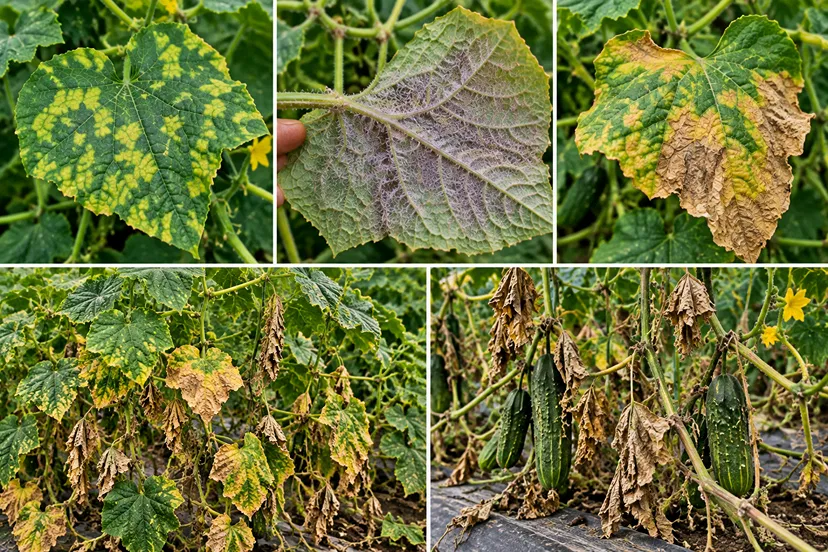
Pale yellow angular blotches on the upper leaf surface, bounded by the veins; a white-to-greyish powdery coating on the underside directly beneath each yellow patch, look under the leaf, not on top; blotch centres browning and dying as the infection advances; leaves yellowing, curling and dropping from the lower canopy upward, with fruit left small and poorly coloured.
Solutions to Manage It
| Product | Active Ingredient |
|---|---|
| Syngenta Miravis Duo Fungicide | Pydiflumetofen 6.89% + Difenoconazole 11.49% w/w SC |
6. Anthracnose and Fruit Rot (Colletotrichum spp.)
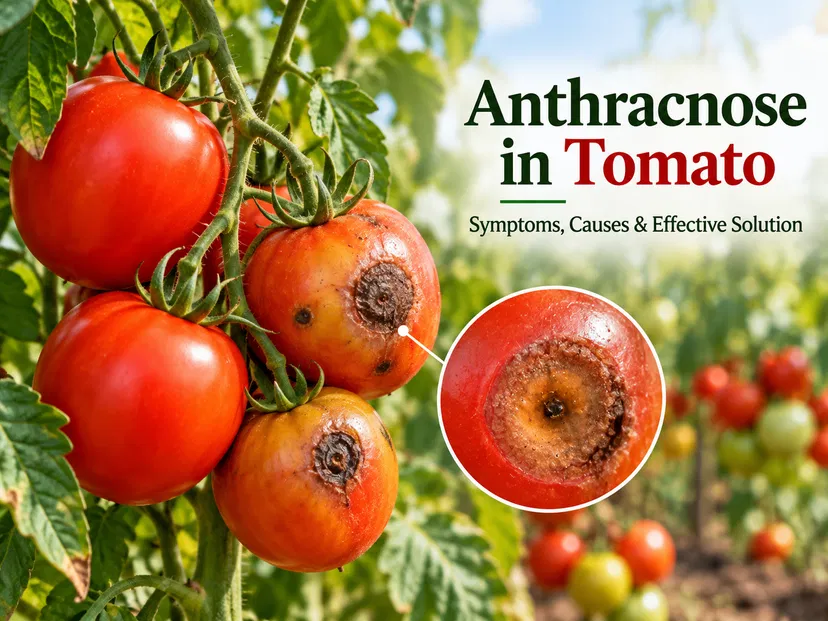
Anthracnose is the disease that hits a grower hardest at the till, because it shows itself only on ripening and ripe fruit, after every cost of the season has already been spent. The fungus often infects green fruit and then stays latent until ripening begins, so a field that looked clean can produce heavily rotted pickings. Damage is worst in wet weather and where fruit touches the soil.
How to Spot It
Small circular sunken water-soaked spots on ripening fruit that enlarge and darken; concentric rings of pink, orange or black spore masses in the sunken centres during humid weather, the clearest sign; rot that stays firm at first and then softens through the flesh; damage concentrated on the lowest fruit and on anything resting on wet soil.
Solutions to Manage It
| Product | Active Ingredient |
|---|---|
| Bayer Buonos Fungicide | Tebuconazole 38.39% w/w SC |
7. Bacterial Leaf Spot (Xanthomonas spp.)
Bacterial leaf spot spreads by splashing water and by handling, which makes it a particular problem in nurseries and in fields worked while the foliage is wet. Because it is bacterial, fungicides will not touch it, and the spots it leaves on fruit are enough on their own to make produce unsaleable. Warm, wet weather drives it fastest.
How to Spot It
Small dark brown to black angular spots on leaves, each often surrounded by a narrow yellow halo and looking greasy or water-soaked when fresh; spots that stay small and numerous rather than enlarging into blotches; raised dark scabby specks on the fruit surface; worst spread along rows after rain, overhead irrigation or field operations carried out on wet plants.
Solutions to Manage It
| Product | Active Ingredient |
|---|---|
| Katyayani Kmycin | Streptomycin Sulphate 90% + Tetracycline Hydrochloride 10% SP |
8. Bacterial Wilt (Ralstonia solanacearum)
Bacterial wilt is the most difficult disease on this list, because there is no curative treatment once a plant is infected and the bacterium survives in soil for years. Plants collapse suddenly, often at full growth and with a load of fruit on them, and the losses come in patches that widen season after season wherever tomato follows tomato.
How to Spot It
Sudden wilting of a healthy green plant, with no yellowing of the leaves beforehand, the key difference from fungal wilt; wilting that strikes in the heat of the day with no recovery overnight; brown discolouration of the vascular ring when the lower stem is cut across. Confirm with the stem-ooze test: hang a cut piece of stem base in clear water and watch for a milky white stream within a few minutes, which is diagnostic.
Solutions to Manage It
| Product | Active Ingredient |
|---|---|
| Katyayani Striker Bio Fungicide | Pseudomonas fluorescens |
9. Fusarium Wilt (Fusarium oxysporum f. sp. lycopersici)
Fusarium wilt enters through the roots and plugs the plant's internal water-conducting tissue, so infected plants decline gradually rather than collapsing. They flower and set poorly, and finally die. The fungus persists in soil for several years, which is why rotation and resistant varieties matter more here than any spray.
How to Spot It
Yellowing that begins on the lower leaves and frequently affects one side of the plant or a single branch while the rest stays green, a one-sided pattern that distinguishes it from bacterial wilt; leaves drooping by day and recovering by evening at first, then staying wilted permanently; brown streaks running through the inner woody tissue when the stem is split lengthwise; roots intact but stem base discoloured.
Solutions to Manage It
| Product | Active Ingredient |
|---|---|
| Multiplex Nisarga Bio Fungicide | Trichoderma viride 1.5% WP |
| IPL Sanjeevni Bio Fungicide | Trichoderma viride 1.0% WP |
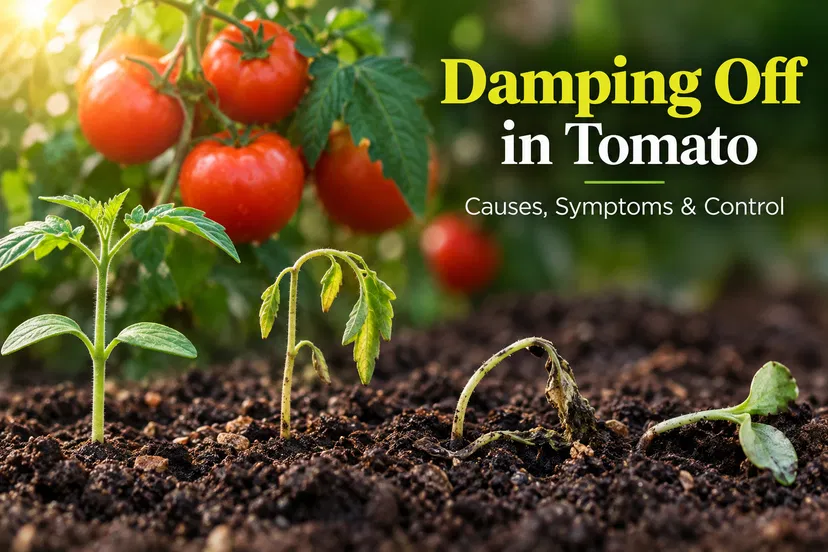
10. Damping Off (Pythium and Rhizoctonia spp.)
Damping off strikes before the crop ever reaches the main field, rotting seed in the nursery bed or toppling seedlings within days of emergence. In a crowded, overwatered nursery it can clear whole patches of seedlings in a very short time, and since tomato is almost always transplanted, a nursery failure sets back the entire planting schedule.
How to Spot It
Seeds that fail to come up in patches; emerged seedlings with a soft, water-soaked, pinched stem right at soil level, toppling over while the leaves are still green; losses spreading outward in roughly circular patches; damage worst in densely sown beds, in low spots and wherever watering has been heaviest.
Solutions to Manage It
| Product | Active Ingredient |
|---|---|
| Multiplex Nisarga Bio Fungicide | Trichoderma viride 1.5% WP |
| IPL Sanjeevni Bio Fungicide | Trichoderma viride 1.0% WP |
Disclaimer: Always confirm current label registration, approved dosage, water volume, and pre-harvest interval (PHI) for your state before using any product, labels are periodically revised by regulatory authorities.
This guide is a general advisory. Do your own research and verification before using any product. Always confirm suitability for your crop stage, region, and field conditions before making any purchase, spray, or crop-management decision.