When it comes to protecting crops from destructive pests, few insecticides are as widely used and discussed as neonicotinoids. Among the most recognized active ingredients in this group are thiamethoxam and imidacloprid. Both are effective systemic insecticides, but they are not identical. If you are comparing thiamethoxam vs imidacloprid, understanding how they differ in performance, application, persistence, and crop use can help you make a more informed choice.
Although both products target similar pests and share a related mode of action, their speed of uptake, residual performance, and best-use scenarios may vary. This guide explains the key differences in practical terms so growers can understand where each insecticide may fit within a responsible pest management program.
What Are Neonicotinoids?
Neonicotinoids are a class of systemic insecticides designed to disrupt the nervous systems of insects. They are absorbed by plants and distributed through their tissues, making them effective against sucking pests such as aphids, whiteflies, leafhoppers, thrips, and certain soil-dwelling insects.
Because these products move within plant tissues, they may protect new growth and provide longer-lasting control than some contact insecticides. However, repeated use can contribute to resistance and may affect non-target organisms, so careful product selection and application are essential.
Thiamethoxam vs Imidacloprid: The Core Difference
At a glance, both thiamethoxam and imidacloprid are broad-spectrum neonicotinoid insecticides with systemic activity. Both may be used in seed treatment, foliar spraying, and soil application, depending on the crop, formulation, and product label.
Imidacloprid is one of the earliest and most widely recognized neonicotinoids. It has a long history of agricultural use and is valued for strong systemic movement and extended residual control in suitable applications.
Thiamethoxam is a later-generation neonicotinoid that is often selected where rapid plant uptake and early crop protection are important. Its systemic properties make it useful during vulnerable crop establishment stages.
How Thiamethoxam and Imidacloprid Work
Both insecticides act on nicotinic acetylcholine receptors in the insect nervous system. This disrupts normal nerve signaling, leading to feeding cessation, paralysis, and eventual death.
- Imidacloprid: Known for systemic activity and dependable residual control.
- Thiamethoxam: Often associated with rapid uptake and quick suppression of active pests.
Despite their similar mode of action, differences in chemical structure, formulation, plant movement, and environmental conditions can influence how they perform in the field.
Effectiveness Against Common Pests
Both products are commonly used against sap-feeding pests, although crop type, pest pressure, resistance status, and application timing can influence the final result.
Imidacloprid is commonly used against:
- Aphids
- Whiteflies
- Planthoppers
- Leafhoppers
- Some beetles and chewing insects, depending on the formulation
Thiamethoxam is commonly used against:
- Aphids
- Whiteflies
- Thrips
- Flea beetles
- Early-season soil and seedling pests
In many farming programs, these insecticides are used to manage early pest pressure or protect young plants. The better choice depends on the registered crop use, target pest, crop stage, and local resistance conditions.
Speed of Action and Residual Control
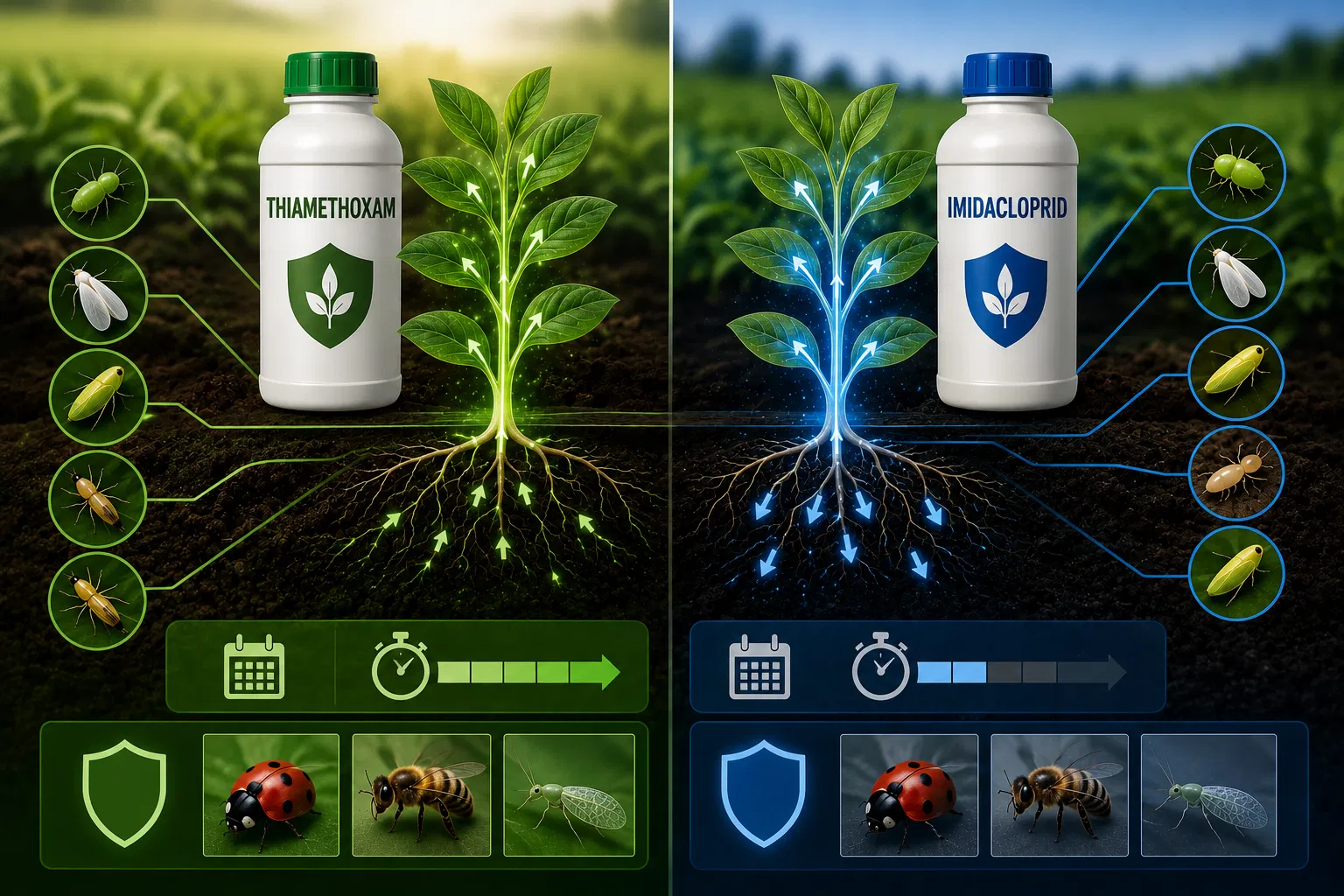
Thiamethoxam is often selected when rapid early protection is a priority. Its systemic uptake can help suppress sucking pests soon after application, particularly when used during early crop establishment.
Imidacloprid is frequently valued for consistent residual activity. Once absorbed by the plant, it may provide extended protection against susceptible pests when used according to label directions.
In practical terms: thiamethoxam may be preferred when quick early protection is important, while imidacloprid is often chosen where dependable residual activity is the main priority.
Actual performance depends on the crop, formulation, pest species, weather, application method, and resistance profile. Neither product should be selected solely on the assumption that one is always faster or longer-lasting in every situation.
Application Methods
Both neonicotinoids are versatile and may be used through several application methods, depending on the product label.
Common thiamethoxam applications:
- Seed treatment
- Foliar spray
- Soil drench or soil application
Common imidacloprid applications:
- Seed treatment
- Foliar spray
- Soil application
- Specialized horticultural applications where locally approved
The application method strongly influences performance. Soil and seed applications rely on root uptake, while foliar sprays depend on coverage, timing, and the activity of the target pest.
Crop Use and Agronomic Fit
Thiamethoxam and imidacloprid are used in a broad range of agricultural systems, including cereals, vegetables, fruits, cotton, pulses, and ornamental crops.
Thiamethoxam is often selected for early-season protection, especially where rapid uptake and seedling establishment are important. It is commonly used in preventive or early-intervention programs against sucking pests.
Imidacloprid is widely used in horticultural and field crops and is available in several formulations. Its long history of use and broad registration have made it a familiar option for many growers.
The better choice is not necessarily the product perceived as stronger. It is the product that best matches the registered crop, pest species, growth stage, application method, and resistance-management plan.
Role in Crop Protection Programs
Both active ingredients can support broader crop protection strategies when they are used at the right time and for the correct target pest. They should not, however, replace regular field scouting, pest identification, or integrated pest management.
Before treatment, growers should confirm:
- The target pest is listed on the product label
- The crop is approved for treatment
- The pest population has reached a treatment threshold
- The chosen formulation suits the application method
- Previous sprays have not relied repeatedly on the same mode of action
Resistance Management Considerations
Resistance is a major concern when comparing thiamethoxam and imidacloprid. Because both belong to the same insecticide group, rotating only between these two active ingredients may not provide effective resistance management.
Pests resistant to one neonicotinoid may show reduced sensitivity or cross-resistance to another. To reduce the risk:
- Rotate with insecticides from different mode-of-action groups.
- Use only label-approved rates and timings.
- Apply treatments only when field monitoring shows they are justified.
- Combine chemical control with cultural, mechanical, and biological methods.
- Avoid repeated back-to-back applications of neonicotinoids.
A strong resistance-management plan helps preserve the effectiveness of both insecticides for future use.
Environmental and Pollinator Considerations
Like other systemic insecticides, thiamethoxam and imidacloprid require careful handling to reduce risks to pollinators, beneficial insects, aquatic organisms, and other non-target species.
Responsible use includes:
- Following all label restrictions
- Avoiding application while bees are actively foraging
- Preventing spray drift and runoff
- Respecting flowering-stage restrictions
- Using only the amount required for effective control
Application timing and method can significantly affect environmental exposure. Local regulations and product labels should always take priority over general recommendations.
Thiamethoxam vs Imidacloprid: Which Is Better?
There is no universal winner in the comparison between thiamethoxam and imidacloprid. The best choice depends on the specific crop, pest, timing, formulation, resistance status, and label approval.
- Thiamethoxam may be suitable where rapid uptake and early crop protection are priorities.
- Imidacloprid may be suitable where consistent systemic and residual control is required.
Growers should also consider regional resistance patterns, environmental restrictions, application equipment, and the pest-management products already used during the season.
Quick Comparison Table
| Feature | Thiamethoxam | Imidacloprid |
|---|---|---|
| Insecticide class | Neonicotinoid | Neonicotinoid |
| Movement in plant | Systemic | Systemic |
| Common strength | Rapid uptake and early protection | Consistent residual control |
| Typical applications | Seed, soil, and foliar | Seed, soil, and foliar |
| Main target group | Sucking and early-season pests | Sucking pests and selected soil insects |
| Resistance group | Same mode-of-action group as imidacloprid | Same mode-of-action group as thiamethoxam |
Final Takeaway
Thiamethoxam and imidacloprid are both systemic neonicotinoid insecticides used against several important agricultural pests. Their practical differences are mainly related to uptake, residual performance, formulation, application method, and agronomic fit.
When comparing them, focus on the registered crop and pest, field conditions, resistance history, application timing, and local label requirements rather than choosing based on brand recognition alone.
For dependable results, match the insecticide to the pest, crop, and growth stage, and always use it as part of an integrated pest management strategy.