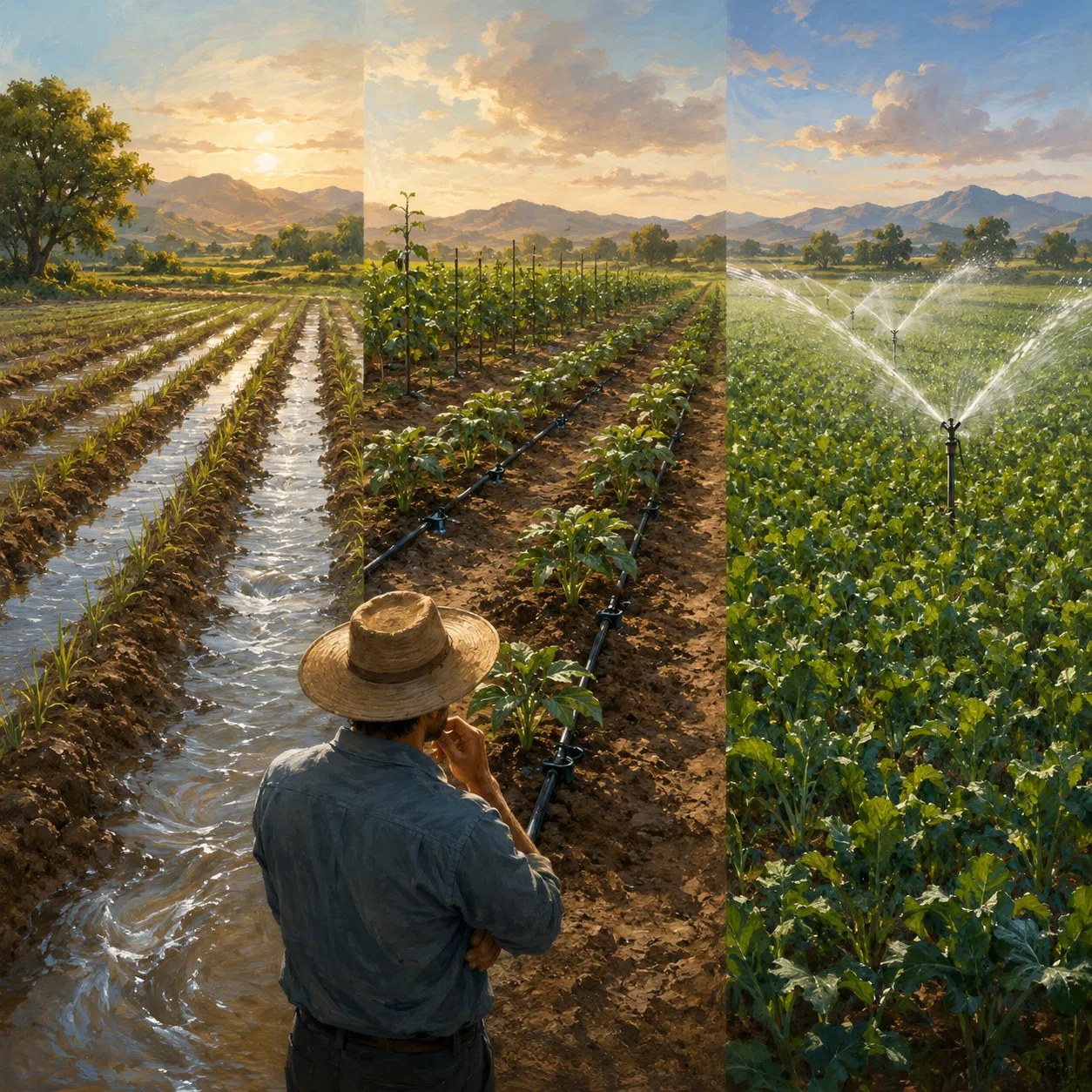
Choosing the right irrigation method can make a major difference in crop health, water use efficiency, labor costs, and overall yield. Whether you manage a small garden, a farm field, or a commercial landscape, the decision often comes down to three common options: surface irrigation, drip irrigation, and sprinkler irrigation.
Each method has clear advantages, but each also comes with trade-offs. The best choice depends on your soil type, crop needs, water availability, budget, and long-term goals. If you want to reduce waste, improve plant performance, and make smarter irrigation decisions, understanding these systems is the first step.
What Is Surface Irrigation?
Surface irrigation is one of the oldest and simplest irrigation methods. Water is applied directly to the soil surface and allowed to flow across the field by gravity. Common surface irrigation techniques include furrow irrigation, border irrigation, and basin irrigation.
This method is often used in areas where land is relatively flat and water is abundant or inexpensive. It does not require complex equipment, making it accessible and low-cost to install.
Advantages of Surface Irrigation
- Low initial cost: Requires minimal equipment and infrastructure.
- Simple operation: Easy to understand and manage.
- Suitable for large fields: Works well in certain broad-acre applications.
- Low energy use: Often relies on gravity instead of pumps.
Disadvantages of Surface Irrigation
- Lower water efficiency: Water loss from runoff, evaporation, and deep percolation can be significant.
- Uneven distribution: Some areas may receive too much water while others receive too little.
- Labor intensive: May require more monitoring and field preparation.
- Not ideal for all soils: Heavy clay or sandy soils can create irrigation challenges.
What Is Drip Irrigation?
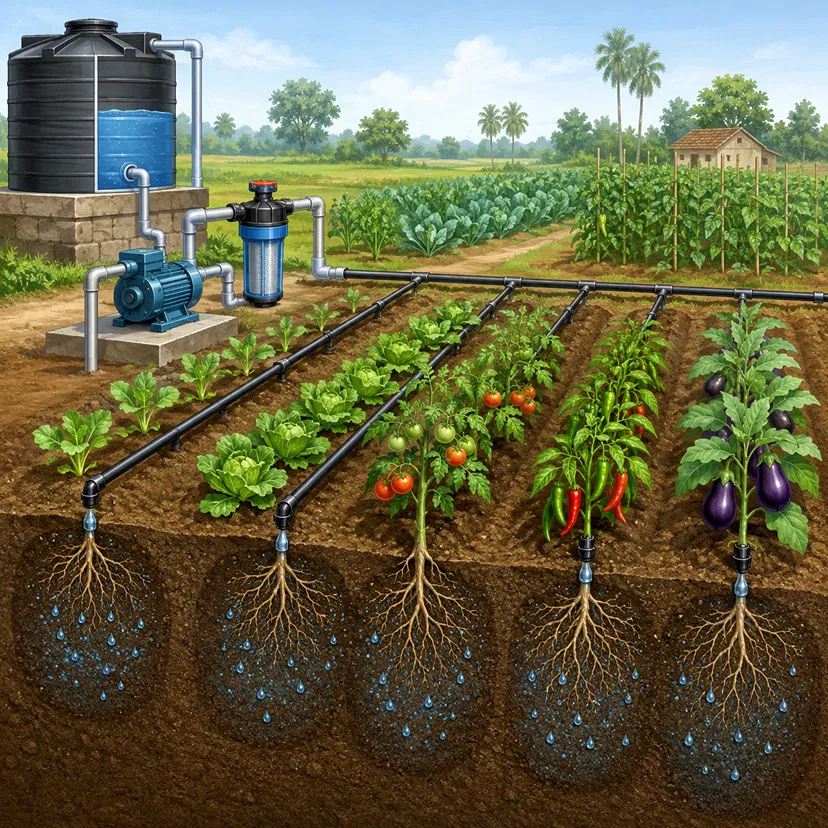
Drip irrigation delivers water slowly and directly to the plant root zone through a network of tubes, emitters, and valves. It is one of the most efficient irrigation methods because it reduces water loss and targets exactly where plants need moisture most.
This system is especially popular in orchards, vineyards, vegetable production, greenhouses, and landscaped areas where precision matters. It can be installed above ground or below the surface, depending on the crop and application.
Advantages of Drip Irrigation
- High water efficiency: Minimizes evaporation, runoff, and waste.
- Precise application: Delivers water directly to roots.
- Supports healthier plants: Reduces leaf wetness and the risk of some diseases.
- Works well with fertilization: Fertigation can improve nutrient management.
- Ideal for water-scarce regions: Helps conserve limited resources.
Disadvantages of Drip Irrigation
- Higher upfront cost: Requires more components and installation planning.
- Maintenance needs: Emitters can clog without proper filtration.
- May require technical knowledge: System design and upkeep matter.
- Not always practical for all crops: Some field crops may be better served by other methods.
What Is Sprinkler Irrigation?
Sprinkler irrigation distributes water through pipes and sprays it over the crop or landscape in a pattern similar to rainfall. Systems range from simple portable sprinklers to more advanced center pivot and overhead irrigation setups.
This method is widely used because it is flexible and can suit many crop types, soil conditions, and field layouts. It is often chosen when uniform coverage is important and surface irrigation is not practical.
Advantages of Sprinkler Irrigation
- Versatile: Suitable for many crops, lawns, and field shapes.
- Fairly uniform coverage: Can distribute water evenly when properly designed.
- Useful on varied terrain: Better than surface irrigation on uneven land.
- Can cool crops: May help reduce heat stress in certain situations.
Disadvantages of Sprinkler Irrigation
- Water loss to evaporation and wind drift: Efficiency can drop in hot or windy conditions.
- Higher energy demand: Often requires pumps and pressure.
- Potential for leaf disease: Wet foliage can encourage fungal issues.
- Moderate to high cost: More expensive than surface systems in many cases.
Surface vs Drip vs Sprinkler: Key Differences
Each irrigation method serves a different purpose. Comparing them side by side makes it easier to decide which one fits your needs best.
- Water efficiency: Drip irrigation is usually the most efficient, sprinkler irrigation is moderate, and surface irrigation is typically the least efficient.
- Installation cost: Surface irrigation is usually cheapest to install, drip irrigation may cost more upfront, and sprinkler systems often fall in the middle to high range depending on design.
- Maintenance: Surface systems are simpler, drip systems need filtration and emitter care, and sprinkler systems require nozzle and pressure management.
- Crop suitability: Drip works best for high-value crops, sprinklers suit many crops and landscapes, and surface irrigation is better for select field conditions.
- Water source and pressure: Surface systems need less pressure, drip and sprinkler systems usually need more controlled water delivery.
How to Choose the Right Irrigation Method
The best irrigation method depends on practical conditions, not just theoretical efficiency. Before making a decision, consider the following factors carefully.
1. Evaluate Your Crop Type
Different crops have different water needs. High-value crops like vegetables, grapes, berries, and orchards often benefit most from drip irrigation. Large grain fields or certain forage crops may work well with surface or sprinkler systems, depending on the site.
2. Consider Soil Conditions
Soil texture affects how water moves. Sandy soils drain quickly and may need frequent, precise watering, which favors drip irrigation. Clay soils hold water longer but may cause runoff with surface irrigation. Sprinklers can work across many soil types if application rates are controlled properly.
3. Think About Water Availability
If water is limited or expensive, efficiency becomes critical. Drip irrigation is usually the strongest choice for conservation. If water is plentiful and the field is suitable, surface irrigation may still be practical. Sprinklers are a good middle ground when broad coverage is needed.
4. Factor in Budget and Labor
Surface irrigation may be best when initial budgets are tight. However, lower startup cost can sometimes mean higher long-term water use and labor demands. Drip irrigation often costs more to install but can save money over time through reduced water use and improved yield. Sprinkler systems may require more energy and equipment investment.
5. Assess Terrain and Field Shape
Flat, uniform land is more compatible with surface irrigation. Uneven terrain often calls for sprinklers or drip systems. Irregularly shaped plots also tend to benefit from drip irrigation because the layout can be customized more easily.
In irrigation, the cheapest system to install is not always the cheapest system to operate.
Which Method Is Best for You?
If your goal is maximum water efficiency and precise delivery, drip irrigation is usually the best option. If you need a flexible system for a variety of crops or terrain conditions, sprinkler irrigation may be the better fit. If low setup cost and simple operation are your top priorities, surface irrigation can still be a practical choice.
There is no universal winner. The right irrigation system is the one that matches your field conditions, crop requirements, and long-term resource strategy. In many operations, the smartest solution is not choosing one method forever, but selecting the method that delivers the best results for a specific situation.
Final Thoughts
Surface irrigation, drip irrigation, and sprinkler irrigation each have a place in modern agriculture and landscaping. The best method depends on how much water you can afford to use, how much you want to invest upfront, and what kind of plants you are growing.
If you are looking for the highest efficiency, go with drip. If you need flexibility and broad coverage, choose sprinklers. If you want simplicity and lower initial costs, surface irrigation may be enough. Review your conditions carefully, compare the trade-offs, and choose the system that supports healthy plants and sustainable water use.
Ready to make a better irrigation decision? Start by evaluating your crops, soil, and water supply, then choose the method that gives you the best balance of efficiency, cost, and performance.