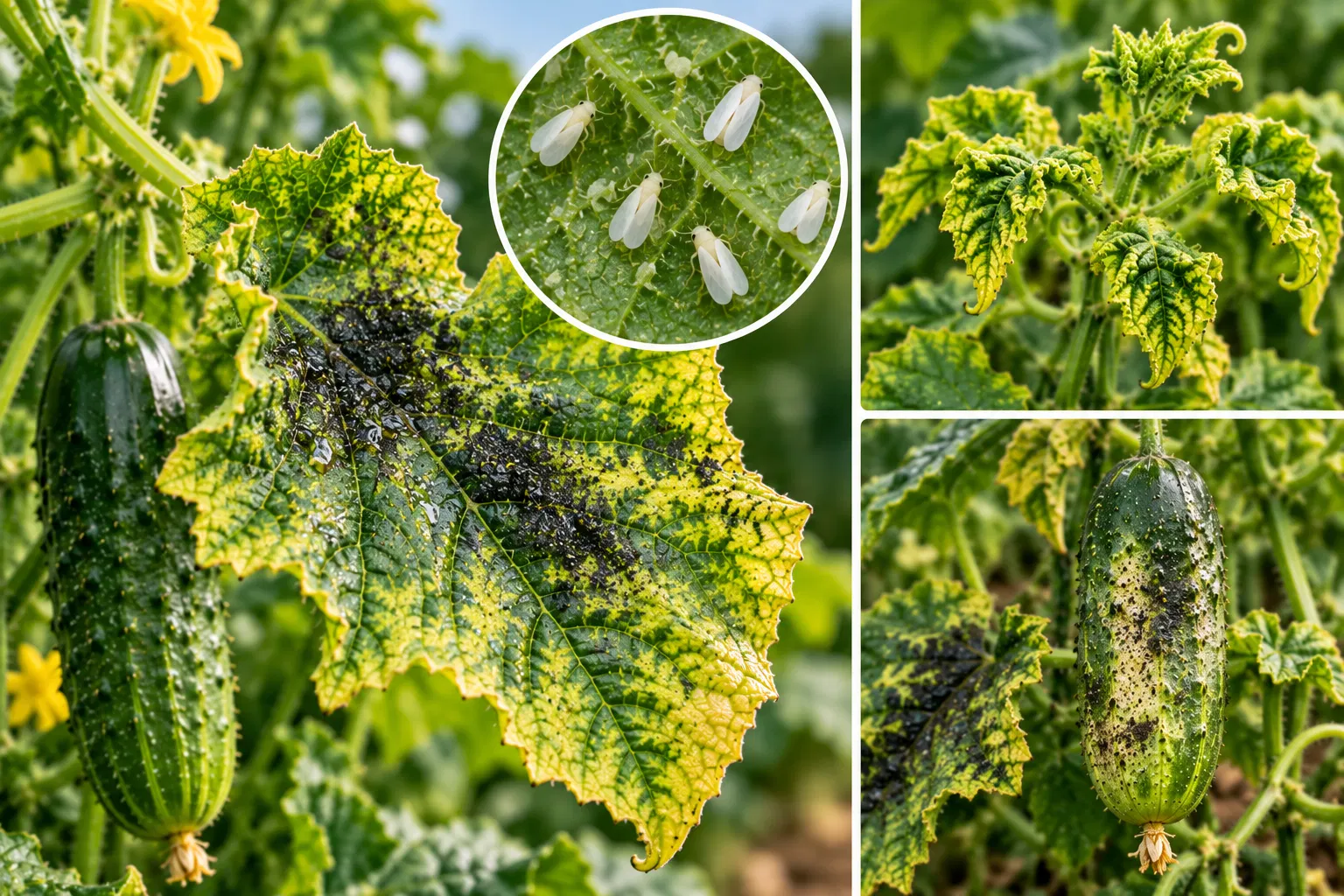
Whitefly (Bemisia tabaci) colonises the underside of cucumber leaves, where nymphs and adults alike pierce the phloem to feed, draining the plant of sap and excreting sugary honeydew that fuels sooty mould growth. Adults also act as the primary vector for cucurbit yellow stunting disorder virus and other whitefly-transmitted viruses, picking up and spreading infection as they move between plants, which means unmanaged populations can cost a crop far more than the direct feeding damage.
Symptoms of Whitefly in Cucumber
- Tiny white, moth-like insects that flutter up in a cloud when the plant is disturbed
- Yellowing, curling, and premature drying of affected leaves
- Sticky honeydew on the leaf surface, often followed by black sooty mould
- Stunted vine growth and reduced fruit set in heavy infestations
- Mottling or mosaic patterns on new leaves, a sign of whitefly-transmitted virus
Causes of Whitefly in Cucumber
- Warm weather that speeds up the whitefly life cycle and population build-up
- Dense planting and overcrowded vines that limit airflow through the canopy
- Nearby infested crops or weeds acting as a source of migrating adults
- Excess nitrogen application, which produces the soft new growth whitefly prefers
- Continuous cropping of cucurbits or other whitefly-host crops in the same field
Solutions to Control Whitefly in Cucumber
Dimpropyridaz 120 g/l SL
A newer-generation insecticide that acts on the pest's nervous system through a mode of action distinct from older chemistries, making it a useful rotation option where whitefly populations have built up resistance to repeated use of the same product. It's also registered for jassids and aphids on cucumber, giving broader sucking-pest cover from one spray.
Product Recommendations
Afidopyropen 50 g/L DC
A selective insecticide from the pyropene class that disrupts feeding in piercing and sucking pests, stopping whitefly from feeding within hours of contact even though it works differently from conventional contact or systemic chemistries. Its selectivity also makes it comparatively gentler on beneficial insects working the same field.
Product Recommendations
Note: Rotate between different modes of action across the season instead of repeating the same one, and keep nitrogen application in check to avoid pushing out the soft new growth whitefly is drawn to.
Disclaimer: Always confirm current label registration, approved dosage, water volume, and pre-harvest interval (PHI) for your state before using any product - labels are periodically revised by regulatory authorities.
This guide is a general advisory. Do your own research and verification before using any product. Always confirm suitability for your crop stage, region, and field conditions before making any purchase, spray, or crop-management decision.