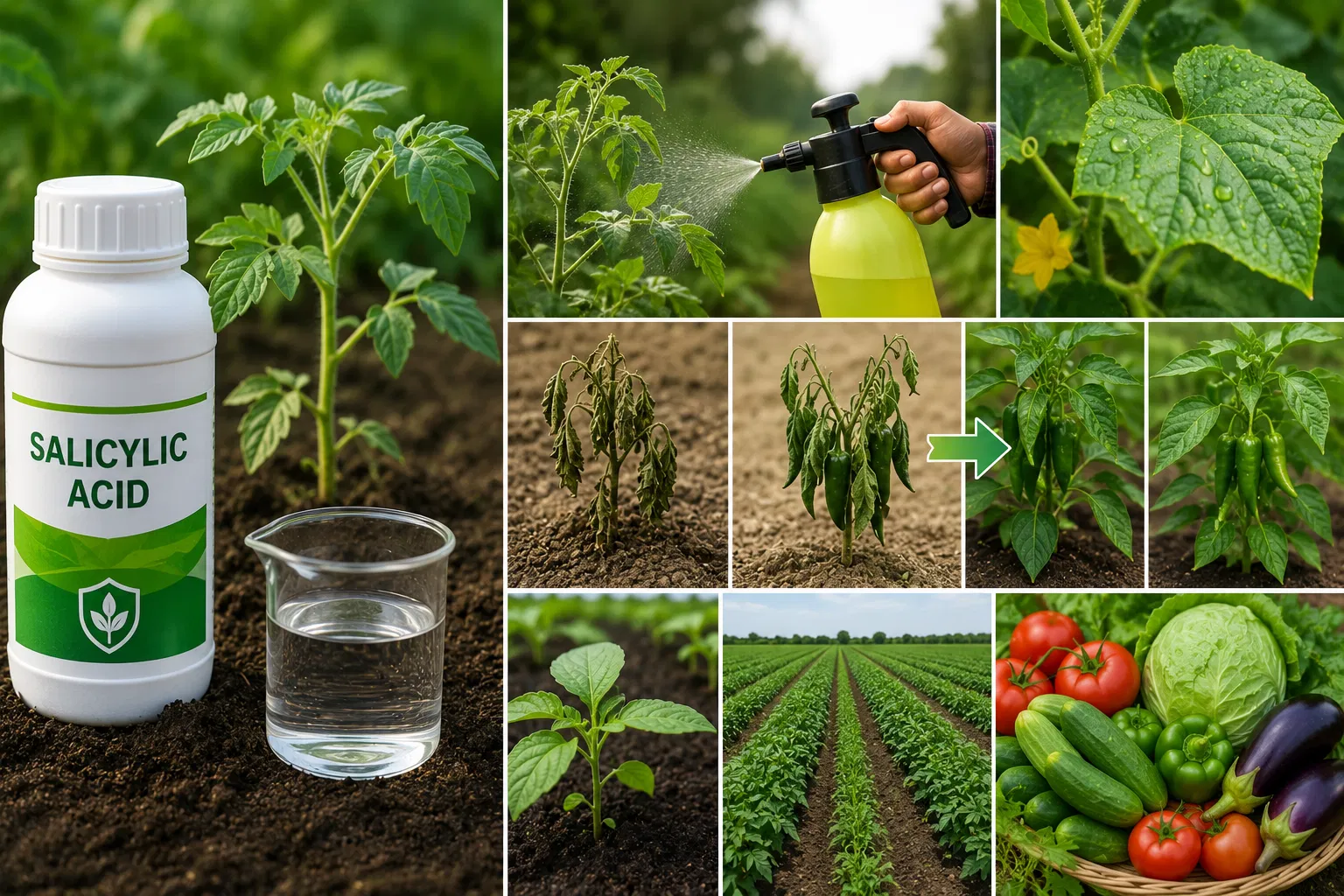
When crops face heat, drought, disease, salinity, or other environmental stress, they activate complex internal defence systems. One of the key natural compounds involved in this response is salicylic acid in plants.
Salicylic acid is a signalling molecule that helps plants recognize threats, activate immune responses, regulate antioxidant activity, and recover from stressful conditions. Understanding its role can help farmers and growers make better crop-management decisions and improve plant resilience.
What Is Salicylic Acid in Plants?
Salicylic acid is a naturally occurring plant hormone involved in growth regulation, defence signalling, and stress response. Unlike essential nutrients that serve mainly as structural or metabolic inputs, salicylic acid acts as a communication signal between plant cells.
It helps plants determine when to activate protective mechanisms, strengthen tissues, produce defence-related compounds, and adjust physiological processes in response to environmental pressure.
Plants naturally produce small quantities of salicylic acid, particularly after pathogen infection, physical damage, drought, temperature stress, or other adverse conditions.
Why Salicylic Acid Is Important for Crop Health
Salicylic acid supports crop health by helping plants respond to both biological and environmental stress. When a plant detects infection or damage, salicylic acid contributes to the activation of defence-related genes and protective enzymes.
Its functions may include:
- Activating natural plant immunity
- Improving resistance to certain pathogens
- Supporting drought and salinity responses
- Reducing oxidative cell damage
- Improving adaptation to heat and cold
- Supporting recovery after stress
These responses do not make crops completely immune to stress. Instead, salicylic acid helps plants respond faster and manage damage more effectively.
How Salicylic Acid Improves Plant Stress Tolerance
1. Activates Disease Resistance
Salicylic acid is best known for its role in plant immunity. When plants detect certain pathogens, salicylic acid levels may increase and trigger the production of defence-related proteins and enzymes.
This response is particularly important against biotrophic pathogens, which obtain nutrients from living plant tissues. Salicylic acid can help slow pathogen development and prepare unaffected tissues for possible infection.
2. Supports the Drought Response
During water stress, plants must regulate water loss while maintaining essential metabolic activity. Salicylic acid may influence stomatal behaviour, antioxidant activity, photosynthesis, and water-use processes.
Depending on the crop, concentration, and application timing, these responses may help plants maintain better physiological balance during moderate drought conditions.
3. Helps Plants Cope With Heat Stress
High temperatures can damage cell membranes, reduce photosynthesis, disrupt enzyme activity, and affect flowering or fruit development. Salicylic acid may support membrane stability and stimulate protective biochemical responses under heat stress.
However, it cannot compensate for prolonged extreme heat, severe moisture deficiency, or unsuitable crop selection.
4. Supports Cold-Stress Adaptation
Low temperatures can slow metabolism and damage plant cells. Salicylic acid may help improve the activity of protective enzymes and support physiological adjustments that reduce cold-related injury.
The response varies between crops, varieties, growth stages, and temperature conditions.
5. Reduces Oxidative Damage
Environmental stress often causes plants to produce excess reactive oxygen species. At high concentrations, these molecules can damage proteins, lipids, cell membranes, and genetic material.
Salicylic acid helps regulate antioxidant enzymes that neutralize reactive oxygen species and reduce oxidative injury. This antioxidant response is one of the main ways it supports plant survival during stress.
6. Improves Salinity Tolerance
Saline conditions can interfere with water absorption, nutrient balance, photosynthesis, and root development. Salicylic acid may help regulate antioxidant activity and ion balance under moderate salinity stress.
It should not be considered a substitute for proper drainage, irrigation-water testing, salt management, or the selection of salt-tolerant crops.
7. Supports Recovery After Stress
After stressful conditions improve, plants must restore photosynthesis, repair damaged tissues, and resume normal growth. Salicylic acid may support this recovery by helping regulate metabolism and protective enzyme activity.
Faster recovery can contribute to more uniform crop growth and reduce the effect of temporary stress on yield development.
Salicylic Acid and Systemic Acquired Resistance
One of the most important functions of salicylic acid is its association with systemic acquired resistance, commonly known as SAR.
SAR is a plant-wide defence response that develops after a localized infection or stress signal. Once activated, tissues in other parts of the plant become better prepared to respond to future pathogen attacks.
Think of salicylic acid as part of the plant's alarm system: a threat in one area can trigger signals that prepare other tissues to respond more quickly.
Systemic acquired resistance does not directly eliminate pathogens. Instead, it primes the plant's natural defence mechanisms so they can respond faster and more strongly when another attack occurs.
How Plants Produce Salicylic Acid
Plants synthesize salicylic acid through internal biochemical pathways associated with compounds such as chorismate and phenylalanine. Production often increases after pathogen infection, physical injury, ultraviolet exposure, drought, salinity, or temperature stress.
The amount produced depends on:
- Plant species and variety
- Type and severity of stress
- Plant growth stage
- Environmental conditions
- Interaction with other plant hormones
Salicylic acid can also be applied externally in some agricultural and research settings. However, the response to external application depends heavily on concentration, crop sensitivity, formulation, and timing.
Potential Agricultural Benefits of Salicylic Acid
When used appropriately and supported by good agronomic practices, salicylic acid may provide several potential benefits.
- Stronger natural defence responses: Plants may respond more effectively to certain pathogens.
- Improved drought resilience: Crops may maintain better physiological function during moderate water stress.
- Greater temperature tolerance: Protective mechanisms may reduce damage from heat or cold.
- Reduced oxidative injury: Antioxidant systems may become more active.
- Improved crop recovery: Plants may resume normal growth more efficiently after stress.
- More uniform crop performance: Better stress management may reduce variation between plants.
- Potential yield protection: Reducing stress-related damage may help preserve yield potential.
Results are not always consistent across crops or growing environments. Field performance depends on the complete production system rather than salicylic acid alone.
Factors That Influence Salicylic Acid Effectiveness
Crop Species and Variety
Different crops and varieties have different natural salicylic acid levels and sensitivities. A concentration that benefits one crop may produce little response or cause injury in another.
Application Concentration
Salicylic acid is active at low concentrations. Applying too little may have no measurable effect, while an excessive concentration can inhibit growth, damage leaves, or disrupt normal plant processes.
Application Timing
Preventive or early-stress applications may provide a different response from applications made after severe damage has already occurred.
Useful application stages may include:
- Seed treatment, where specifically recommended
- Early seedling development
- Before an expected period of moderate stress
- During the early stages of stress
- Before critical flowering or fruit-development stages
Growth Stage
Seedlings, vegetative plants, flowering crops, and fruiting crops may respond differently. Young tissues can also be more sensitive to unsuitable concentrations.
Environmental Conditions
Temperature, humidity, sunlight, soil moisture, salinity, and existing crop stress can all influence the plant's response.
Application Method
Responses may differ depending on whether salicylic acid is applied as a seed treatment, root-zone treatment, or foliar spray. Only application methods supported by the product label and crop-specific recommendations should be used.
Best Practices for Using Salicylic Acid in Crop Management
- Use crop-specific recommendations: Do not assume that one concentration is suitable for every crop.
- Follow the product label: Confirm approved crops, application methods, rates, and safety instructions.
- Apply at the correct stage: Preventive or early-stress treatments may be more useful than late applications.
- Avoid excessive concentrations: Higher rates do not necessarily produce stronger benefits.
- Test a small area first: Evaluate crop response before treating an entire field.
- Apply under suitable weather: Avoid spraying during extreme heat, strong wind, or before rainfall unless the label permits it.
- Check mixture compatibility: Conduct a jar test before combining it with other agricultural inputs.
- Record crop response: Compare treated and untreated areas under similar conditions.
Salicylic Acid Is Not a Standalone Solution
Salicylic acid can support natural plant defences, but it does not replace essential crop-management practices.
Healthy crops still require:
- Suitable crop varieties
- Balanced nutrition
- Proper irrigation and drainage
- Accurate pest and disease diagnosis
- Appropriate planting density
- Healthy soil and root systems
- Timely field monitoring
It should be viewed as one component of an integrated crop-health strategy rather than a cure for every form of stress.
Salicylic Acid and Other Plant Hormones
Plant stress responses are controlled by a network of interacting hormones. Salicylic acid often interacts with jasmonic acid, ethylene, abscisic acid, auxins, cytokinins, and other signalling compounds.
These interactions allow plants to allocate energy according to the type of threat they face. For example, salicylic acid is often associated with defence against certain biotrophic pathogens, while jasmonic acid is commonly linked to responses against chewing insects and necrotrophic pathogens.
Because hormone pathways can support or suppress one another, applying an external signalling compound without considering crop conditions may produce unpredictable results.
Common Mistakes to Avoid
- Using the same concentration on every crop
- Applying without checking the product label
- Treating severely damaged plants too late
- Expecting salicylic acid to replace irrigation or nutrition
- Mixing it with other inputs without compatibility testing
- Applying during extreme weather conditions
- Assuming more frequent applications will produce better results
- Evaluating performance without an untreated comparison area
How to Evaluate Results in the Field
Farmers should assess salicylic acid treatments using measurable observations rather than relying only on general plant appearance.
Useful indicators include:
- Leaf wilting during stress
- Recovery after irrigation
- Leaf colour and membrane injury
- Flower retention
- Fruit development and uniformity
- Disease severity
- Plant survival
- Marketable yield
A small, untreated comparison area can help determine whether observed improvements are related to the treatment or to changes in weather and field conditions.
Conclusion
Salicylic acid in plants is an important natural signalling molecule that helps regulate immunity, antioxidant activity, drought response, temperature adaptation, salinity tolerance, and recovery after stress.
Its agricultural value depends on correct concentration, timing, crop sensitivity, environmental conditions, and application method. It works best when combined with balanced nutrition, suitable irrigation, healthy soil, accurate diagnosis, and good agronomic management.
Farmers considering external salicylic acid applications should follow crop-specific guidance, begin with a small trial, monitor plant response carefully, and avoid treating it as a substitute for essential crop care.