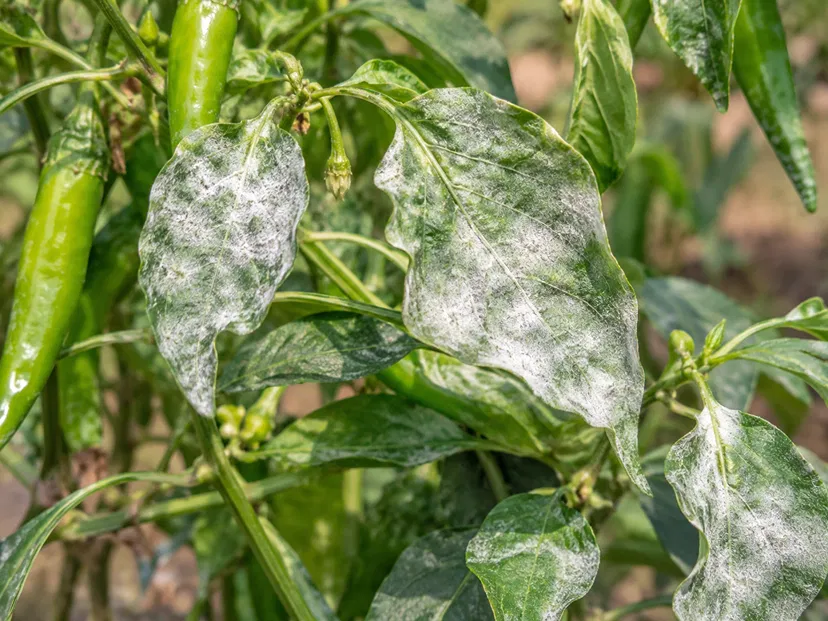
Powdery mildew is one of the most common fungal diseases affecting chilli, showing up as white, powdery patches on leaves and stems that spread quickly in warm, humid, or dry-humid alternating conditions. Left unchecked, it reduces photosynthesis, weakens the plant, and cuts yield. Because different fungicide groups work on the pathogen in different ways, growers usually rotate between chemistries to keep the disease from developing resistance. Here are ten proven solutions.
1. Hexaconazole 75% WG
Hexaconazole is a systemic triazole fungicide that inhibits ergosterol biosynthesis, a key component of the fungal cell membrane. Its 75% WG formulation is highly concentrated, giving protective, curative, and antisporulant action against powdery mildew in chilli with a long duration of control.
Product Recommendations
2. Sulphur 80% WP
Sulphur is one of the oldest and most trusted fungicides for powdery mildew, working through contact and vapour action to disrupt fungal spore germination. It also has secondary acaricidal activity and supplies plant-available sulphur, an essential nutrient, along the way.
Product Recommendations
3. Carbendazim 25% + Flusilazole 12.5% SE
This dual systemic combination pairs a benzimidazole (Carbendazim) with a silicon-based triazole (Flusilazole), giving both acropetal and basipetal movement within the plant. It offers strong preventive and curative control of powdery mildew along with a phyto-tonic effect on the crop.
Product Recommendations
4. Tebuconazole 25% WG
Tebuconazole is a triazole (DMI) fungicide that disrupts fungal cell wall synthesis, offering protective, curative, and eradicative action with a greening effect on foliage. It's one of the most widely used single-active fungicides against powdery mildew, fruit rot, and leaf spots in chilli.
Product Recommendations
5. Meptyl Dinocap 35.7% EC
Meptyl Dinocap is a classic contact fungicide with a unique mode of action, acting as an uncoupler of oxidative phosphorylation in fungal cells. It's especially effective on powdery mildew affecting woody plant parts and works well even at low temperatures, making it a good rotation partner for systemic fungicides.
Product Recommendations
6. Myclobutanil 10% WP
Myclobutanil is a systemic triazole fungicide that inhibits ergosterol biosynthesis, providing both preventive and curative control. It's registered for powdery mildew, leaf spot, and dieback in chilli, and is valued for its ability to act on infections up to 96 hours after they start.
Product Recommendations
7. Kresoxim-methyl 15% + Chlorothalonil 56% WG
Kresoxim-methyl is a strobilurin with meso-stemic and translaminar movement, paired here with Chlorothalonil, a multi-site contact fungicide. Together they offer protective, curative, and eradicative action with long residual control against powdery mildew and related diseases.
Product Recommendations
8. Boscalid 25.2% + Pyraclostrobin 12.8% WG
This premium dual-mode fungicide combines an SDHI (Boscalid) with a strobilurin (Pyraclostrobin), targeting fungal respiration at two separate sites. It's highly effective against powdery mildew, leaf spot, and anthracnose, and also improves fruit finish and stress tolerance in the crop.
Product Recommendations
9. Azoxystrobin 12.5% + Tebuconazole 12.5% SC
This combination brings together a strobilurin and a triazole, giving dual-site systemic and translaminar action against fungal cell wall formation and respiration. It offers complete disease management for powdery mildew and fruit rot in chilli, with acropetal movement throughout the plant.
Product Recommendations
Disclaimer: Always confirm current label registration, approved dosage, water volume, and pre-harvest interval (PHI) for your state before using any product — labels are periodically revised by regulatory authorities.
This guide is a general advisory. Do your own research and verification before using any product. Always confirm suitability for your crop stage, region, and field conditions before making any purchase, spray, or crop-management decision.