Weak roots, poor nutrient uptake, compacted soil, and low moisture retention can limit crop growth even when farmers follow a regular nutrition programme. Potassium humate is an organic soil-conditioning input used to improve the root-zone environment, support nutrient efficiency, and encourage healthier crop establishment.
For farmers managing depleted, sandy, compacted, or low-organic-matter soils, potassium humate can complement balanced fertilization and better soil-management practices. However, it should be treated as a soil conditioner and nutrient-efficiency aid—not as a complete replacement for essential crop nutrition.
What Is Potassium Humate?
Potassium humate is a water-soluble form of humic substances commonly obtained from leonardite or other carbon-rich organic deposits. It primarily contains humic compounds combined with potassium.
Humic substances influence the physical, chemical, and biological properties of soil. Depending on the product formulation and application method, potassium humate may help improve soil aggregation, nutrient retention, microbial activity, and root-zone conditions.
How Potassium Humate Supports Soil Health
Healthy soil provides roots with air, moisture, nutrients, and beneficial biological activity. Potassium humate may support these functions in several ways.
- Improves soil aggregation: Humic substances can help soil particles form more stable aggregates, supporting aeration and water movement.
- Supports nutrient retention: Improved nutrient-holding capacity may help keep certain nutrients available in the root zone.
- Encourages biological activity: A favourable soil environment can support beneficial microorganisms involved in nutrient cycling.
- Improves moisture management: Humates may support water retention in light or low-organic-matter soils.
- Supports nutrient-use efficiency: Better root-zone conditions can help crops access nutrients more effectively.
The level of response depends on soil type, organic-matter content, crop condition, irrigation, application rate, product quality, and the existing fertility programme.
How Potassium Humate Supports Root Growth
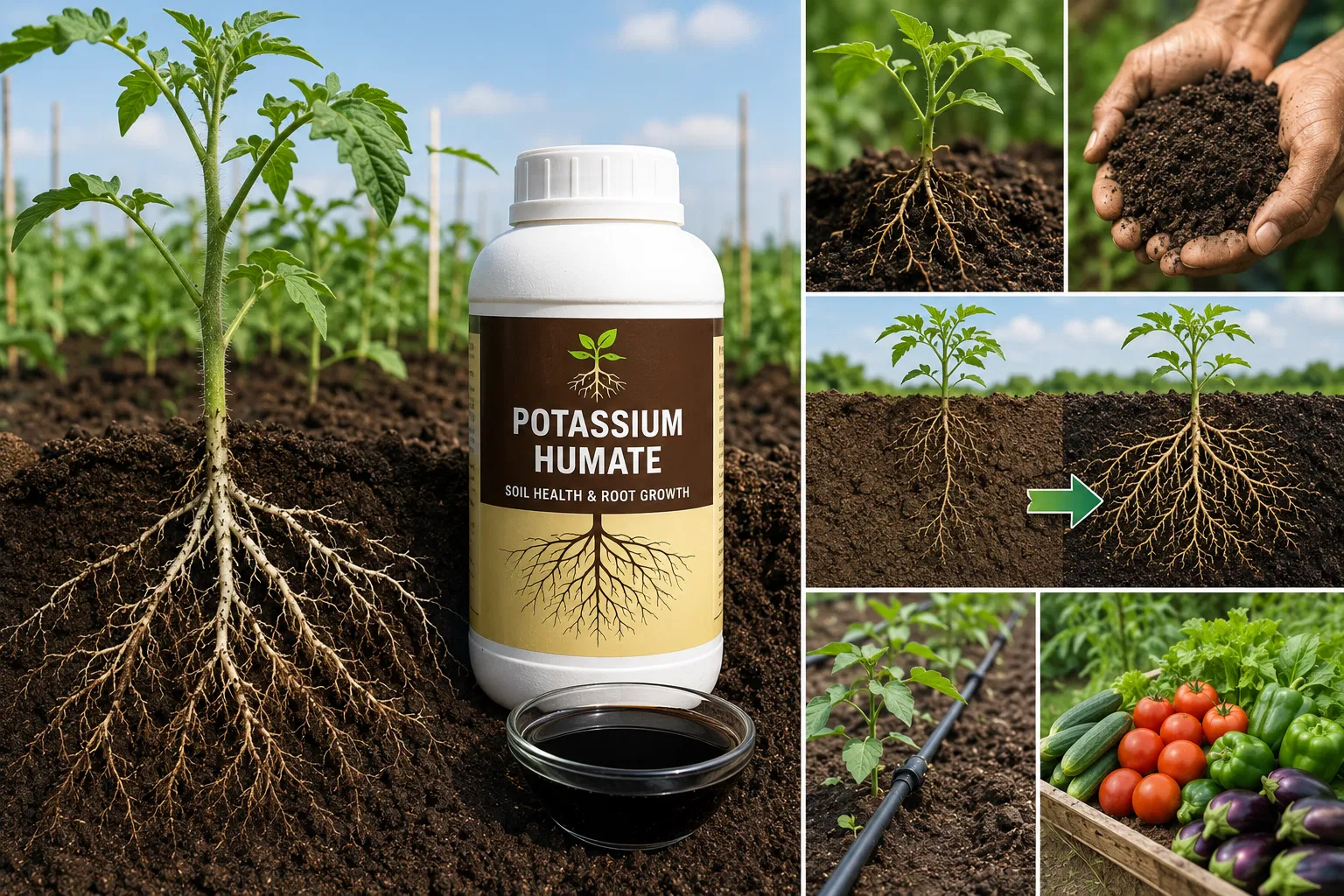
Strong roots allow crops to explore a larger volume of soil for water and nutrients. Potassium humate may encourage root development by improving conditions in the rhizosphere—the area of soil directly influenced by plant roots.
Potential root-related benefits include:
- Improved root elongation
- Greater lateral-root development
- Better early seedling establishment
- More efficient nutrient and moisture uptake
- Reduced transplant stress under suitable conditions
- Improved crop recovery after environmental stress
Farmer insight: Potassium humate works best when it supports an already balanced programme of good soil preparation, irrigation, nutrition, and crop management.
Main Benefits of Potassium Humate for Crops
1. Better Nutrient Availability
Humic substances can interact with nutrients in the soil and may help maintain their availability near plant roots. This can improve the efficiency of nitrogen, phosphorus, potassium, and certain micronutrients when other growing conditions are favourable.
Potassium humate should be used alongside suitable fertilizers selected according to soil-test results and crop requirements.
2. Stronger Crop Establishment
Applications during seedling growth, transplanting, or early crop development may support faster and more uniform establishment. Crops with healthy early root systems are generally better prepared for later moisture and nutrient demands.
3. Improved Stress Tolerance
Well-developed roots and improved soil moisture conditions may help plants cope better with drought, salinity, heat, and other forms of stress. However, potassium humate cannot compensate for severe irrigation shortages, unsuitable salinity levels, or poor drainage.
4. Increased Soil Biological Activity
Beneficial bacteria and fungi are important for decomposition, nutrient cycling, and root-zone health. Potassium humate may help create conditions that support biological activity, particularly when combined with organic matter and good soil management.
5. Long-Term Soil Improvement
Repeated use as part of a wider soil-health programme may gradually improve soil condition. Results are usually more consistent when potassium humate is combined with compost, crop residues, cover crops, balanced nutrition, reduced compaction, and efficient irrigation.
Potassium Humate Application Methods
The correct application method depends on the product formulation, crop, soil type, irrigation system, and intended purpose. Always follow the directions printed on the product label.
Soil Application
Potassium humate may be applied to the soil during land preparation, through irrigation water, or as a directed root-zone treatment. Soil application is generally preferred when the objective is to improve root-zone activity and soil properties.
Seed Treatment
Some formulations may be used as seed treatments to support germination and early root development. Compatibility, concentration, drying time, and seed safety should be confirmed from the product label before treatment.
Fertigation
Water-soluble potassium humate products may be applied through drip or fertigation systems where approved. This method can distribute the material through the active root zone and may support ongoing nutrient uptake.
Check product solubility, filtration requirements, tank compatibility, and irrigation-system cleanliness before fertigation.
Foliar Application
Certain potassium humate products are labelled for foliar application. Foliar spraying may support crop performance during selected growth stages, but it does not provide the same soil-conditioning benefits as root-zone application.
Best Time to Apply Potassium Humate
Potassium humate is commonly used during stages when rapid root establishment and efficient nutrient uptake are important.
- During land preparation
- At sowing or transplanting
- During early root development
- After transplant stress
- Alongside scheduled fertigation
- Before predictable periods of moderate environmental stress
Application timing should be adjusted according to crop stage, soil moisture, irrigation availability, and label recommendations.
Best Practices for Potassium Humate Application
- Test the soil first: Check soil pH, electrical conductivity, organic matter, and nutrient status.
- Select the correct formulation: Confirm whether the product is intended for soil application, fertigation, seed treatment, or foliar use.
- Follow the label rate: Concentration varies widely between liquid, powder, granule, and soluble formulations.
- Apply during responsive stages: Early establishment and active root growth are commonly targeted.
- Maintain adequate soil moisture: Dry soil can restrict root activity and reduce the response.
- Check tank compatibility: Conduct a jar test before mixing potassium humate with fertilizers or other inputs.
- Use balanced nutrition: Potassium humate cannot correct major nutrient deficiencies without an appropriate nutrient source.
- Evaluate results over time: Soil-health improvements are often gradual rather than immediate.
Which Crops May Benefit from Potassium Humate?
Potassium humate may be used in many crop-production systems, subject to product registration and label directions.
- Vegetable crops such as tomato, chilli, onion, brinjal, cucumber, and okra
- Fruit crops such as grapes, citrus, banana, pomegranate, and berries
- Field crops such as maize, wheat, rice, cotton, soybean, and pulses
- Root and tuber crops such as potato, carrot, beetroot, and sweet potato
- Nursery, greenhouse, and protected-cultivation crops
Crops grown in sandy, low-organic-matter, compacted, saline, or drought-prone soils may respond differently. Farmers should evaluate results through small field trials before adopting a new programme across a large area.
Signs That Potassium Humate May Be Supporting the Crop
Farmers should assess potassium humate through measurable crop and soil observations rather than expecting an immediate visual transformation.
- More uniform crop establishment
- Healthier white feeder roots
- Improved root branching
- Reduced transplant shock
- More uniform plant vigour
- Improved response to nutrient applications
- Better moisture retention in the root zone
- More consistent growth under moderate stress
Where possible, compare treated and untreated sections of the field under the same irrigation and nutrition programme.
Potassium Humate vs. Potassium Fertilizer
Potassium humate and conventional potassium fertilizers serve different primary purposes.
Standard potassium fertilizers are used mainly to supply potassium as an essential plant nutrient. Potassium humate may contain potassium, but its main agricultural role is usually associated with humic substances, soil conditioning, and improved nutrient efficiency.
Therefore, potassium humate should not automatically replace a recommended potassium fertilizer application. Soil testing, crop demand, expected yield, and product nutrient analysis should guide the potassium programme.
Can Potassium Humate Replace Organic Matter?
Potassium humate can complement organic-matter management, but it does not replace compost, crop residues, green manure, or other bulk organic amendments.
Organic materials contribute carbon, nutrients, soil structure, and biological diversity. A comprehensive soil-health programme may combine potassium humate with:
- Well-decomposed compost or farmyard manure
- Crop-residue incorporation
- Cover crops and green manures
- Reduced soil compaction
- Balanced fertilization
- Efficient irrigation and drainage
Common Mistakes to Avoid
- Using potassium humate as a complete fertilizer replacement
- Applying an unverified or poor-quality formulation
- Ignoring soil pH, salinity, or drainage problems
- Using excessive concentration during seed or foliar treatment
- Mixing products without checking compatibility
- Applying through clogged or poorly filtered irrigation systems
- Expecting an immediate yield increase after one application
- Applying without monitoring root growth or soil condition
How to Choose a Potassium Humate Product
When comparing products, review the label for:
- Humic-acid or humate content
- Potassium analysis
- Solubility and recommended application method
- Approved crops and application rates
- Compatibility and storage instructions
- Manufacturing and quality information
Select a formulation suited to the available equipment and intended application. A fully soluble product is particularly important for drip irrigation and fertigation systems.
Conclusion
Potassium humate for soil health and root growth can support soil aggregation, nutrient availability, microbial activity, moisture retention, and crop establishment when used correctly. Its value is generally greatest when it forms part of a complete soil-health and crop-nutrition strategy.
Begin with soil testing, choose a suitable formulation, follow the product label, and compare field performance over time. Combining potassium humate with balanced fertilization, organic matter, proper irrigation, and good agronomic practices can help develop healthier roots, more resilient crops, and more productive soils.