Introduction
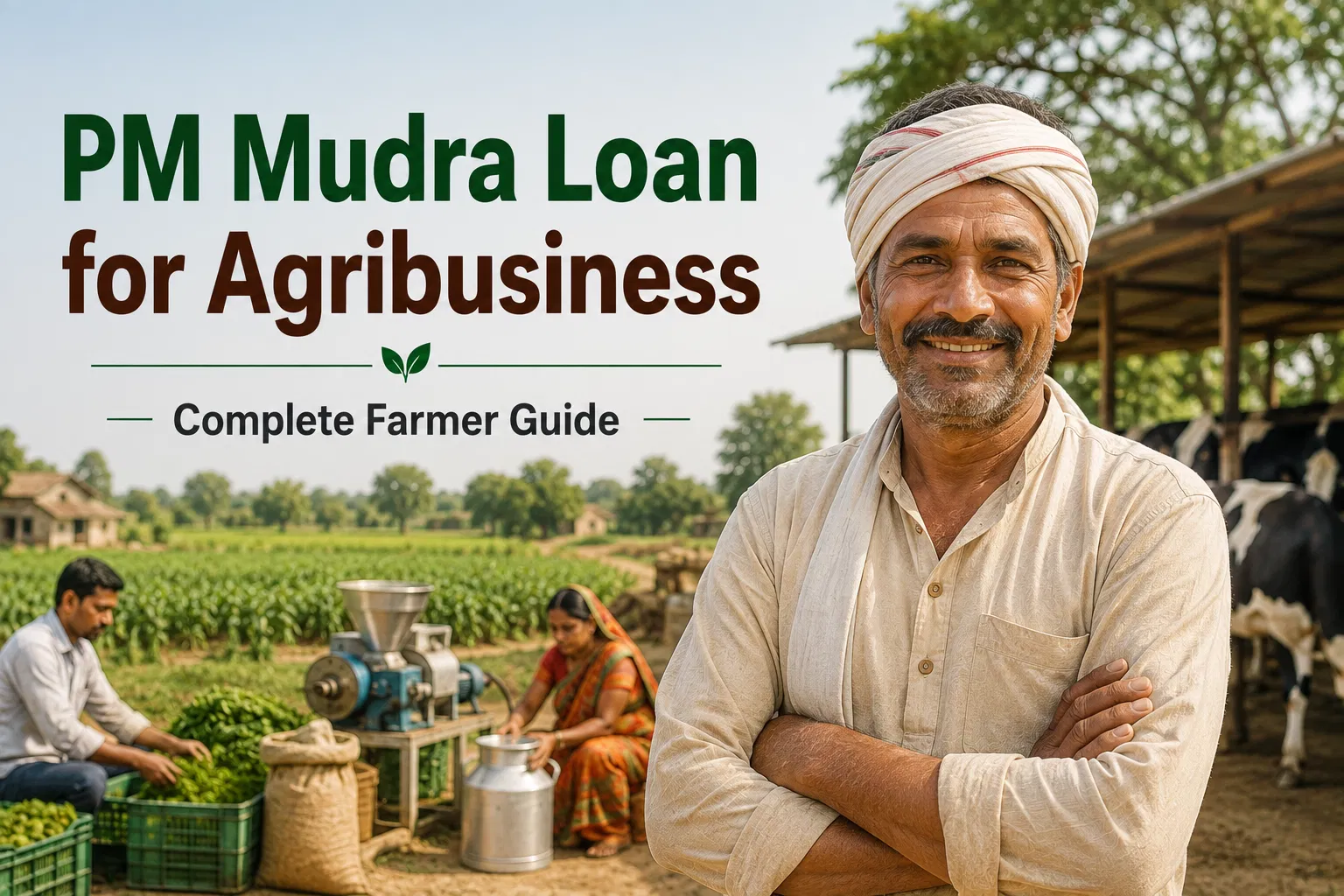
Beyond crop cultivation, a farming household often runs several small businesses side by side — a dairy unit, a seed or input trading counter, a small food-processing setup, or an agri-clinic offering soil testing and advisory services. The Pradhan Mantri Mudra Yojana (PMMY) is built for exactly this kind of agribusiness: collateral-free, guarantor-free credit for non-farm and allied-agriculture micro enterprises. It won't fund the crop itself, but for the business built around or alongside farming, it's one of the most accessible credit routes available.
PM Mudra for Agribusiness: Overview
- Scheme Name — Pradhan Mantri Mudra Yojana (PMMY), launched 8 April 2015 by the Department of Financial Services, Ministry of Finance
- Loan Tiers — Shishu (up to ₹50,000), Kishore (₹50,001–₹5 lakh), Tarun (₹5,00,001–₹10 lakh), Tarun Plus (₹10–20 lakh, for repeat Tarun borrowers)
- Collateral — None required; covered under the Credit Guarantee Fund for Micro Units (CGFMU) up to ₹20 lakh
- Eligible Agribusiness Activities — Dairy, poultry, fishery, beekeeping, livestock rearing, agri-clinics and agribusiness centres, food and agro-processing, grading/sorting/aggregation, and small agri-trading or transport
- Lenders — Public and private banks, RRBs, small finance banks, NBFCs, and MFIs
Objectives of Mudra for Agribusiness
- Give farming households a formal credit route for the business activities that sit alongside crop cultivation.
- Support agri-value-chain services — grading, sorting, aggregation, agro-processing — that add income beyond the farm gate.
- Enable agri-clinics and agribusiness centres run by agriculture graduates and trained rural entrepreneurs.
- Fund small commercial transport (tractors, goods vehicles) that moves produce and inputs.
- Build formal credit history for rural micro-entrepreneurs through the MUDRA Card and structured repayment.
Key Features for Agribusiness Applicants
- Agri-clinics and agribusiness centres — advisory, soil/water testing, custom hiring of farm equipment — are explicitly eligible, typically financed under Kishore or Tarun depending on scale.
- Food and agro-processing units (e.g., papad, pickle, jam-making, small-scale value addition) fall under the eligible activities list, alongside grading, sorting, and aggregation services.
- Commercial tractors, power tillers, and small transport vehicles used for business purposes (not personal use) can be financed under Mudra.
- Loans are collateral-free up to the CGFMU-covered limit; larger Tarun and Tarun Plus loans may still require the lender's standard risk assessment even without physical collateral.
- About 60% of Mudra disbursals in agri-allied categories go toward setting up new units rather than expanding existing ones, reflecting the scheme's strong first-time-entrepreneur focus.
Benefits to Agribusiness Owners
- No collateral or guarantor requirement removes the single biggest obstacle most rural micro-entrepreneurs face with conventional bank loans.
- Four loan tiers allow a business to start small (Shishu) and scale up (Kishore, Tarun, Tarun Plus) as revenue and repayment history build.
- Priority-sector classification for agri-allied Mudra loans generally means faster processing and comparatively lower interest rates than unsecured personal loans.
- Women, SC/ST, and EBC (economically backward class) applicants often receive preferential interest rates or faster processing from many lenders.
- Convergence is possible — an agribusiness can combine a Mudra loan for working capital with a NABARD-linked or state subsidy scheme for capital-intensive infrastructure.
Limitations to Keep in Mind
- Direct crop loans, land improvement, and irrigation infrastructure remain outside Mudra's scope — a separate crop credit or NABARD-linked scheme is needed for those.
- Interest rates are set by individual lenders, not the government, so shopping across banks and NBFCs matters for the effective cost of borrowing.
- Tarun Plus is restricted to borrowers who have already repaid a Tarun loan, so it isn't available on a first application.
- A viable, well-documented business plan is still required for Kishore and above — Mudra removes the collateral barrier, not the need for a credible project.
Documents Required
- Identity and address proof (Aadhaar, PAN, Voter ID, or similar)
- Business registration/Udyam Registration and GST details, where applicable
- Detailed business plan or project report describing the agribusiness activity, costs, and expected income
- Bank statements for the last 6 months (for Kishore and above)
- Quotations for equipment or machinery to be purchased
How to Apply
- Identify the agribusiness activity and estimate the funding need to select the right loan tier.
- Apply through the Udyamimitra portal, the Jan Samarth portal, or directly at a participating bank, RRB, NBFC, or MFI branch.
- Submit KYC documents along with a clear business plan for the specific agribusiness activity.
- On approval, funds are disbursed and a MUDRA Card may be issued for managing working capital.
- Maintain timely repayment to build a track record that supports graduating to a higher loan tier later.
Conclusion
For the agribusiness layer built around farming — dairy, agri-clinics, food processing, small-scale trading and transport — Mudra offers a genuinely practical, collateral-free credit route. The key is matching the specific activity to the right loan tier and pairing Mudra with dedicated agricultural schemes for anything that falls outside its scope, like crop loans or larger infrastructure projects.
Disclaimer: Loan limits, interest rates, and eligibility criteria are set individually by lending institutions and are subject to periodic revision. Readers are advised to verify current details on the official MUDRA website (mudra.org.in) or with their nearest bank branch before applying or making any financial decision.