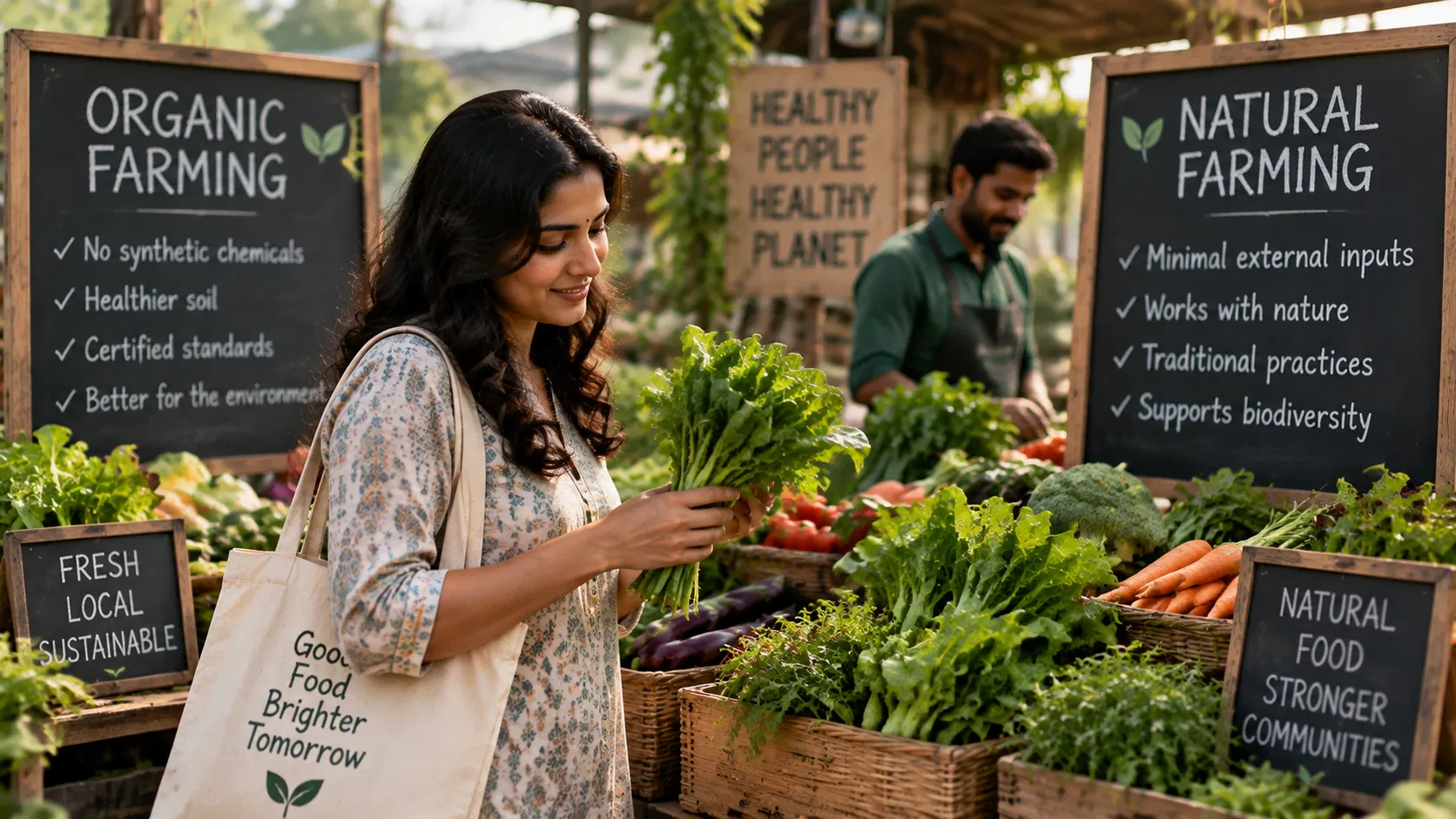
"Organic" and "natural" get used almost interchangeably on packaging and at farmers' markets, but they refer to genuinely different farming systems in India — with different inputs, different costs, and very different rules around what can carry the label. Here's what actually separates them.
Organic Farming: Certified, Input-Based
Organic farming avoids synthetic fertilizers, pesticides, and genetically modified seed, but it still permits purchased or externally sourced inputs — as long as they're organic-approved. This includes compost, farmyard manure, vermicompost, biofertilizers, and biological pest control products. Crop rotation, mixed cropping, and green manuring are core practices used to maintain soil fertility without synthetic chemicals.
Crucially, selling produce as "organic" in India requires certification — typically under the National Programme for Organic Production (NPOP) for export-oriented and larger operations, or the Participatory Guarantee System (PGS-India) for smaller and cluster-based farmers. This certification process involves documentation, regular inspection, and compliance with defined input and practice standards.
Natural Farming: Zero External Inputs
Natural farming, most commonly practiced in India as Zero Budget Natural Farming (ZBNF) — developed by agriculturalist Subhash Palekar — goes a step further by avoiding external inputs almost entirely, whether chemical or organic. Instead of buying compost or biofertilizers, natural farming relies on inputs made on-farm from locally available materials, primarily cow dung and urine from indigenous cow breeds (Bos indicus).
The core ZBNF practices are Beejamrit (a cow dung and urine-based seed treatment), Jeevamrit (a fermented microbial culture applied to soil), mulching, and Waaphasa (maintaining optimal soil aeration and moisture rather than continuous irrigation). Natural farming does not currently have a formal, widely recognized certification system in India comparable to NPOP, which affects how it can be marketed.
Side-by-Side Comparison
| Aspect | Organic Farming | Natural Farming (ZBNF) |
|---|---|---|
| Inputs | Purchased organic-approved inputs (compost, biofertilizers, bio-pesticides) | On-farm, cow-based preparations (Jeevamrit, Beejamrit) |
| Cost | Moderate — input purchase adds cost | Very low — minimal purchased inputs |
| Certification | Required to sell as "organic" (NPOP / PGS-India) | No standardized formal certification |
| Market Positioning | Premium, certified, export-friendly | Mostly local/direct sales, self-reliance focused |
| Government Schemes | Paramparagat Krishi Vikas Yojana (PKVY), MOVCD-NER | National Mission on Natural Farming |
What This Means for Consumers
An "Organic Certified" label carries a defined, inspected standard — you can reasonably expect it reflects documented practices and approved inputs. A product marketed as "natural" from a local farmer or market may genuinely follow chemical-free, low-input methods, but without formal certification, that claim relies more on trust in the specific seller than on a verifiable, standardized system. Neither label is a guarantee of nutritional superiority over the other — the meaningful common ground is both systems avoid synthetic chemical inputs, which is usually the actual concern driving the purchase.
For Growers: Choosing Between the Two
For farmers or serious home growers exploring either system, organic methods are generally easier to start with using ready-made inputs like biofertilizers and organic fertilizers, especially where certification and market access matter. Natural farming requires more hands-on preparation of on-farm inputs but eliminates most purchased input costs over time — worth exploring further through BigHaat's broader organic farming resources for the certified route.
Frequently Asked Questions
Is natural farming the same as organic farming?
No — natural farming avoids virtually all external inputs, including organic ones, while organic farming permits certified organic inputs purchased from outside the farm.
Which is more expensive, organic or natural farming?
Organic farming typically costs more due to purchased inputs and certification fees; natural farming (ZBNF) is designed to minimize input costs almost entirely.
Can natural farming produce be sold as "organic"?
Not without going through formal organic certification — following natural farming practices alone doesn't confer the certified organic label.
Is one method healthier than the other?
Both avoid synthetic chemical inputs, which is the main health-related concern for most consumers; neither has been shown to be conclusively superior in nutritional content.
Disclaimer: General informational overview; specific certification requirements and government schemes may vary by state and change over time. Consult official NPOP/PGS-India resources for current certification rules.