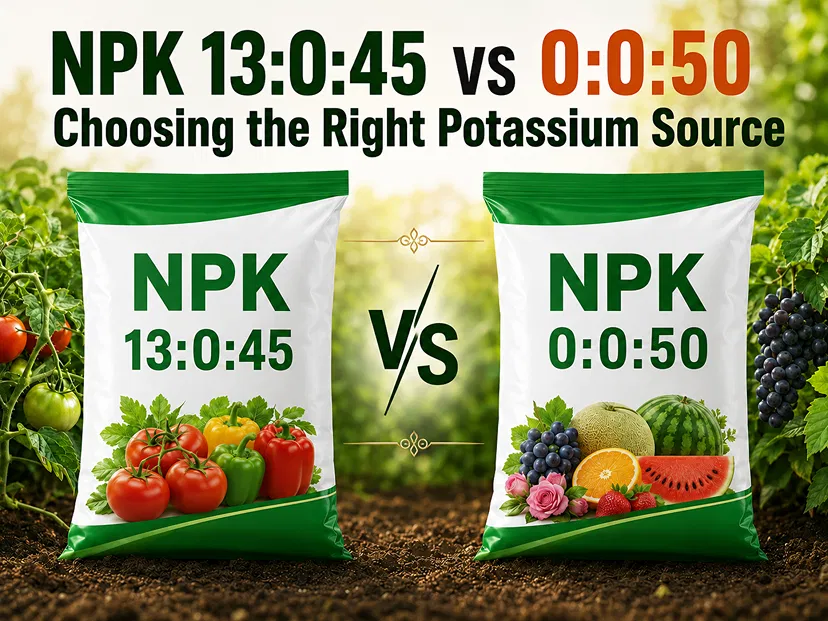
Choosing between NPK 13-40-13 and 13-0-45 can make a major difference in crop performance, especially when timing, plant stage, and nutrient demand are all working together. Both are popular water-soluble fertilizers (WSF), but they serve very different purposes. If you pick the wrong one, you may waste money or miss the results your crop needs most.
The key is simple: 13-40-13 is a phosphorus-focused starter fertilizer, while 13-0-45 is a potassium-heavy fertilizer with nitrogen. One helps drive roots, flowering, and early establishment. The other supports fruit filling, quality, stress tolerance, and yield. Knowing when and why to use each one is essential for smarter fertigation and foliar programs.
What Is NPK 13-40-13?
NPK 13-40-13 is a high-phosphorus, balanced nitrogen-potassium fertilizer designed to support early plant development. Its nutrient breakdown means it contains:
- 13% Nitrogen (N)
- 40% Phosphorus (P)
- 13% Potassium (K)
This formula is widely used during transplanting, early vegetative growth, root establishment, and flowering initiation. The high phosphorus content is the standout feature. Phosphorus supports root expansion, energy transfer, and early crop vigor.
Best use: when plants need strong roots, early establishment, and a growth boost at the start of the season.
What Is NPK 13-0-45?
NPK 13-0-45 is a potassium-rich fertilizer with nitrogen and no phosphorus. Its nutrient profile is:
- 13% Nitrogen (N)
- 0% Phosphorus (P)
- 45% Potassium (K)
This product is commonly used in the fruiting, bulking, and maturation stages. Potassium plays a major role in sugar movement, enzyme activation, water regulation, fruit color, size, firmness, and overall crop quality. Because it contains no phosphorus, it is ideal when plants already have enough P in the root zone or when extra phosphorus is no longer needed.
Best use: when crops are moving into high potassium demand for yield, quality, and stress tolerance.
NPK 13-40-13 vs 13-0-45: The Main Differences
These two WSF products are not interchangeable. Each one supports a different stage of crop development and a different nutrient goal.
1. Nutrient Emphasis
- 13-40-13: phosphorus-dominant, good for roots and early growth
- 13-0-45: potassium-dominant, good for fruit filling and quality
2. Growth Stage
- 13-40-13: best in nursery, transplant, early vegetative, and flowering initiation stages
- 13-0-45: best in flowering, fruit set, fruit enlargement, and ripening stages
3. Plant Response
- 13-40-13: encourages root growth, early vigor, and better establishment
- 13-0-45: improves fruit quality, stress tolerance, and carbohydrate movement
4. Soil and Crop Need
- 13-40-13: useful when phosphorus levels are low or the crop is young
- 13-0-45: useful when potassium demand rises and phosphorus should be limited
When to Use NPK 13-40-13
Use 13-40-13 when the crop needs a strong foundation. Phosphorus is most important early in the crop cycle, especially when roots are still expanding and the plant is building its structure.
Common situations for using 13-40-13 include:
- After transplanting
- During seedling establishment
- For root development stimulation
- At early vegetative growth
- At pre-flowering stage in some crops
It is especially useful for crops that struggle with early root stress, slow establishment, or poor nutrient uptake. Because it contains balanced N and K along with high P, it can support a more even start.
When to Use NPK 13-0-45
Use 13-0-45 when the plant has already established a strong root system and is now shifting energy into yield formation. Potassium becomes more critical as the crop enters reproductive stages.
Common situations for using 13-0-45 include:
- Flowering and fruit set
- Fruit sizing and bulking
- Ripening and maturity
- Stress periods such as heat, drought, or salinity
- Improving fruit firmness, color, and shelf life
Because it has no phosphorus, 13-0-45 is often a better fit late in the crop cycle when excess phosphorus could be unnecessary or even counterproductive.
Which One Is Better for Fertigation?
The better choice depends on the crop stage and your fertility plan. In fertigation systems, both products can play an important role, but not at the same time for the same reason.
Choose 13-40-13 if your goal is:
- Early root stimulation
- Improved transplant success
- Better early growth
- Stronger flowering transition
Choose 13-0-45 if your goal is:
- Higher potassium supply
- Better fruit quality
- Improved yield and crop uniformity
- Stronger resistance to environmental stress
Can They Be Used Together?
In some programs, both products may be used at different times, but blending them blindly is not recommended. Crop nutrition should follow plant demand, soil test results, water quality, and stage of development.
A common strategy is to start with 13-40-13 early and shift to 13-0-45 later. This staged approach matches nutrient supply with changing crop needs. That way, the crop gets phosphorus when it matters most and potassium when quality and filling become the priority.
How to Choose the Right WSF
To decide between NPK 13-40-13 and 13-0-45, ask these questions:
- What stage is the crop in?
- Does the plant need roots or fruits right now?
- What do soil and water tests show?
- Is phosphorus already sufficient in the root zone?
- Is potassium demand increasing?
If the crop is young and still establishing, 13-40-13 is usually the better match. If the crop is producing flowers or fruit and needs improved filling and quality, 13-0-45 is often the smarter choice.
Practical Crop Nutrition Tips
To get the best results from either fertilizer, follow these simple best practices:
- Use soil and tissue testing to guide decisions
- Match fertilizer type to crop stage
- Monitor irrigation water quality and pH
- Avoid overapplying phosphorus when not needed
- Adjust potassium supply during reproductive growth
- Work with a crop nutrition plan, not just a product label
Water-soluble fertilizers are powerful tools, but only when used with precision. The goal is not to add more nutrients at random. The goal is to supply the right nutrient at the right time.
Final Verdict: NPK 13-40-13 vs 13-0-45
If you need a fertilizer for early growth, rooting, and establishment, choose NPK 13-40-13. If your crop is in the fruiting, bulking, or ripening stage, choose NPK 13-0-45. The first supports the start of the crop cycle. The second supports the finish.
The smartest fertilizer program uses each product where it performs best. When you understand the difference between phosphorus-driven early nutrition and potassium-driven late nutrition, you can improve crop health, maximize yield, and avoid costly mistakes.
Bottom line: pick 13-40-13 for roots and early vigor, and 13-0-45 for fruit quality and final yield. Make the choice based on crop stage, soil conditions, and your production goal for the best results.