Introduction
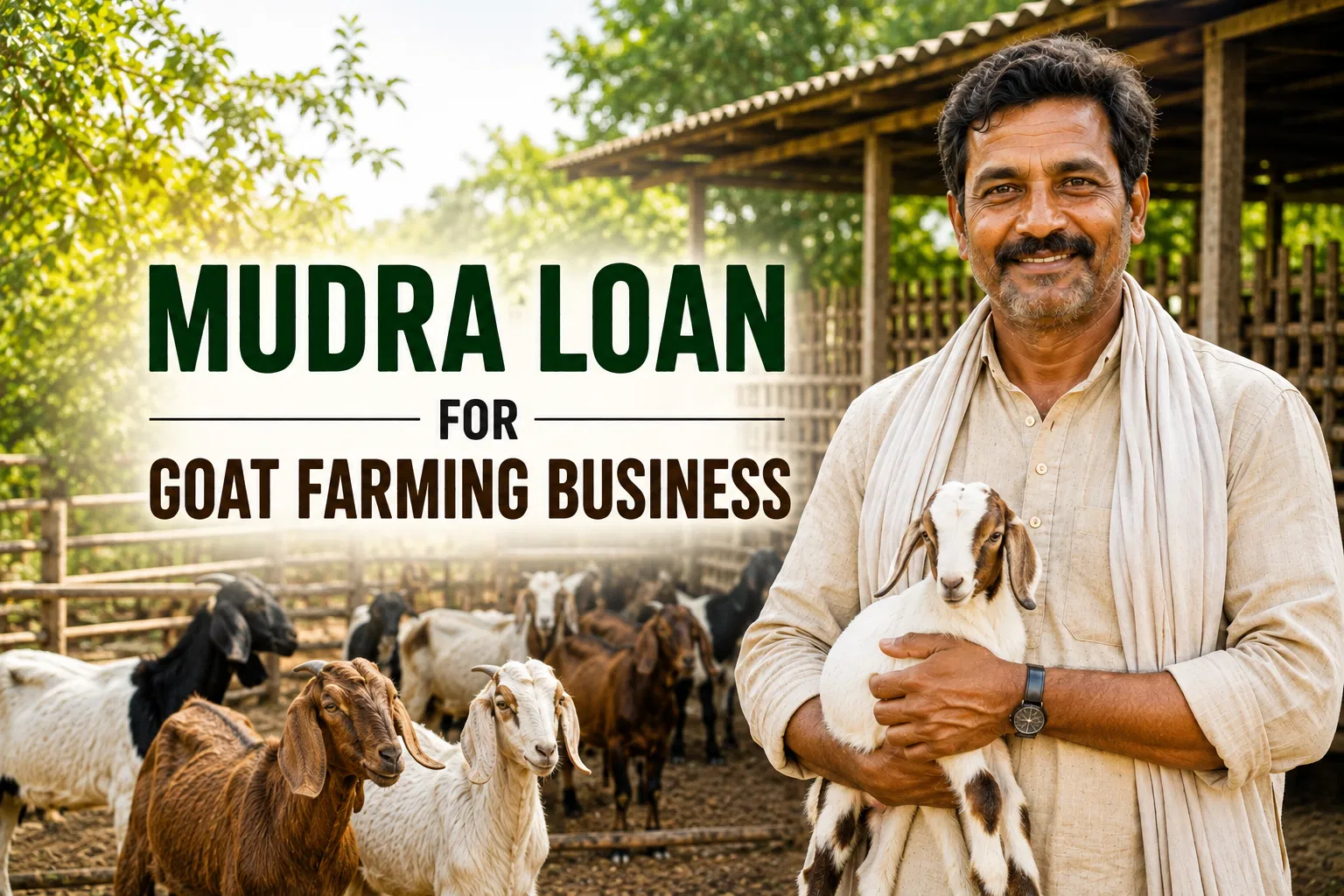
Goat farming has become one of the more attractive livestock businesses in rural India — goats are hardy, need less space and water than cattle, and can be started on a relatively modest budget. As a livestock-rearing activity, goat farming falls within Mudra's eligible allied-agriculture list, alongside dairy and poultry. It also has a distinct advantage: many state governments and the National Livestock Mission (NLM) offer a separate capital subsidy that can be layered on top of a Mudra loan, meaningfully lowering the net cost of setting up a unit.
Mudra Goat Farming Loan Overview
- Maximum Loan Amount — Up to ₹10 lakh under standard Mudra tiers; up to ₹20 lakh under Tarun Plus for repeat, well-repaid borrowers
- Loan Tiers — Shishu (up to ₹50,000) for a handful of goats; Kishore (₹50,001–₹5 lakh) for an established small farm of roughly 10–25 goats; Tarun (₹5–10 lakh) for larger commercial units
- Collateral — None required up to ₹1.6 lakh; standard bank collateral/guarantee norms apply above that threshold
- Interest Rate — Set by individual lenders, commonly in the range of 8–12% per annum
- Complementary Subsidy — National Livestock Mission (NLM) offers up to 50% subsidy on project cost (up to ₹50 lakh) for goat/sheep units; several states add their own top-up (e.g., Maharashtra offers up to 50% for general category and 75% for SC/ST)
Objectives of the Goat Farming Mudra Loan
- Provide collateral-free credit to start or expand a goat rearing micro-enterprise.
- Support landless and small farmers for whom goats are more accessible than cattle due to lower space and water needs.
- Encourage rural women, SC/ST, and first-time entrepreneurs into a business with relatively fast returns (typically 18–24 months to profitability).
- Fund the full unit cycle — animal purchase, shed, fencing, feed, and basic veterinary care.
Loan Amount and Eligible Uses
- Purchase of breeding does and bucks — common commercial breeds include Sirohi, Osmanabadi, Barbari, and Black Bengal, or Boer crossbreeds for higher meat yield.
- Construction of a goat shed, including raised flooring/slatted platforms and basic fencing.
- Feed, fodder cultivation, and mineral/vitamin supplementation for the herd.
- Veterinary care, vaccination, and deworming costs.
- Working capital for ongoing feed and labour costs via the MUDRA Card.
Layering Mudra with NLM and State Subsidy
- The National Livestock Mission's Entrepreneurship Development and Employment Generation component offers a capital subsidy — commonly cited around 50% of project cost up to a ₹50 lakh ceiling — for goat and sheep breeding units.
- Some state schemes go further: for instance, a Maharashtra state scheme has offered a 10-goat-and-1-buck unit with 50% subsidy for general category and 75% for SC/ST beneficiaries.
- The typical structure is: bank loan (often via Mudra for smaller units) covers the bulk of the project cost, with the NLM/state subsidy adjusted against the loan after project verification — the subsidy is not paid out separately in cash upfront.
- Because subsidy percentages and ceilings vary by state and beneficiary category, it's worth checking with the local Animal Husbandry Department before finalising the project size.
Benefits to Goat Farming Entrepreneurs
- Lower entry cost than dairy or larger livestock businesses, making Shishu and Kishore tiers a realistic fit for many first-time farmers.
- Goats are drought-resilient and can survive on bushes, weeds, and dry fodder, reducing feed cost risk compared to cattle.
- Multiple income streams — meat, milk (for certain breeds), manure, and breeding services — improve overall project viability.
- Potential to combine a Mudra loan with NLM or state subsidy, substantially cutting the net cost of the project once subsidy is adjusted.
Limitations to Consider
- Mudra itself is a loan only — any capital subsidy comes from a separate scheme (NLM or a state programme), and the two must be applied for and coordinated correctly, generally through the same lending bank.
- Some sources describe goat/livestock rearing loans inconsistently across lenders — a few treat it cautiously as a 'farming sector' activity, so it's worth confirming with the specific bank that goat rearing will be processed under Mudra rather than a separate agriculture loan product.
- Larger commercial units (100+ goats) generally exceed Mudra's ceiling and need a NABARD-linked term loan alongside NLM subsidy instead.
- Disease outbreaks and market price volatility for meat/live animals are real risks that a project report should account for realistically.
Documents Required
- Aadhaar Card and PAN Card
- Address and land ownership/lease proof for the shed site
- Duly filled application form with passport-size photographs
- Business plan/project report with herd size, shed cost, feed cost, and expected income from meat/milk/breeding sales
- Caste/category certificate, where applicable, for enhanced NLM or state subsidy
How to Apply for a Mudra Goat Farming Loan
- Decide on herd size and breed based on available land, local market demand (meat vs. milk), and budget.
- Prepare a project report with realistic cost and income projections, ideally consulting the local Animal Husbandry Department for current subsidy norms.
- Approach a nationalised or public sector bank, RRB, or NBFC, and apply for the Mudra category matching the project size.
- If layering NLM or a state subsidy, confirm with the bank that the project will be routed to claim the subsidy after disbursement and verification.
- On sanction, purchase animals and construct the shed as per the project report, and begin repayment as per the agreed schedule.
Conclusion
Goat farming's relatively low entry cost, hardiness, and multiple income streams make it a strong fit for Mudra's Shishu and Kishore tiers, especially for first-time and landless rural entrepreneurs. The bigger financial upside, though, often comes from combining a Mudra loan with the National Livestock Mission's or a state government's capital subsidy — so it's worth checking current subsidy rates with the local Animal Husbandry Department before finalising the project.
Disclaimer: Loan amounts, interest rates, and subsidy percentages vary by lender, state, and beneficiary category, and are subject to periodic revision. Readers are advised to verify current details on the official MUDRA website (mudra.org.in), NABARD's National Livestock Mission pages (nabard.org), their state Animal Husbandry Department, or with their nearest bank branch before applying or making any financial decision.